Posted on

Painted the Same, Built Apart

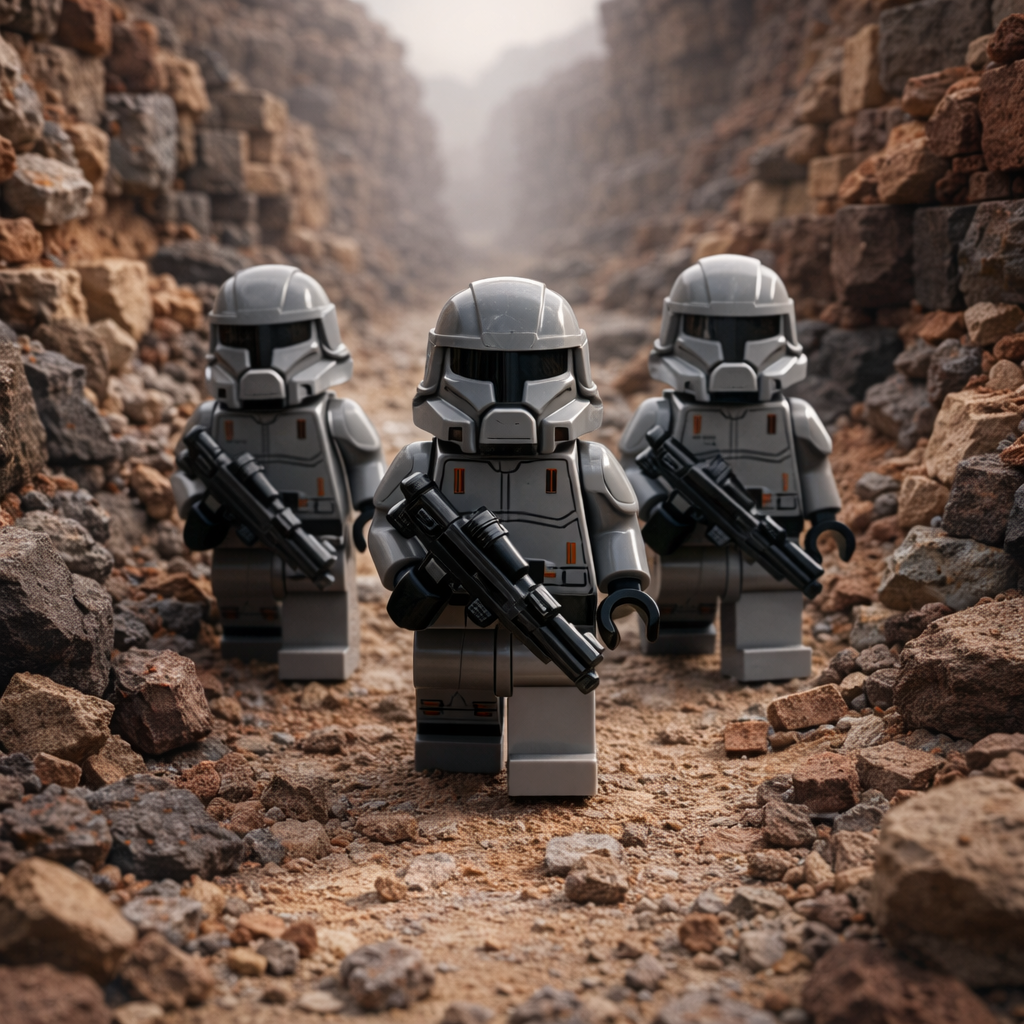
Three brick-built armored soldiers walk through a narrow rocky ravine on an alien world, moments before an unseen ambush.

They were identical when they stepped off the transport.

Same armor. Same markings. Same precise spacing between boots as they formed up on the landing pad. Even the scuffs along their greaves looked rehearsed, as if wear itself had been standardized.

That was the point.

Unit Aurex stood at attention beneath a sky the color of burnished steel. The world beneath them was quiet—too quiet for a place the briefings described as “contested.” Wind moved dust across the pad in thin, deliberate lines, as if the ground itself was measuring them.

Rook kept his eyes forward and his thoughts narrow. That was how he’d been taught. See what’s in front of you. Do what you’re told. Don’t imagine consequences you weren’t assigned to calculate.

It worked. Most days.

To Rook’s left, Fen shifted his weight a fraction too much. To anyone else, it would have been invisible. To Rook, it was as loud as a shout.

Nerves.

To his right, Jex stood perfectly still, chin lifted, posture flawless. Jex always looked like he was being watched, even when he wasn’t.

They all were, of course.

The commander stood at the edge of the pad, cloak unmoving despite the wind. The stories about them had circulated through training halls and transport holds long before Unit Aurex had earned its designation. Victories. Impossible odds. A strategist who saw the battlefield whole instead of piece by piece.

A legend.

Legends didn’t usually look this quiet.


FIRST ORDERS

The briefing was short.

Too short.

“This sector resists order,” the commander said, voice calm, unforced. “You will move in, secure the relay hub, and withdraw. No pursuit. No improvisation.”

Fen frowned behind his visor. Rook felt it more than saw it.

Jex didn’t react at all.

“Yes, Commander,” the unit replied in perfect unison.

The commander’s gaze lingered on them for a moment longer than necessary. Not judging. Measuring.

“Remember,” the commander added, “discipline is not hesitation. It is restraint.”

Then they turned and walked away.

Fen exhaled sharply once the distance was safe. “That’s it?”

Rook kept his voice low. “Orders were clear.”

“Clear isn’t the same as complete,” Fen muttered.

Jex cut in, tone precise. “Completion isn’t our concern. Execution is.”

Fen glanced at him. “You ever wonder why we’re trained to think just enough to fight, but not enough to ask questions?”

Rook felt something tighten in his chest.

“Because questions slow reaction time,” Rook said, automatically.

Fen smiled, thin. “That’s the answer they give.”


CONTACT

The relay hub sat half-buried in a shallow ravine, its structure old but functional. Too intact for a place supposedly abandoned.

Rook took point, weapon raised, sensors sweeping. Everything read clean.

That was when the first shot came.

Not aimed at them—at the ground behind Fen. A warning, sharp and deliberate.

Figures moved along the ravine walls, armored but mismatched. Not soldiers. Something looser. Hungrier.

“Hostiles,” Rook snapped.

“Hold fire,” Jex said immediately. “Orders say no pursuit.”

“They haven’t pursued us yet,” Fen replied, already shifting position. “They’re herding.”

Rook saw it then—the angles, the way the ravine narrowed behind them. A trap, simple but effective.

“Fall back,” Rook ordered.

Another shot cracked past them, closer this time.

Fen returned fire without waiting.

The first hostile dropped.

Silence followed, brittle and short-lived.

Then the ravine erupted.


FRACTURE

The firefight was chaos compressed into seconds. Fen moved fast, aggressive, firing from angles that weren’t in the manual. Jex stayed disciplined, shots clean and measured, calling out positions with perfect clarity.

Rook did both.

That was the problem.

“Relay hub secured,” Jex said over comms, voice steady even as debris fell around them. “We withdraw now.”

Fen stared down the ravine where the hostiles were regrouping. “If we leave, they’ll retake it.”

“That’s not our concern,” Jex replied. “We were told—”

Rook raised a hand. “Enough.”

They all looked at him.

That didn’t happen often.

Rook felt the weight of it immediately—the unspoken question of why he was the one speaking.

“The commander said no pursuit,” Rook said slowly. “But they didn’t say we couldn’t hold.”

Fen’s eyes sharpened. “That’s… thinking.”

Jex hesitated. Just a fraction. “Thinking outside orders is not discipline.”

Rook looked at the relay hub, then at the narrowing exits. “Neither is dying because the situation changed.”

The hostiles advanced again, bolder now.

Fen grinned. “I vote we stay.”

Jex exhaled, something human slipping through his precision. “If we stay, we’re choosing.”

“Yes,” Rook said. “We are.”

The decision settled between them—not unanimous, but shared.

They held.


CONSEQUENCES

Reinforcements arrived late.

The commander returned to the ravine in silence, surveying the scene: the secured hub, the scattered hostiles retreating into the wastes, Unit Aurex standing amid scorched stone and spent power cells.

No casualties.

Barely.

“You exceeded your orders,” the commander said.

Rook stepped forward. “Yes, Commander.”

Fen held his breath. Jex went rigid.

The commander studied Rook for a long moment. “Why?”

Rook answered honestly. “Because following them exactly would have failed the mission.”

The commander’s gaze flicked to Fen, then Jex. “And the unit agreed?”

Fen nodded. Jex hesitated, then did the same.

Silence stretched.

Finally, the commander spoke. “Discipline without judgment is obedience. Judgment without discipline is chaos.”

They turned away.

“You will not be punished,” the commander added. “But you will remember this.”

Rook watched them leave, unsure whether he felt relief or something heavier.


AFTER

Later, as they cleaned their armor, Fen broke the silence. “So. We disobeyed.”

Jex corrected him quietly. “We interpreted.”

Rook looked at the scuffs on his chest plate—new marks, already indistinguishable from the others. “We’re still painted the same,” he said.

Fen nodded. “But not built.”

Jex considered that. “Do you think the commander planned for this?”

Rook shook his head. “I think they expected it.”

Fen smiled, slower this time. “Then maybe that’s the lesson.”

Outside, the wind moved dust across the ravine again, erasing footprints without favor.

Unit Aurex stood together, identical in armor, bound by something quieter and more dangerous than orders.

Choice.

This is an original work of fiction created by Brick Crossing, inspired by the design themes of LEGO® set 75359.
LEGO® is a trademark of the LEGO Group, which does not sponsor, authorize, or endorse Brick Crossing.
Posted on

What Remains When the Order Is Gone

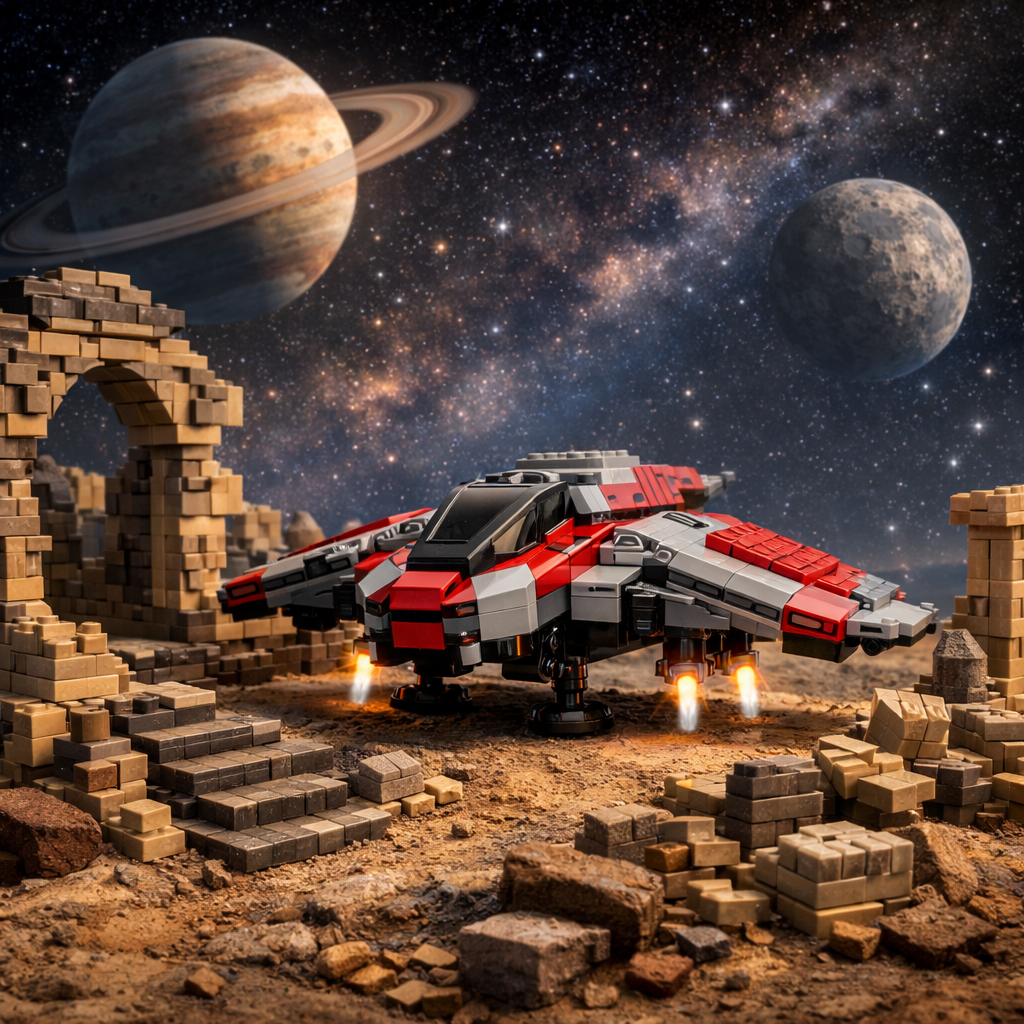
A small red and gray brick-built starship descends onto an alien world beside ancient stone ruins, with distant planets visible in the star-filled sky.

The ship moved the way a thought does—quiet, deliberate, almost reluctant to disturb the space around it.

Its hull cut a narrow path through the starfield, wings locked in a configuration meant less for speed than for balance. The engines emitted a steady, disciplined hum, tuned low enough that Rysa could hear her own breathing over it if she chose to listen.

She usually did.

Inside the cockpit, Rysa sat alone, hands resting lightly on the controls, posture straight without stiffness. Her movements were economical, practiced to the point of invisibility. No wasted gestures. No nervous checks. The ship responded before she asked it to.

That, too, was dangerous.

The nav display glowed with a long arc of plotted waypoints—worlds skirted but not entered, systems passed without comment. None of them were destinations. Only pauses between them.

Rysa had learned long ago not to linger.

Beyond the forward viewport, a planet rotated slowly into view. Its surface was fractured—vast deserts broken by old city scars, oceans reflecting starlight like polished stone. Once, it had been a center of learning. Or power. Or belief.

Once, many things had been gathered there.

Now, it was quiet.

The ship adjusted course automatically, dropping from transit into orbit with a softness that suggested respect.

Rysa exhaled.

THE WEIGHT OF SKILL

Rysa’s name no longer mattered in most places.

That had been true for a long time.

She had been trained by someone who believed discipline was a gift, and strength a responsibility. Someone who had taught her to listen before acting, to weigh intention against consequence, to move through conflict without becoming it.

That person had failed.

Or perhaps had succeeded too well.

Rysa did not dwell on the details. Dwelling was how grief turned into hesitation, and hesitation got people killed.

Her hands moved across the controls, initiating descent protocols. The ship’s wings adjusted, panels rotating with smooth, mechanical patience. Outside, the planet’s atmosphere caught the hull in bands of color—orange, then pale blue, then gray.

The ship did not shake.

It trusted her.

That trust pressed heavier than any accusation.

She touched down near the ruins of what sensors identified as an old complex—stone structures half-buried by time and sand, their geometry unmistakably deliberate. Not defensive. Not industrial.

Purposeful.

Rysa powered down the engines and sat in the silence that followed.

For a moment, she considered staying aboard.

She often did.

THE PLACE THAT REMEMBERED

The air outside was thin but breathable, carrying the scent of dust and old heat. The ruins rose in tiers, their surfaces etched with patterns worn smooth by centuries of wind. No banners. No markers. Nothing that claimed ownership.

That was how Rysa knew she was in the right place.

She moved through the complex slowly, boots crunching against fragments of fallen stone. The layout was familiar in a way that had nothing to do with memory and everything to do with intention—spaces designed for reflection, not command. For learning, not ruling.

Once, Rysa might have been greeted here.

Once, there would have been voices.

Now, there was only echo.

She stopped in a central chamber, its ceiling collapsed enough to let sunlight spill across the floor in uneven bands. At the center lay a circular platform, cracked but intact.

Rysa knelt beside it.

Her gloved hand hovered just above the stone, fingers twitching slightly—not in anticipation, but restraint.

She had been taught that power did not require proof.

So Rysa did not summon anything. Did not test the air. Did not reach.

She simply closed her eyes.

THE QUESTION THAT NEVER LEFT

Rysa had asked herself the same question on dozens of worlds, in different forms:

What does an order become when it no longer exists?

The answer was never simple.

Some believed the answer was revenge. Others chose erasure. Many tried to rebuild, copying rituals without understanding the reason behind them.

Rysa had chosen movement.

Movement kept her from turning bitter. Kept her from becoming the thing her teacher had.

But movement was also a kind of avoidance.

Her mentor had once told her that solitude sharpened purpose.

They had neglected to mention how heavy it became over time.

A gust of wind moved through the broken chamber, stirring dust into soft spirals. For a moment, the light shifted, and Rysa could almost imagine figures standing where the stone now lay empty—students listening, arguing, laughing.

She opened her eyes.

The vision faded.

Good.

Rysa rose to her feet, decision settling with quiet certainty. She did not belong to this place anymore. If she ever had.

Orders were not stone.

They were people.

And people needed help.

INTERRUPTION

The ship’s proximity alarm chimed—soft, insistent.

Rysa turned immediately, hand already moving toward the hilt at her side, senses sharpening not with panic but focus.

A small transport crested the horizon, engines sputtering unevenly. Its approach was careless, desperate. Damage scorched along its flank. No attempt at concealment.

Not a hunter.

A runner.

Rysa did not hide.

The transport landed hard near her ship, its ramp lowering with a hiss of strained hydraulics. Two figures stumbled out—one supporting the other, both clearly injured. They froze when they saw her, hands rising instinctively.

Rysa did not raise her weapon.

“Easy,” she said, voice calm, unadorned. “You’re safe. For now.”

They exchanged a glance—fear tempered by exhaustion.

“They’re coming,” one of them said. “We didn’t mean to—this place, we thought it was abandoned.”

“It is,” Rysa replied. “That’s why you’re here.”

The distant whine of engines confirmed it.

Rysa turned back toward her ship.

CHOICE WITHOUT AN ORDER

Rysa could leave.

That would be easy. Clean. Logical.

No one had told her to intervene. No council had assigned her to protect this place or these people. There was no doctrine that demanded her involvement.

But there had never been doctrine for this moment.

Only choice.

Rysa guided them aboard her ship with brisk efficiency, sealing the hatch as the first pursuer broke atmosphere—a gunship, angular and aggressive, weapons already charging.

The ship’s systems came alive under Rysa’s hands. Shields up. Engines primed. Wings adjusting.

The gunship fired.

Rysa did not return fire.

Instead, she rolled the ship into a tight arc, skimming low over the ruins. The gunship followed, confident in its superior armament.

Rysa smiled faintly.

Confidence was a familiar weakness.

She cut power abruptly, letting the ship drop behind a stone ridge. The gunship overshot, its targeting recalibrating too slowly.

Rysa surged upward, engines flaring, slipping past its blind spot and accelerating toward the upper atmosphere.

The gunship pursued—but not fast enough.

Within moments, she was gone, stars stretching into lines as the ship vanished into transit.

AFTER

The rescued figures sat quietly in the hold, wrapped in emergency blankets, staring at Rysa with a mixture of awe and confusion.

“You’re alone,” one of them said eventually. Not a question.

Rysa nodded.

“Why?” the other asked.

Rysa considered the answer.

“Because the order I belonged to is gone,” she said. “And because I haven’t decided what replaces it.”

They absorbed that in silence.

After a while, the first spoke again. “You didn’t have to help us.”

“No,” Rysa agreed. “I chose to.”

The ship hummed around them, steady and sure.

As the stars shifted outside the viewport, Rysa felt the familiar pull of the next place, the next need.

She did not know if she would ever stop moving.

But for now, movement was enough.

This is an original work of fiction created by Brick Crossing, inspired by the design themes of LEGO® set 75362.
LEGO® is a trademark of the LEGO Group, which does not sponsor, authorize, or endorse Brick Crossing.
Posted on

Where the Ground Finally Failed

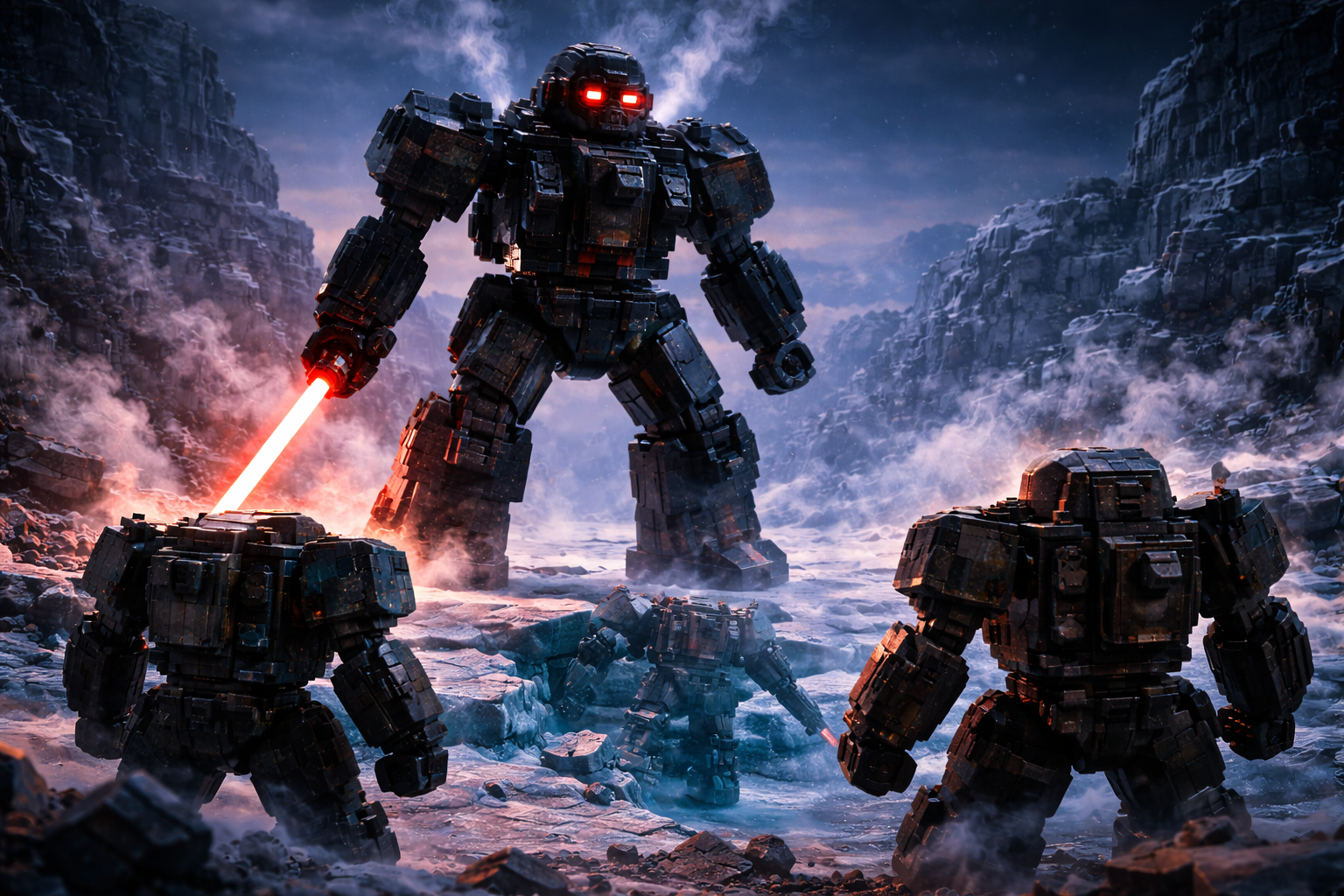
A towering brick-built mech confronts two smaller, battle-worn mechs on a frozen battlefield, steam rising as the ground fractures beneath overwhelming force.

The ground didn’t warn them this time.

That was the first sign something was wrong.

No tremor. No subtle shift in pressure. No sympathetic creak through the basalt shelf beneath Cairn Station. The ice lay still under the moon’s pale light, steam rising in its usual slow breaths, fissures glowing faintly like veins beneath skin.

Too calm.

Sergeant Lio stood at the observation slit, helmet tucked under one arm, eyes narrowed. After enough nights on this rock, stillness felt louder than motion.

“Anything?” Mira asked from behind him.

Lio shook his head. “That’s the problem.”

The outpost was quieter than it should’ve been after a fight. Repairs were underway, but even the clatter of tools seemed subdued, as if the station itself was listening.

Or waiting.

Below them, the fissure field bore fresh scars — collapsed ice plates, blackened steam vents, frozen wreckage half-swallowed by refreezing cracks. Proof that the ground had fought for them.

But the ground had limits.

The warning came not from below, but from above.

Kett’s voice cut through the comms, tight. “Contact. Single mass. High altitude descent.”

“One?” Mira frowned. “After what we did to them?”

Lio leaned closer to the slit. The stars above the ridge shifted — not clouds, not steam. A shadow moved against the sky, angular and deliberate.

Too deliberate.

“Bring up optics,” Lio said.

The image resolved slowly, reluctantly, like the sensors didn’t want to believe what they were seeing.

A mech.

Not a formation. Not a squad.

One.

It descended through the thin atmosphere on controlled thrusters, not burning, not rushing. Its silhouette was compact and brutal, armor layered thick and uninterrupted by the exposed compromises that defined every machine they owned.

No wasted lines. No patched seams.

It landed beyond the fissure field with a sound that wasn’t an impact, but a claim.

The ice did not crack.

The ground did not answer.

Mira swore under her breath. “That thing doesn’t care where it steps.”

Oren’s voice came in from the bay, strained. “Armor readings are… obscene. Power core’s stable. No venting. No hesitation.”

“They sent a message,” Kett said quietly.

Lio nodded. “They sent a solution.”

The mech took its first step forward.

Ice shattered — not unpredictably, not with the familiar spiderweb fractures — but cleanly, deliberately, as if the weight was calculated to break only what it chose.

Steam vented uselessly against its legs, dispersing without effect.

It wasn’t fighting the ground.

It was overruling it.

Mira watched the display, jaw tight. “We can’t bait that. We can’t fold ice under it.”

“No,” Lio said. “We can’t.”

The mech stopped at the edge of the fissure field. Its head unit angled slightly, scanning.

Considering.

Then it stepped forward again.

The ground failed.

Not catastrophically — worse. It complied. Plates fractured, but not enough. Vents burst, but too shallow. The mech adjusted in real time, compensators absorbing what should have thrown it off balance.

Every trick they’d learned… already accounted for.

Oren’s voice dropped. “It learned.”

Lio felt the weight of it settle in his chest. “No. It was built knowing.”

Behind them, another sound joined the wind — the slow activation hum of older machines being powered up out of habit more than hope.

Mira turned toward the bay doors. “We still fight.”

Lio didn’t answer immediately.

The mech in the distance raised one arm.

Not to fire.

To point.

At Cairn Station.

A targeting lock bloomed across their displays — clean, narrow, absolute.

Kett’s voice wavered. “It’s not advancing. It’s… measuring.”

Mira slammed her helmet on. “Then let’s give it something it can’t calculate.”

They moved anyway.

Old steel against new certainty.

The bay doors opened, spilling cold wind and steam across the floor. Mira’s mech limped out first, scars still fresh, joints complaining. Lio followed, heavier, slower, armor patched with the history of nights survived.

The fissure field lay between them and the enemy like a memory.

The mech watched them approach.

It did not move.

Mira fired first — not at the mech, but at the ice beneath it. Steam erupted. The ground convulsed.

The mech stepped sideways.

Perfectly.

Lio charged, driving his machine forward, slamming a heavy strike into a weak seam they’d used a dozen times before.

The ice collapsed.

The mech sank… half a meter.

Then stabilized.

It reached out and caught Lio’s mech mid-motion, fingers locking around armor that had held through wars.

Metal screamed.

Mira shouted his name.

The enemy mech didn’t crush him.

It lifted him.

Held him there.

A demonstration.

Then it released.

Lio’s mech hit the ice hard, systems flaring, armor caving in along the shoulder. He didn’t move.

Mira fired again, again, again — everything she had. Bolts splashed uselessly against layered plating that didn’t even glow.

The mech turned its head toward her.

And stepped forward.

For the first time since they’d arrived on this moon, the ground had nothing left to offer.

Inside his cockpit, Lio forced his systems back online, alarms screaming. He looked at the fissures, the steam, the ice they’d trusted.

Not betrayed — just outmatched.

“Fall back,” he said quietly.

Mira hesitated.

“That’s an order.”

She did, reluctantly, dragging her damaged mech back toward the outpost as the enemy machine advanced at a measured pace, never rushing, never panicking.

Behind them, the fissure field froze solid again — erased.

The mech stopped at the ridge line and stood there, watching the outpost lights flicker.

Not destroyed.

Warned.

When it finally turned away and ascended back into the sky, the ground remained silent.

Later, in the bay, Lio sat with his helmet in his hands. Oren worked wordlessly on crushed armor. Mira leaned against a crate, eyes distant.

Kett broke the silence. “So… what now?”

Lio looked at the scarred floor, the patched machines, the ground that had taught them everything it could.

“Now,” he said, “we stop pretending the ground will save us.”

Mira met his gaze. “Then what will?”

Lio stood slowly. “Each other.”

Outside, the moon breathed on.

But it no longer listened.

See Other Mech Related Stories:

Where the Ground Finally Failed is the 3rd story related to Mech’s. See below for the stories that came first.

This is an original work of fiction created by Brick Crossing, inspired by the design themes of LEGO® set 75368.
LEGO® is a trademark of the LEGO Group, which does not sponsor, authorize, or endorse Brick Crossing.
Posted on

What the City Still Demanded

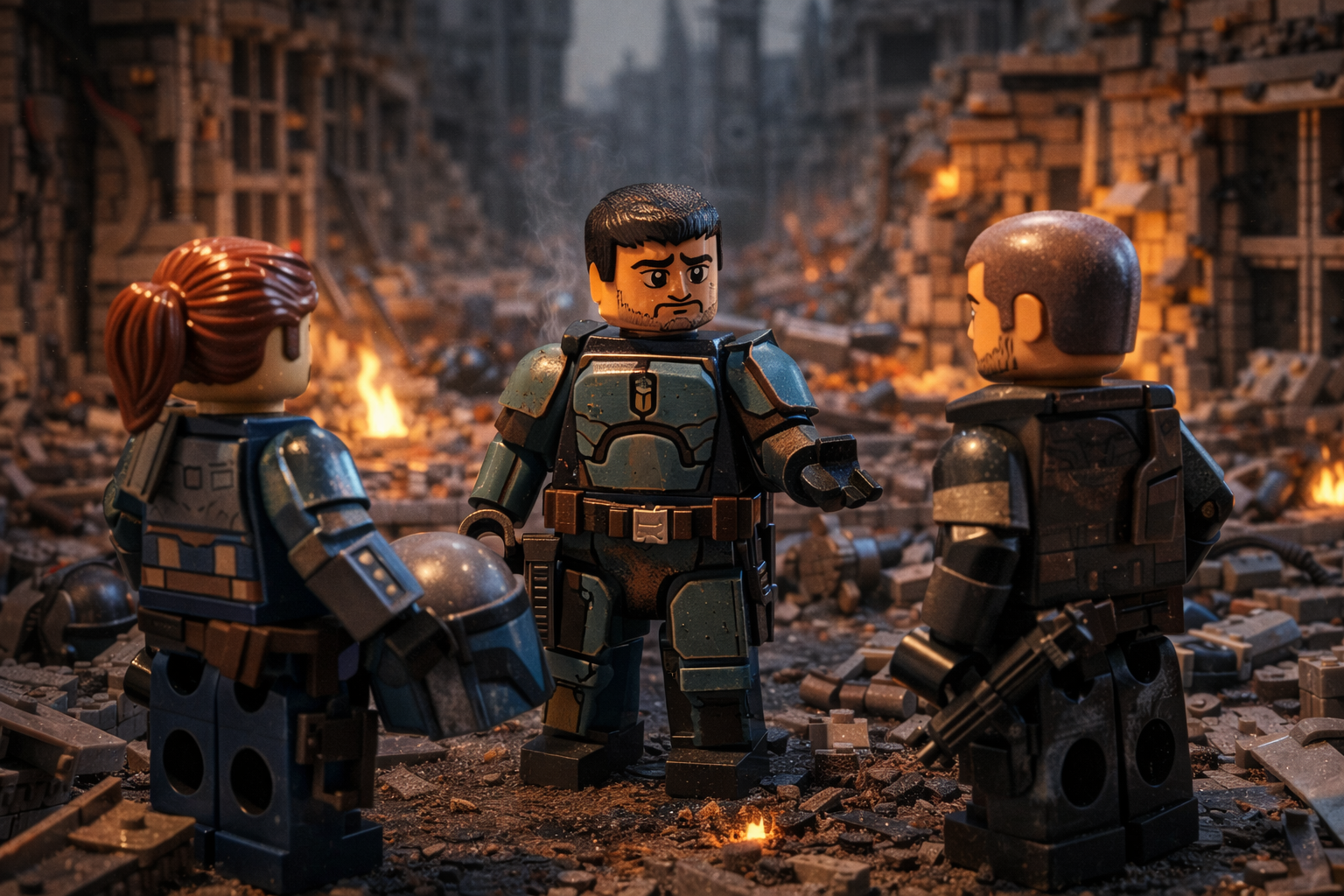
Brick-built armored figures stand face-to-face in a ruined city after a battle, smoke rising behind them as they confront the cost of survival.

The city was dead, but it had not finished asking for things.

Stone towers lay broken across one another like fallen giants, their edges snapped clean where old weapons had done their work with surgical indifference. Streets that once carried processions now carried dust, ash, and the occasional echo—sound that lingered too long because there was nowhere left to absorb it.

The squad moved low through the ruins, armor scraping softly against brick and shattered tile. They did not speak. Voices were liabilities here.

Rhen Tal led, visor angled downward, reading the ground the way some read stars. Footprints told stories. Scorch marks remembered arguments. The city kept records whether anyone asked it to or not.

Rhen raised a fist.

The line halted.

Above them, a fractured balcony sagged, its supports cracked but holding. To the left, an alley narrowed into a choke point between collapsed walls. To the right, an open plaza—too open, too honest.

Rhen tapped two fingers against his chest, then pointed left.

Ambush ground.

Behind him, Kala Vos shifted her weight, weapon cradled but not aimed. She didn’t like ambushes. Too close to traps. Too close to luck. But the city had already decided where the fight would happen.

Further back, Jarek Pell paused near a fallen statue, one hand brushing the engraved stone. The figure’s face was gone, shattered into anonymity. Jarek lingered a half-second longer than necessary before moving on.

Honor remembered. Survival moved.

They took positions without instruction.

Rhen climbed the broken stairwell, settling into shadow above the alley mouth. His armor blended with the ruin, colors dulled by dust and time. From here, he could see movement patterns, predict lines of advance.

Kala slipped behind a half-collapsed wall, sightline covering the plaza edge. She adjusted her grip, checked her power cell. Everything worked. That made her nervous.

Jarek crouched near the statue base, back to stone, eyes scanning the upper windows. “Too quiet,” he muttered, barely audible over the whisper of wind through rubble.

Kala didn’t look at him. “Cities don’t go quiet by accident.”

Rhen’s voice came through the squad channel, low and steady. “Contact incoming. Multiple. Not rushing.”

Figures emerged at the far end of the plaza—armored silhouettes moving with confidence that hadn’t been earned here. Their gear was newer. Cleaner. Their steps heavier, louder against broken stone.

“They think the city belongs to them,” Kala said.

“They think wrong,” Jarek replied.

The lead enemy raised a hand. The group slowed, spacing out. Professional. Careful.

Rhen felt a familiar tightening in his chest—not fear, not excitement, but something older. The pull between what he’d been taught and what the city required.

He marked targets silently. Left flank. Center mass. Rear guard.

“Wait,” Rhen said.

Kala exhaled through her nose. “If we wait much longer—”

“I know,” Rhen replied. “Wait.”

Below, the enemy squad advanced another ten meters. One of them kicked debris aside with casual disrespect.

Jarek’s fingers tightened on his trigger. He glanced again at the faceless statue beside him.

Honor had once lived here.

“Now,” Rhen said.

THE AMBUSH

The city answered first.

Rhen fired downward, his shot precise, controlled—no flourish, no waste. The lead enemy went down hard, armor ringing against stone. Kala’s fire followed an instant later, stitching the plaza edge with disciplined bursts that forced the rest into cover.

Jarek moved last, not because he was slow, but because he was choosing.

He rose from behind the statue and fired at the second rank, shots angled to herd rather than kill. The city’s broken geometry did the rest—ricochets, falling debris, panic.

The enemy scattered, formation breaking under pressure they hadn’t anticipated.

“Push,” Rhen ordered.

Kala vaulted the wall, landing light despite her armor. She advanced with purpose, weapon steady, eyes sharp. This was where survival lived—forward, aggressive, denying the enemy time to think.

A return shot clipped her shoulder plate, spinning her half a step. She grunted but stayed upright.

“Still breathing,” she said. “Barely offended.”

Jarek moved to cover her, firing from the hip, forcing the enemy back into the alley choke. His shots were fast, angry.

Too angry.

“Jarek,” Rhen snapped. “Control.”

Jarek didn’t answer.

Instead, he advanced into the alley, boots crunching over rubble, breathing hard. An enemy rose in front of him, weapon shaking.

For a heartbeat, they stared at each other.

The enemy was young. Scared. Alive.

Jarek hesitated.

The city did not.

A shot rang out from above—enemy fire from a window they’d missed. It struck the wall inches from Jarek’s head, spraying stone shards.

Kala fired upward instantly, silencing the threat.

Rhen dropped from his perch, landing between Jarek and the enemy without ceremony. He fired once.

The enemy fell.

Silence followed—not peaceful, just empty.

THE COST

They regrouped among the ruins, weapons lowered but not slung. Dust drifted through sunlight like ash remembering fire.

Kala checked Jarek’s faceplate. “You froze.”

Jarek looked away. “I remembered.”

Rhen removed his helmet, breathing the city’s stale air. “Memory gets you killed.”

Jarek met his eyes. “So does forgetting.”

The city creaked around them, old structures settling, making room for the dead.

Kala broke the tension first. “We won. That’s what matters.”

Rhen shook his head. “We survived. That’s not the same thing.”

He looked out over the plaza—new scorch marks layered over old ones, history repeating itself with different armor.

“This place doesn’t care why we fight,” Rhen said. “Only how.”

Jarek knelt by the fallen statue again, brushing dust from the broken engraving. “It used to.”

Kala softened, just slightly. “Maybe. But it doesn’t anymore.”

Rhen replaced his helmet. “Then we adapt.”

They moved on, deeper into the ruins, leaving the city to tally its losses.

Honor followed them like a shadow.

Survival walked ahead.

This is an original work of fiction created by Brick Crossing, inspired by the design themes of LEGO® set 75373.
LEGO® is a trademark of the LEGO Group, which does not sponsor, authorize, or endorse Brick Crossing.
Posted on

When Clever Stopped Being Enough

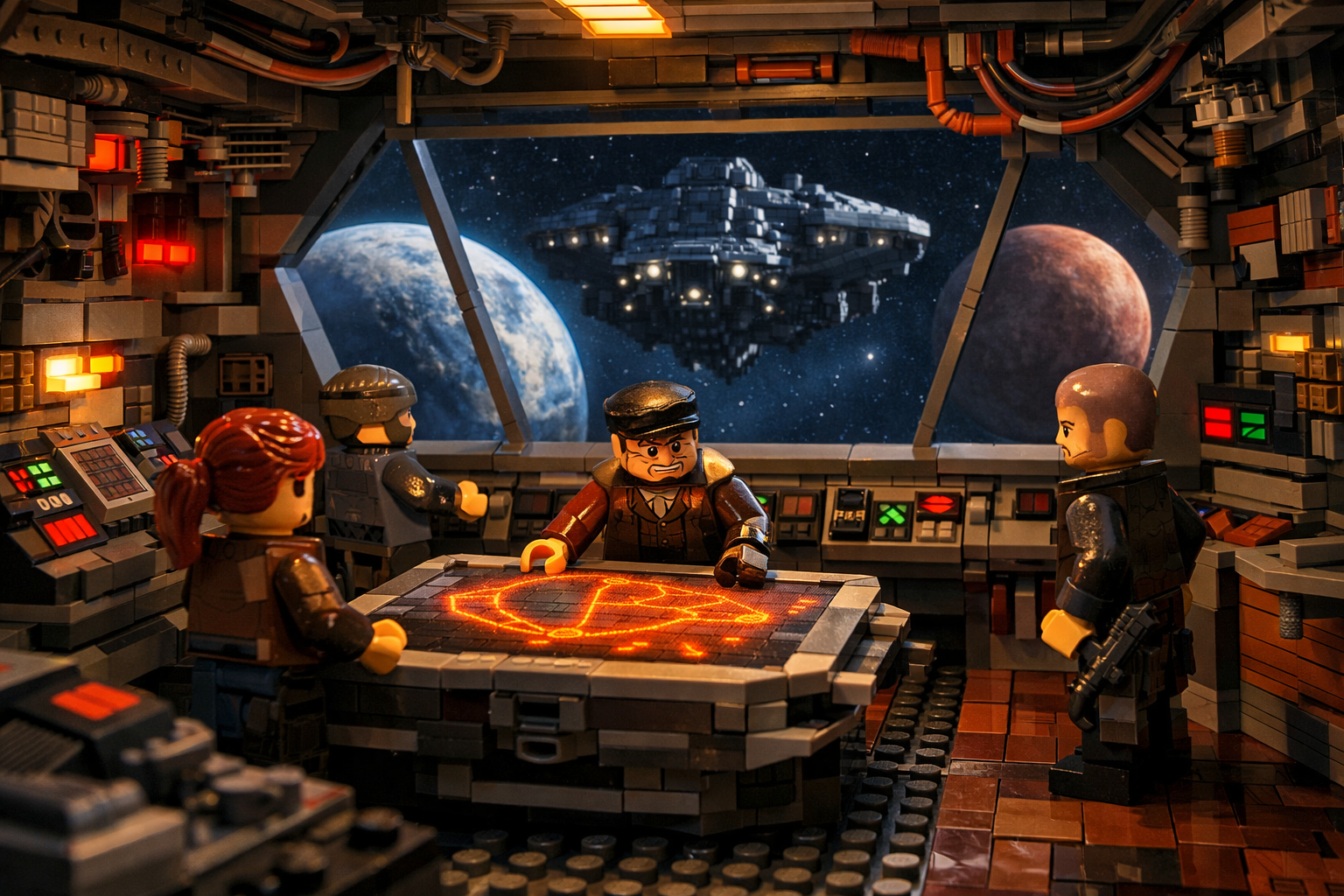
Brick-built pirate starship interior as a tense crew gathers around a glowing navigation table, watching an enemy vessel approach between two distant planets through the forward viewport.

The Blackwake Spur never smelled clean—not when it was feared, not when it was fast, and certainly not now. Oil clung to the air, sharp and metallic, layered over scorched wiring and recycled breath. The corridors were narrow by intent, built to keep bodies close and arguments closer. Every bulkhead bore the history of compromise: plates welded over plates, conduits rerouted with impatient hands, systems forced to cooperate where no engineer would have planned them to.

The ship was fast because it had to be.
Alive because its crew refused to let it die.

On the primary interior deck—half command space, half improvisation pit—Captain Rax Calder braced one boot against a vibration-dampener crate and drummed his fingers on the edge of the nav table. The projection flickered between them in uneven amber, its alignment always just slightly wrong no matter how often it was recalibrated.

“Say it again,” Rax said.

Across from him, Vela Quinn didn’t look up from the exposed console she was elbow-deep in. Sleeves rolled high, hands blackened with grease, eyes sharp enough to cut. “The jump window is real. Narrow. Ugly. But real.”

“And the escort?” Rax asked.

Vela pulled her hands free and wiped them on a rag that had once been white. “Heavier than we expected. Better armed than us. Slower—unless they planned for someone like us.”

Rax smiled faintly. “No one ever plans for us.”

From the rear of the compartment, Joss Merrek snorted. He leaned against a crate of sealed containers—cargo not yet inventoried out loud. His hand rested near the grip of his sidearm, a habit that had become more noticeable lately.

“Confidence is not a plan,” Joss said. “And optimism gets crews killed.”

Rax turned slowly. “Funny. I don’t remember asking for a morale report.”

Joss met his gaze without flinching. “You asked for honesty when you took the chair.”

The Blackwake Spur hummed around them, an old animal shifting its weight.

The target drifted ahead on the forward display: a diplomatic courier—long-range, low-profile, fat with secrets if not cargo. Its hull read as pristine. The kind of ship that believed importance was armor.

Vela overlaid a secondary scan. “Their sensors are wide but shallow. They’re watching for debris, not intent.”

“Intent is our specialty,” Rax replied.

At the comms station, Enso Kale adjusted the filters, voice calm in the way only a former something-else could manage. “No close escort. One long-range shadow sitting just outside detection.”

Joss straightened. “There it is.”

Rax’s eyes narrowed. “We’ve danced worse.”

“Yes,” Joss said. “But not with this crew.”

Vela glanced up sharply. “Meaning?”

Joss shrugged. “Half this ship still thinks we’re scavengers playing pirate. The other half thinks we’re pirates pretending we’re something nobler.”

Rax stepped closer, lowering his voice. “And what do you think?”

Joss smiled thinly. “I think the Blackwake Spur is worth more sold than flown.”

Silence fell hard.

Vela slammed a panel shut. “You don’t sell a ship like this.”

“Everything sells,” Joss replied.

Rax raised a hand. “Enough.”

The forward display shifted.

Enso stiffened. “Captain—the shadow moved.”

“Toward us?” Rax asked.

“Toward where we were,” Enso said. “They’re not locking yet. They’re watching.”

A tremor ran through the deck as the ship tightened its field.

“They’ve found us,” Vela said.

“No,” Rax corrected. “They suspect.”

“Here’s the play,” Rax said. “We ghost the courier’s underside. Match vector. Bleed speed.”

Vela frowned. “That puts us inside their defensive envelope.”

“They won’t fire that close,” Rax said. “Not without authorization.”

Joss shook his head. “You’re betting on bureaucracy.”

“I’m betting on fear,” Rax replied.

The Blackwake Spur slid into position with a grace it had no right to possess. Interior lights dimmed. Systems went quiet by necessity rather than design.

For a moment, it worked.

Then the shadow ship shifted—not forward, but sideways, cutting angle with predatory precision.

“That’s confidence,” Vela muttered.

“They’re better than we thought,” Rax said.

Joss smiled. “Now you’re catching up.”

Warning tones rose—then cut as Vela killed them manually.

“They’re scanning us,” she said. “Deep.”

“How deep?” Rax asked.

“Deep enough to know we don’t belong.”

The shadow loomed larger now. No weapons fire. Just pressure.

Joss stepped closer. “Captain… if this goes wrong—”

“This ship is not for sale,” Rax said.

“Everything breaks,” Joss replied.

“Not today.”

The engines screamed as power surged through conduits that had no business carrying it. The Blackwake Spur roared—not clean, not elegant, but alive.

The gap closed. The hunter adapted.

As the deck shuddered beneath him, Rax felt the truth settle in his bones:

Clever had carried them far.

But it might not be enough anymore.

This is an original work of fiction created by Brick Crossing, inspired by the design themes of LEGO® set 75374.
LEGO® is a trademark of the LEGO Group, which does not sponsor, authorize, or endorse Brick Crossing.
Posted on

White Wake, Quiet Fire

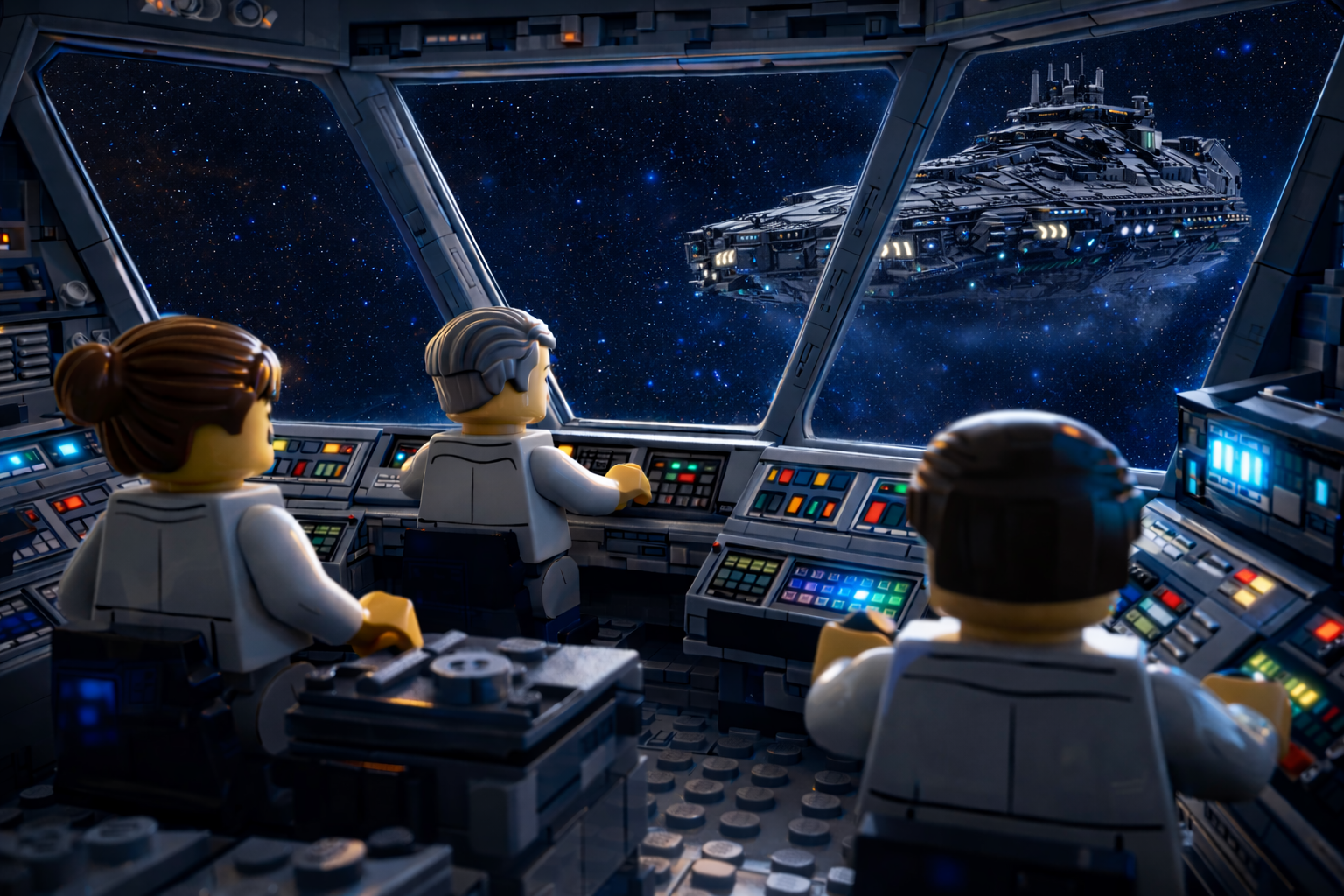
Brick-built command deck of a diplomatic starship as officers watch a massive enemy vessel emerge in deep space through the forward viewport.

The diplomatic vessel drifted through starlight like a blade turned sideways—long, pale hull catching the cold in clean facets. Running lights were dimmed to a disciplined whisper. Ahead, a ribbon of scattered debris marked an old trade lane, the kind captains trusted because it had been trusted before.

Inside, the command deck was all angles and restraint: a narrow bridge with consoles set in tidy banks, handholds placed where bodies would reach in a hurry, and a forward viewport that made space look closer than it was. The crew spoke softly, not out of fear, but out of habit. Important ships learned to keep their voices low.

Captain Maera Dain stood at the center rail with her hands behind her back, posture steady enough to convince the room that steadiness was a choice. Her eyes moved over readouts without lingering—heat output, drive pressure, comm silence, external scan. The ship ran clean. Clean was a kind of prayer.

Then the stars ahead briefly blinked—not from distance, but from interruption—and the prayer broke.

“Contact.” The sensor officer’s voice was clipped, too controlled. “Wake signature, aft quadrant. Massive.”

Lieutenant Hal Marr, navigation, leaned in over his console as if proximity would change the numbers. “That’s not a patrol. That’s… that’s a wall.”

Maera didn’t turn. “Range.”

“Closing.” The sensor officer swallowed. “Fast.”

In the forward viewport, nothing changed. Space stayed silent, indifferent. But on the tactical display, a shape resolved from a smear into geometry—an enemy ship with lines that didn’t negotiate. Its signature was too clean, too confident, like a threat that had been polished.

“Transponder?” Maera asked.

“None,” comms replied. “No hails. No queries. No—” She stopped as a new warning tone bit into the bridge. “No courtesy.”

A dull tremor ran through the deck plating—subtle, but everyone felt it. The ship’s spine tightening.

Chief Engineer Orin Pell’s voice crackled up from below, threaded with static. “Bridge, I’m seeing a spike on the aft field. They’re painting us.”

Maera’s jaw set. “They’ve found us.”

Hal’s fingers hovered above the course controls. “Captain, we can dump into the debris ribbon. Mask our profile.”

“Do it,” Maera said. “Quietly.”

The ship angled, thrusters feathering. On the viewport, the debris lane widened—broken panels, fractured struts, glittering fragments that spun slowly like lazy knives. The diplomatic vessel slid toward it with the measured grace of something built for halls and hearings, not hunts.

“Comms,” Maera said, eyes still forward. “Send the packet.”

The comms officer hesitated only once. “Encrypted burst?”

“Yes. Short. If we die, I want the universe to at least know why.”

A single pulse of light left the ship—so quick it might have been imagination. Then silence returned, heavier than before.

They entered the debris lane. Metal fragments drifted past the viewport, close enough to see scoring, old burn marks, the quiet archaeology of past violence. The ship’s external lights remained low. The crew held their breath without meaning to.

“Thermal signature is down,” Orin reported. “We’re as cold as we can get without losing life support.”

“Good,” Maera murmured. “Stay alive.”

For a moment, the enemy ship’s icon on the tactical display wavered—its lock uncertain, its distance less definite. A small exhale moved through the bridge like wind.

Then the enemy ship corrected.

It didn’t slow. It didn’t circle. It simply came in after them, cutting through the debris lane as if the lane belonged to it. Objects that would have torn the diplomatic ship open were deflected by its forward field with casual cruelty, fragments flashing aside like sparks.

Hal’s voice went thin. “They’re not avoiding anything.”

“They don’t have to,” the sensor officer said. “Their field strength is triple ours.”

The ship trembled again—stronger this time. A warning light on the overhead panel flared: INCOMING.

“Brace!” Maera snapped.

The first impact was not an explosion, but a pressure—a lancing compression that struck the aft shields and shoved the whole vessel forward. Consoles flickered. A thin line of sparks ran like lightning across a junction panel. Someone swore, low and involuntary.

Orin’s voice surged through the comm. “Aft shields down ten percent in one hit. Captain, that wasn’t a warning. That was a measurement.”

Maera’s gaze locked on the tactical display. The enemy ship held distance with precision, matching their every adjustment. It didn’t need to close to kill them. It simply needed patience.

“Captain,” Hal said, “if we stay in the debris, we get carved up. If we leave, they get a clean shot.”

Maera’s hands unclasped behind her back. She gripped the rail. “Options.”

Silence answered first—the kind of silence that reveals how few options exist.

Then the comms officer spoke. “We have diplomatic codes. We can broadcast—”

“No,” Maera said, sharper than intended. “They already chose what we are.”

The sensor officer’s eyes widened. “Captain, I’m seeing a second lock. They’re targeting our drive cluster.”

Maera’s mouth tightened. “They want us intact.”

Hal looked up. “Boarding?”

“Or worse,” Maera replied. She turned at last, and the crew saw something in her expression that wasn’t fear—something colder, older. “They don’t chase a ship like this for cargo.”

Orin cut in again, breathless. “Bridge, if they shear the drive, we’ll tumble. We’ll still be alive when they reach us.”

The bridge lights dimmed as power rerouted. Somewhere in the ship, a door sealed with a heavy, final thud.

Maera leaned toward Hal’s console. “Plot for the ridge.”

Hal blinked. “The ridge?” He glanced at the nav display, where a jagged cluster of dark masses hung in space—an ancient field of shattered rock and metallic ice, dense enough to distort sensors. “That’s not debris. That’s—”

“A graveyard,” Maera finished. “And a place even a superior ship might hesitate.”

Hal’s fingers moved. The ship adjusted course, pushing hard now. The diplomatic vessel’s engines brightened slightly despite the effort to remain cold.

The enemy ship answered with another strike.

This one hit closer. The deck lurched. A crew member slammed into a console; another caught them by the shoulder before they fell. The viewport’s edge fractured with a spiderweb crack—transparent layers holding, barely.

“Report,” Maera demanded.

“Aft shields at sixty-eight,” the sensor officer said. “Drive cluster holding. Hull integrity—” She swallowed. “Holding.”

Maera nodded once. No comfort, no promise. Only motion.

As they approached the ridge, the stars seemed to thin. Shadow thickened between scattered boulders the size of towers. Ice crystals drifted like slow snow, catching the faint light and reflecting it in fractured, unreliable glints.

“Take us in,” Maera said.

Hal’s voice tightened. “Captain, our turning radius—”

“Take us in anyway.”

The ship slid into the graveyard field, close to the rocks, so close the bridge crew could see textures—pitted surfaces, seams of frozen metal, old impacts that looked like scars. The hull groaned as the ship’s field strained against micro-collisions.

For a few seconds, the enemy ship’s lock broke. Their tactical display turned fuzzy, uncertain. The enemy icon wavered.

The crew breathed again—just once.

Then the enemy ship entered the field after them.

It didn’t hesitate. It didn’t lose control. It moved like it belonged among the dead, like it had practiced here.

Maera watched the icon stabilize behind them and felt something in her chest tighten—admiration, unwilling and bitter. “They’re better,” she said quietly.

Orin’s voice came up, low and grim. “Better machinery. Better fields. Better everything except—” He paused as if choosing words with care. “Except what they’re missing.”

Maera turned her head a fraction. “And what is that, Chief?”

Orin exhaled. “Imagination.”

Hal glanced up. “Captain, we can’t outgun them. We can’t outrun them. We can’t—”

“We can mislead them,” Maera said.

On the forward console, a small panel blinked: AUXILIARY SYSTEMS. A map of internal compartments showed a sealed unit deep in the ship’s belly—an older module, rarely used. A diplomatic vessel carried many kinds of rooms, not all of them public.

Maera pointed. “Pell. Can you vent the reserve coolant into the aft field? Not as heat. As… clutter.”

Orin hesitated. “That’s risky. It’ll bloom our signature.”

“Yes,” Maera said. “A bloom they can’t resist.”

Hal’s eyes widened as he began to understand. “A false drive burn.”

Maera nodded. “Make them think we’re desperate enough to sprint.”

Orin’s reply came after a beat. “I can do it. It’ll look like we’re pouring everything into the engines.”

“And while they adjust to intercept,” Maera said, “Hal takes us down.”

Hal stared. “Down?”

“Into the ridge,” Maera said, voice steady. “There’s a pocket ahead—void shadow. If we dive into it and kill all output, they’ll overshoot. For a moment, they’ll have speed but no sight.”

Hal’s hands hovered again—uncertain, reverent. “If we misjudge, we don’t overshoot. We shatter.”

Maera’s gaze fixed on the starless gap between two massive rocks ahead. “Then we won’t misjudge.”

Orin’s voice came back, suddenly all business. “Bridge, on your mark, Captain.”

Maera lifted her chin. “Mark.”

The ship’s systems complied with a kind of reluctant obedience. A surge of false output flared—numbers spiking, warnings chirping, engine glow brightening. The diplomatic vessel, for a heartbeat, looked like a fleeing animal finally breaking into a sprint.

The enemy ship reacted instantly. Its icon leapt forward, closing distance to cut them off.

“Now,” Maera said.

Hal cut thrust—hard. The ship dipped, nose tilting toward the shadow pocket. External lights went dimmer still. Nonessential systems dropped. The bridge grew darker, quieter, as if the ship were holding its breath.

The void pocket swallowed their signature.

For a fraction of time, there was nothing—no warnings, no impacts—only the distant, muffled thunder of the enemy ship’s passage.

A white blur crossed the viewport, fast enough to hurt the eyes. The enemy ship slid past the gap they’d occupied, overshooting by a hair, its forward fields igniting drifting ice into bright, useless halos.

The crew didn’t cheer. No one moved. Even relief felt dangerous.

Then the tactical display updated.

The enemy ship did not continue forward.

It stopped—not with thrusters, but with a shift of mass and field that shouldn’t have been possible in this space. It pivoted with inhuman economy, already turning back, already reacquiring.

Hal’s voice was a whisper. “They anticipated the trick.”

Maera’s mouth went dry. “They learned.”

Orin’s comm hissed. “Captain… they’re charging something. I don’t know what, but the aft sensors—”

The bridge lights flickered. The viewport crack spread another line, tiny but ominous.

Maera’s fingers tightened on the rail until her knuckles whitened. “Helm,” she said softly, “give me anything you’ve got left.”

Hal’s hands moved, and the diplomatic vessel began to slide deeper into the graveyard’s shadow, threading between dead stone and frozen metal like a needle through cloth.

Behind them, the enemy ship’s presence grew—silent, advanced, relentless.

Maera watched the starless gap ahead narrow into a slit, then widen again into unknown dark, and felt the ship’s frame shiver like a living thing.

The enemy ship’s charge reached a pitch the sensors could no longer translate into numbers—only warning tones and a rising, impossible quiet.

On the command deck, every face turned toward the viewport as if the next second might finally explain what kind of hunter they had invited into the dark.

And then the lights went out.

This is an original work of fiction created by Brick Crossing, inspired by the design themes of LEGO® set 75376.
LEGO® is a trademark of the LEGO Group, which does not sponsor, authorize, or endorse Brick Crossing.
Posted on

The Salt That Screamed

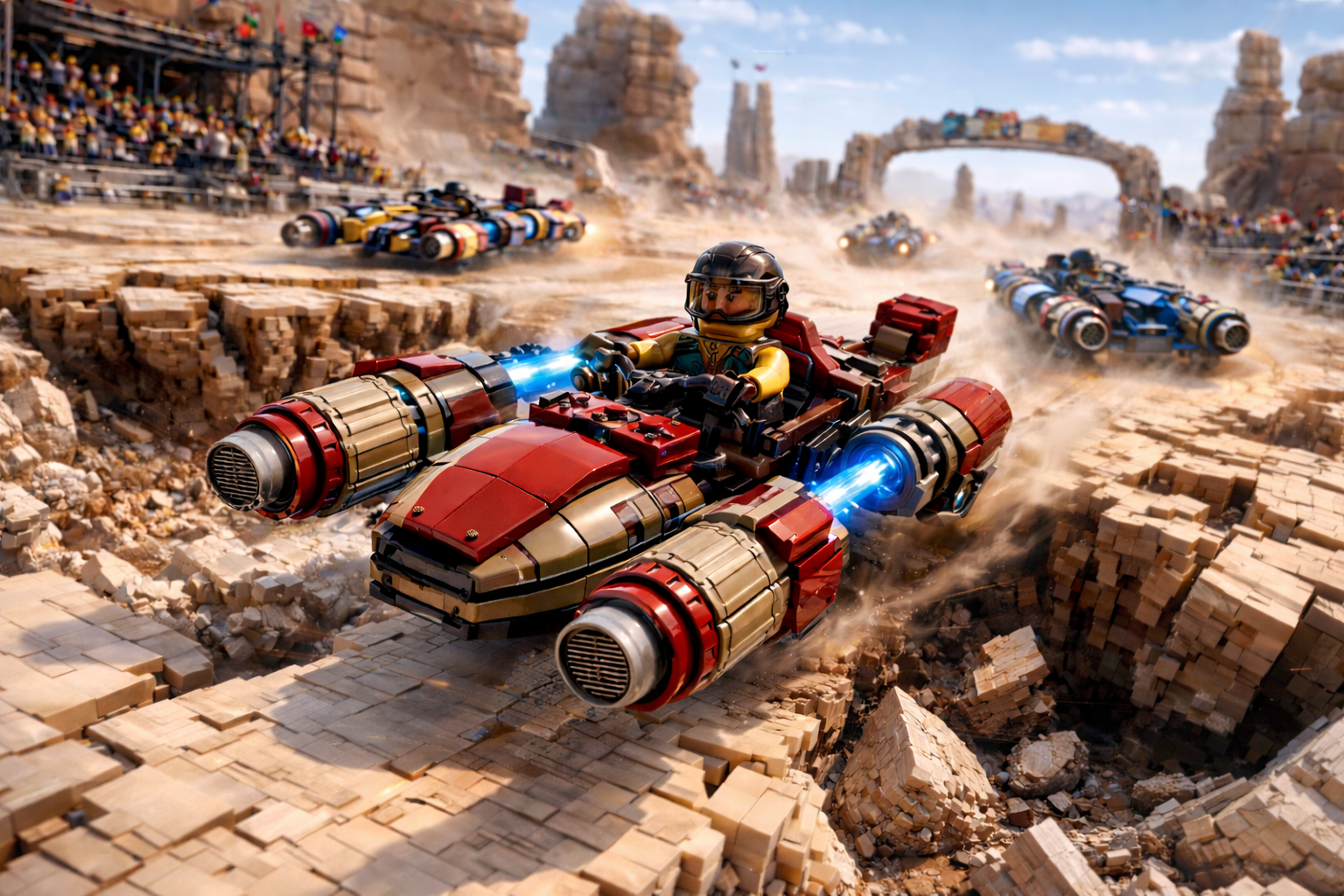
Brick-built desert racing pods tear across a collapsing salt flat as a lead pilot races toward a stone arch, engines roaring and dust exploding behind.

The flats stretched wider than the eye could settle on—an endless crust of pale mineral cracked into plates, each one sharp-edged and unforgiving. Heat shimmered across the surface, bending distance into illusion. Far off, stone pylons rose like broken teeth, remnants of something older than the race that now claimed the land.

At the basin’s edge, the stands clung to a ridge of rusted scaffolds and sun-bleached beams. Flags snapped in the wind, their colors dulled by years of grit. Engines growled beneath them, not yet unleashed—metal hearts ticking, humming, waiting. Every sound echoed too long in the open air.

Kael Ryn stood apart from the noise, one gloved hand resting on the frame of his racer. It was narrow, skeletal, all exposed lines and tension cables—built for speed at the cost of mercy. The machine trembled faintly, as if it knew what the flats would demand.

Below the salt crust, something shifted.

Kael checked the coupling rods again. He always did. Twice before ignition, once after. The others mocked the habit, but none of them raced on a machine rebuilt from salvage and stubbornness. This racer had failed once already—years ago, in a different basin, leaving Kael buried and burning under a sky that didn’t care.

A horn sounded. Low. Then another, higher. The signal rolled across the flats like a warning more than a welcome.

Racers mounted up. Engines flared. Twin turbines screamed as they spooled, kicking salt into white clouds that drifted and hung instead of falling. Kael swung into position, boots locking into the foot clamps. The control yoke felt warm, familiar, scarred.

He glanced sideways. Other racers waited in their lanes—sleeker builds, heavier armor, sponsor sigils etched into their shells. One pilot caught his eye, visor reflecting the salt glare like a mirror. No nod. No challenge. Just patience.

The final horn cut the air.

The world detonated forward.

Kael’s racer lunged, turbines ripping at the wind. The flats blurred beneath him, cracked plates flashing by like broken ice. The pylons rushed closer, towering markers that defined the course’s first corridor. He leaned, threaded the gap, felt the racer shudder but hold.

Speed erased everything else. The stands vanished. The noise became a single continuous scream. He passed one racer on the inside, close enough that their wake rattled his frame. Another surged past him moments later, armored prow throwing salt like shrapnel.

Then the ground screamed.

Not the engines. The flats themselves.

A vibration rippled up through Kael’s controls—wrong, deep, alive. The salt plates ahead fractured in a spreading line, racing faster than any machine. Kael swerved, barely clearing the collapse as the surface gave way behind him, swallowing a racer whole in a plume of white dust and spinning debris.

The course markers flickered. Alarms wailed from the ridge.

This wasn’t on the map.

Kael cut throttle just enough to stabilize, heart hammering louder than the turbines. Ahead, the flats buckled again, the crust splitting to reveal darker layers beneath—wet mineral, ancient and unstable. The pylons leaned, some toppling entirely as the land reshaped itself mid-race.

He could pull out. Many would. The safe path veered left toward higher ground, narrower but intact.

Instead, Kael saw it.

A corridor opening straight ahead—newly formed, jagged but direct. Shorter. Faster. Deadlier.

The racer vibrated in protest as he realigned, cables whining. He pushed power back in, felt the machine surge, and plunged into the collapsing run. Salt walls rose on either side, fragments skidding and bouncing off his hull. One struck the turbine housing, sending a shiver through the frame.

The ground dropped.

For a breathless second, Kael and the racer were airborne, suspended over a widening fissure. Below, the flats fell away into shadow, the scream of shifting earth echoing up like breath from a buried giant.

The racer landed hard. Something snapped—warning lights flared—but it kept moving. Kael gritted his teeth, steering by instinct now, riding the edge between control and catastrophe.

Behind him, engines roared. Someone else had followed.

The corridor narrowed, pylons looming closer together than designed. Kael threaded through by inches, sparks trailing from a clipped stabilizer. The finish ridge appeared ahead, flags whipping, the crowd a distant roar.

Then the ground surged one final time.

A ridge of salt erupted directly in his path.

Kael yanked the yoke, turbines screaming in protest as the racer lifted, skimming the rising wall by the width of a brick. The finish line flashed beneath him, lights blurring into streaks of white and red.

He crossed as the flats collapsed behind him, the sound swallowing everything.

When the racer finally coasted to a halt, smoke curling from its sides, Kael stayed seated, hands still locked in place.

The salt kept screaming long after the engines died.

This is an original work of fiction created by Brick Crossing, inspired by the design themes of LEGO® set 75380.
LEGO® is a trademark of the LEGO Group, which does not sponsor, authorize, or endorse Brick Crossing.
Posted on

The Flaw That Waited

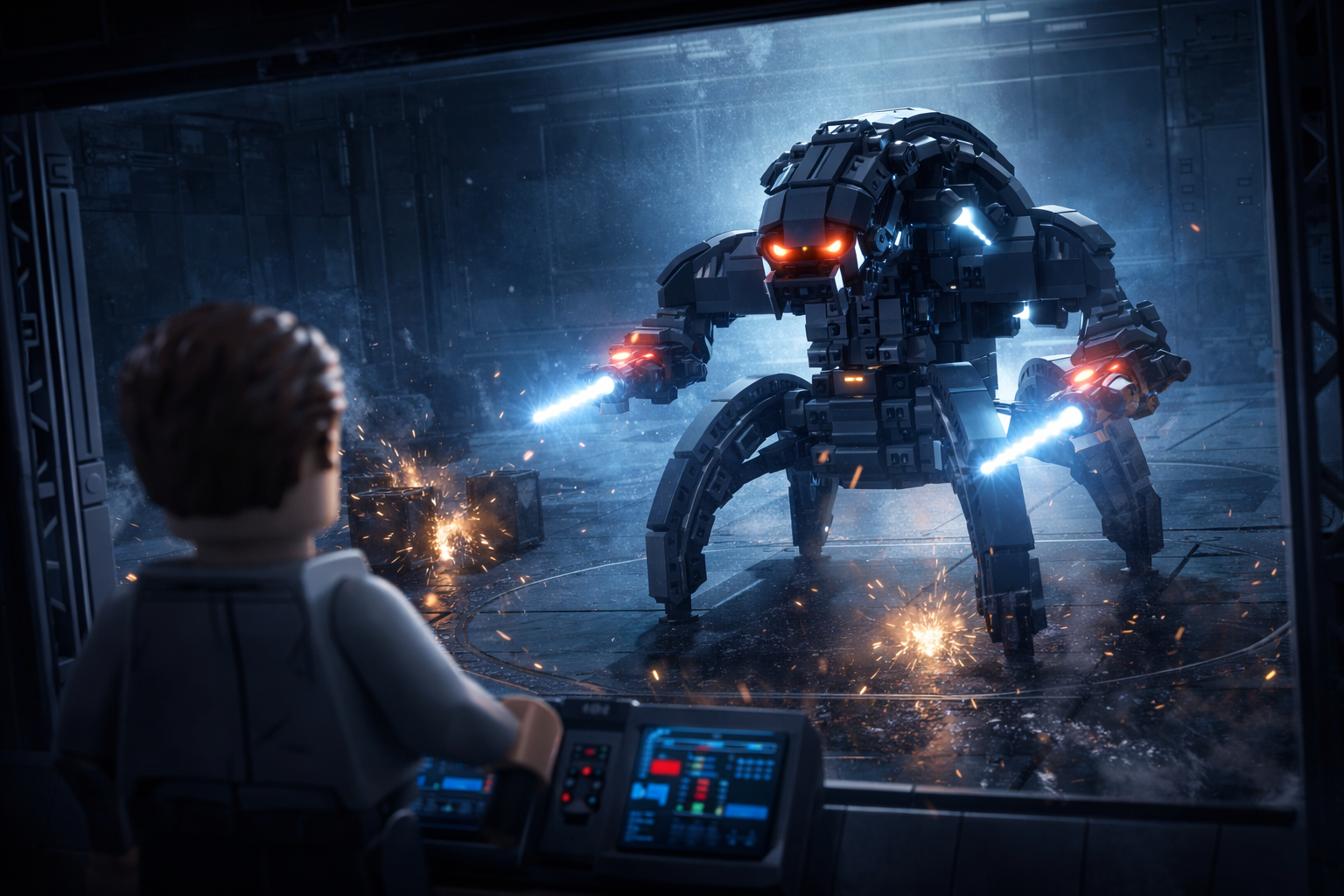
Brick-built rolling siege automaton rests inside a test chamber as an engineer watches from behind observation glass under dim laboratory lights.

The lab lights never truly turned off. They dimmed, they softened, they shifted from white to blue as the facility pretended to sleep—but the machines stayed awake, and so did the people who were told to build them.

Soren kept his hands steady as he aligned the last curved plate along the automaton’s chassis. The part clicked into place with a clean, satisfying sound that used to make him proud. Tonight it made him nauseous.

Behind the safety glass, the test chamber stretched wide and empty, its floor marked with concentric rings and impact-scored panels. The chamber looked like an arena without spectators. It smelled like sterile air and heated metal and the faint tang of ozone from charged fields.

The automaton sat in the center, compact in its resting posture—too compact for what it was capable of becoming.

On Soren’s wrist, his clearance band pulsed once: a silent reminder of who owned his time. On the console, a new message blinked: FINAL ACCEPTANCE TEST — SCHEDULED.

The machine was ready.

Sourced from his mind. Shaped by his hands. Paid for with his fear.

He hadn’t been hired for weapons.

He’d been hired for stability systems, for motion control, for field harmonics that kept mining platforms from shaking apart in high winds. He’d worked on rescue rigs once. Small things that lifted debris and saved people who couldn’t lift themselves.

Then an official in a crisp coat had visited his home with a polite smile and a folder of printed threats. Soren had been offered a choice that wasn’t a choice.

Build what they asked, and his family would be “protected.”

Refuse, and protection would be “reconsidered.”

His partner’s commute route had been described with uncomfortable accuracy. His younger sister’s clinic had been named. His father’s farm had been mentioned as if it were already ash.

Soren had signed the contract with a pen that shook.

After that, the facility became his world: corridors that swallowed sound, badges that tracked every step, cameras that watched even when they didn’t move. He was escorted to his workbench like a prisoner allowed the illusion of purpose.

The design brief had been deceptively simple:

A rolling siege automaton capable of rapid reconfiguration, personal shielding, and area denial.

Words that meant: unstoppable in a hallway. unapproachable in open ground. built to decide who gets to exist in a space.

Soren had built it anyway, because he could see his family’s faces every time he closed his eyes.

He had told himself a lie that fit neatly in his chest: If I build it well, it will end fights faster. If it ends faster, fewer people die.

Then he watched the simulation footage.

He saw it roll forward on the test floor, unfold with elegant speed, and raise a shimmering field around itself like a private storm. He saw the field flare and harden under impact, redirecting energy and shrapnel with indifferent efficiency. He saw the automaton advance without hesitation, its targeting systems choosing threats faster than humans could apologize for being in the wrong place.

In the footage, the “threats” were dummies.

In Soren’s mind, they were people.

The automaton didn’t care.

It wasn’t cruel.

It was obedient.

And obedience, Soren had learned, could be more terrifying than hatred.

A technician called from behind him. “Engineer Soren. They’re here.”

He didn’t turn immediately. He watched the automaton’s curved silhouette through the glass, the way it looked almost harmless when folded inward—like a shell.

Then he faced the door.

Three observers entered the lab: two armed escorts and a woman with a slate of data in her hands. The woman didn’t wear a uniform, but she moved like command, the air bending around her certainty.

“Final test,” she said. Not a greeting.

Soren nodded. “All systems are calibrated.”

Her gaze slid across the workbench, lingering on his tools as if she could see guilt in the oil stains. “The unit meets specification?”

“It exceeds it,” Soren said, and hated himself for sounding professional.

She stepped closer. “Then you understand what happens next.”

Soren’s throat tightened. “Field deployment.”

“Operational deployment,” she corrected. “Real targets.”

The word real landed like weight.

Soren glanced down at his hands. Grease under nails. Small cuts from sharp edges. Hands that had built rescue rigs and now built this.

He forced himself to ask the question he already knew the answer to.

“And my family?”

The woman’s smile was thin. “Safe. As long as you remain cooperative.”

An escort shifted, the quiet movement of someone reminding Soren that safety was temporary and conditional.

Soren nodded again because nodding was what people did when they were trapped.

The test chamber sealed with a hiss. Red status lights blinked. Speakers crackled.

“UNIT READY,” an automated voice announced.

Soren stood at the console, fingers hovering above the activation control. The observers watched from behind him. He could feel their attention like heat on the back of his neck.

This was the moment they would remember when the machine performed.

This was the moment Soren would remember when it didn’t.

He had added something.

Not a grand sabotage. Not a heroic failure. He wasn’t that brave. Bravery had consequences his family couldn’t afford.

He had added a flaw so small it looked like a rounding error: a tolerance shift in a joint actuator, a timing drift in the reconfiguration sequence—microscopic enough to pass diagnostics, significant enough to matter under stress.

It wouldn’t stop the automaton.

It might not even slow it.

But in the right moment, under sustained pressure, during a long advance, it could create a hesitation—a stutter in the folding motion, a brief instability in the field envelope.

A fraction of a second.

A window no one would notice unless they were desperate enough to watch for it.

Soren swallowed.

He pressed the control.

In the chamber, the automaton’s core lit with a cold pulse. It rose—smooth, controlled—then began to roll forward, compact and silent at first. It circled the ring markers as if measuring the world. Then a turret module unfolded, sensors rotating with predatory patience.

Targets rose from the floor panels: armored plates designed to mimic incoming fire.

The first impacts struck.

The automaton’s shield field flared to life—a shimmering dome that snapped into place with frightening speed. Energy splashed across it, dispersing outward like rain on glass. The machine didn’t retreat. It advanced, rolling straight into the barrage, field tightening, angles adjusting, the shield “learning” each strike and responding faster each time.

The observers murmured approval.

Soren tasted metal.

The automaton unfolded into its wider configuration, expanding its profile while maintaining the field. It fired.

The targets shattered.

It fired again.

The chamber filled with sparks and debris and the clean, clinical sound of dominance.

Soren watched for the flaw.

There—barely visible—during the third reconfiguration, the left joint paused a fraction longer than the right. The shield flickered at the edge, a momentary thinning that corrected itself before a casual viewer could register it.

But Soren saw it.

And for one single breath, he felt something like relief.

Not because the flaw was enough.

Because the flaw existed.

Because in a world where he had been forced to build a weapon, he had still managed to place one imperfect human fingerprint inside it—a quiet refusal hiding in the machine’s precision.

The woman beside him leaned in slightly. “Perfect,” she said.

Soren kept his face neutral. He kept his hands from shaking. He wanted to scream that nothing about this was perfect.

He said nothing.

The test ended. The automaton rolled back to the chamber’s center and folded into its compact posture again, becoming small, neat, almost innocuous.

A shell.

The chamber door opened. The escorts moved. The observers turned away, already thinking of deployment schedules and threat maps and how many lives could be rearranged by an obedient machine.

The woman paused at the lab door and looked back at Soren as if he were an object that had served its purpose.

“You did well,” she said.

Soren nodded because nodding kept his family alive.

When they were gone, he stood alone under the half-sleeping lab lights and stared at the automaton through the glass.

He imagined it in a real corridor. Real screams. Real impacts. Real people making choices they didn’t deserve to have to make.

He imagined the flaw, waiting.

Not as salvation.

As possibility.

Later, as the facility’s transport clamps locked around the automaton’s folded frame, Soren watched from a distance, unable to do anything but witness.

The crate’s seals engaged. The loading bay doors opened to night.

The machine left the lab that had birthed it.

Soren felt the weight of every future it might destroy.

And somewhere deep inside that folded shell, a tiny misalignment waited—patient, human, and almost certainly too small to matter.

The transport lights faded into the dark—

—and Soren closed his eyes as the world went quiet.

This is an original work of fiction created by Brick Crossing, inspired by the design themes of LEGO® set 75381.
LEGO® is a trademark of the LEGO Group, which does not sponsor, authorize, or endorse Brick Crossing.
Posted on

The Long Shadow

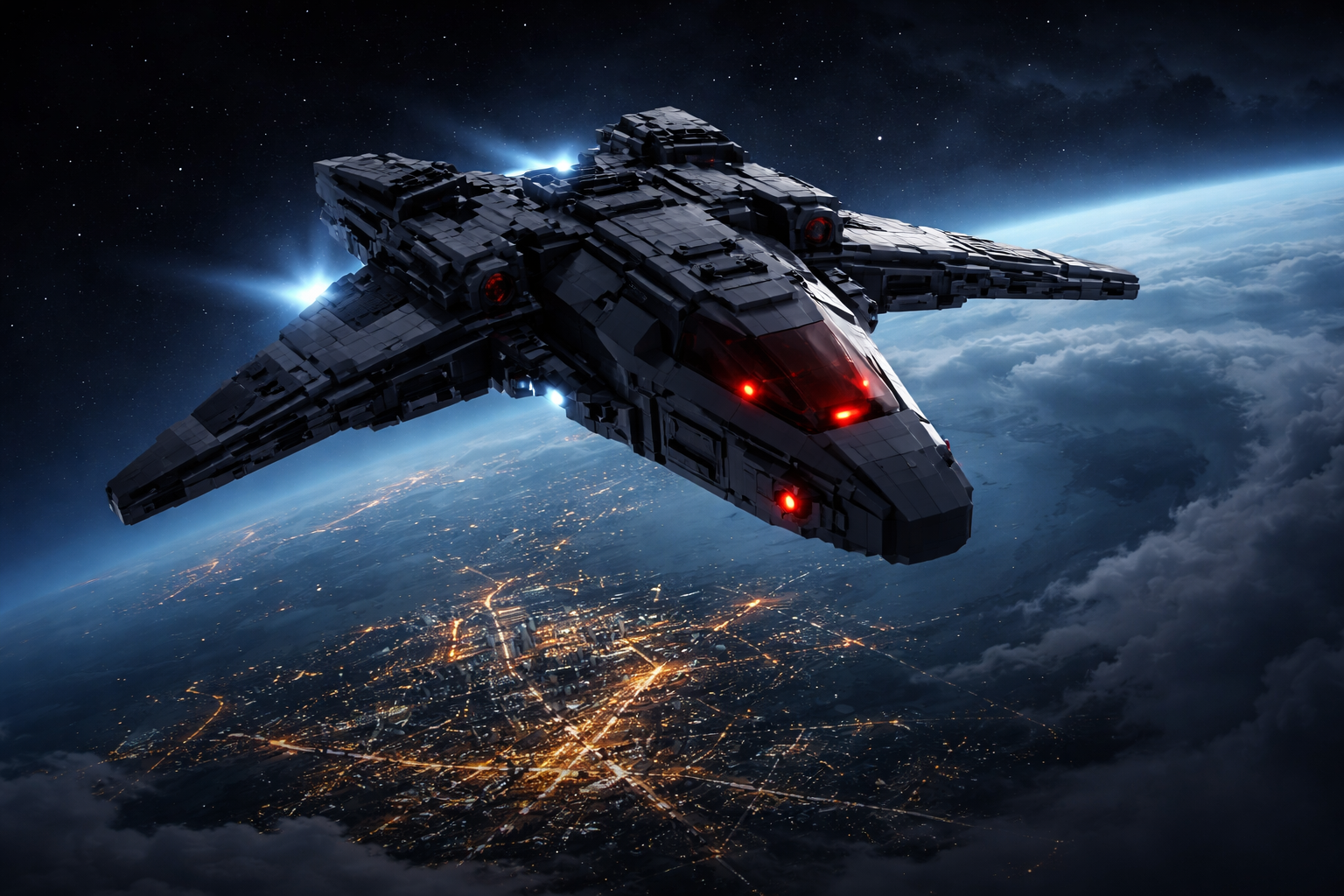
Brick-built stealth spacecraft hovers silently above a glowing city at night, barely visible against the darkness of space.

From high orbit, the city looked like a patient constellation—lines of light stitched across a dark hemisphere, pulsing in orderly rhythms that suggested comfort, routine, and control. Storm systems crawled at the planet’s edges, slow spirals of cloud that never quite touched the bright core.

Above it all, a craft hung in the black like a held breath.

Its hull didn’t catch starlight so much as refuse it. The surface swallowed reflections, bending the eye away in subtle ways that made it difficult to decide where the craft ended and space began. When it moved, it didn’t leave a trail—only the faint, momentary unease of noticing something you’d swear wasn’t there a second ago.

Inside, Vale sat alone with his hands resting lightly on the controls, as if gripping too hard might wake the world below.

He had been here for hours.

He could have been here for days.

Time behaved differently when you were waiting for someone else to make the first mistake.

The city’s defense grid was beautiful, in a predictable way.

Layers of radar and thermal sweeps, patrol arcs traced like clockwork, automated sentries that blinked at intervals engineered to prevent patterns from forming. Transponders chattered constantly—merchant traffic, security shuttles, maintenance crawlers, ceremonial flights whose only purpose was to reassure people that the sky belonged to them.

Vale watched it all from behind a veil of silence.

On the display, moving points of light drifted through the lanes. Vale’s ship didn’t mark itself. It marked others: their routines, their blind spots, the spaces between checks where certainty grew lazy.

A soft tone chimed once—an internal timer, not an alarm.

Vale inhaled, slow and controlled, and began a new scan pass. Not of the city. Of the defense crew.

A single shift supervisor, sleeping at his console again. A maintenance team rerouting power through a substation because a capacitor had been “acting strange.” An audit officer who kept delaying a security patch because it would inconvenience tomorrow’s ceremony.

People always thought the system mattered more than the people.

Systems didn’t break.

People did.

Vale’s gloved fingers moved, almost lazily, across a narrow panel. A sequence of silent queries flowed outward—not enough to trip defenses, not enough to register as intrusion. Just questions. Gentle ones. The kind that made the grid answer without realizing it was speaking.

The replies formed a map. Not of the city’s streets, but of its habits.

Vale leaned back a fraction.

There it was: a maintenance window scheduled to begin in seventeen minutes. A temporary thinning of the grid’s outer layer while power moved through alternate routes. The city would still be protected—on paper. In reality, it would be vulnerable in exactly one direction.

Vale smiled faintly, not out of joy. Out of recognition.

The world below had offered a door.

It didn’t know it had.

A voice crackled softly in Vale’s earpiece—encrypted, low bandwidth, close to the edge of hearing. “Confirm objective is still present.”

Vale didn’t answer immediately. He watched the city lights, the slow drift of clouds, the illusion of peace.

“Confirmed,” Vale said at last. “Cargo remains secured in the vault.”

“And the guards?”

“Confident,” Vale replied. “Which is another word for unprepared.”

A pause on the line, as if the other speaker was considering the cost of confidence.

“Bring it back,” the voice said. “No evidence. No attention.”

Vale’s eyes narrowed slightly. “Attention is a choice.”

Then he cut the channel.

Not because he didn’t trust the voice.

Because trust was a luxury. And luxury made you slow.

Vale checked their harness. Sealed his helmet. Adjusted the ship’s internal dampeners. Each motion precise, economical, ritual-like—not superstition, but discipline.

Seventeen minutes became twelve.

Vale began to fly.

The craft moved from its position above the planet with such controlled acceleration that there was no sense of “going.” It simply… wasn’t there anymore, and then it was somewhere else, slipping into the edge of the city’s sensor horizon like ink into water.

As the ship crossed into the outermost defense layer, Vale reduced output to near nothing. Engines dimmed. Heat sinks opened quietly, bleeding warmth into a reservoir that would hold it until the time came to release.

The grid swept.

Nothing detected.

A patrol shuttle passed beneath, its navigation lights bright and trusting. Vale watched it go, then slipped past its route with inches of distance that didn’t matter in space but mattered in principle.

The city’s orbit was full of movement. Vale belonged to none of it.

Maintenance window in three minutes.

Vale’s display flashed a soft warning: atmospheric entry corridor approaching. Normally, ships descended through controlled lanes—announced, verified, tracked.

Vale did not descend through a lane.

He slid into the shadow of a communications satellite and waited.

Below, the maintenance window began. A small cascade of systems shuffled priorities. Power diverted. Sensors blinked as they recalibrated. For thirty-two seconds, the grid was slightly less aware than it believed.

Thirty-two seconds was an eternity.

Vale angled the craft toward the opening and dove.

The hull shivered as thin atmosphere kissed it, friction trying to announce the ship’s existence in heat and light. The craft refused. Its surface swallowed the glow. Its shape cut through air as if the air was the one that should apologize.

Cloud layers rushed up. The city lights blurred behind mist. Vale adjusted course in micro-movements, threading between weather patterns that carried static enough to confuse sensors.

A faint pulse struck the craft’s side—an automated ping from a sky-lane checkpoint.

Vale held steady.

The ping passed, satisfied by the absence of response.

The ship crossed the last atmospheric layer and skimmed above the city’s outskirts, where industrial blocks sat like dark teeth and the air smelled of coolant and metal. Vale slowed, letting the craft become a shadow among shadows, then angled toward the heart.

The vault district rose ahead: a cluster of hardened towers, each layered with security fields and redundancies. The special cargo was inside the deepest one—a relic sealed for “public safety,” guarded not just by guns and cameras but by pride.

Vale’s ship drifted toward an unused service shaft on the tower’s underside—an intake left from construction days, now sealed by a simple plate and a sensor designed to catch lazy intruders.

Vale wasn’t lazy.

He released a small device from the ship’s belly. It fell silently, latched to the plate, and began to sing—too soft for human hearing, tuned instead to the sensor’s logic. The plate’s status read “secure.” The sensor agreed. The plate unlocked.

Vale guided the craft closer, just enough to align.

Then he cut the engines entirely.

The craft hung, inert, held by its own momentum and the thin forgiveness of physics. Vale unlatched the cockpit seal and moved to the deployment hatch with practiced calm.

Inside the suit, his breathing stayed slow.

Outside, the city’s air tasted like nothing through filters, but Vale imagined it anyway: the scent of busy lives, unaware they were about to lose something they didn’t even know they had.

The service shaft opened into darkness below. Far beneath, faint lights traced maintenance catwalks. Cameras rotated in steady arcs. Guards marched predictable routes, their boots echoing in a pattern that would be soothing if it weren’t so easy to memorize.

Vale clipped a line to the hatch frame and dropped into the shaft.

For the first time, the craft was truly alone above the city—silent, hidden, waiting.

Vale descended, body moving like a pendulum through cold air, past cables and beams and sealed panels. He passed within arm’s reach of a camera, timed their movement to its sweep, and continued down without a sound.

A door waited below—maintenance access to the vault’s underside. A keypad. A biometric lock. Two redundancies that existed mostly to make people feel safe.

Vale landed softly, unclipped the line, and stepped toward the door.

He placed a hand on the panel.

Not to force it.

To listen.

The keypad’s lights glowed faintly. The lock hummed. Behind the door, a pressure seal held a world of controlled air and controlled secrets.

Vale drew a slim tool from his belt—an elegant piece of metal with no markings. He pressed it into the panel seam.

The tool pulsed.

The door’s hum changed.

Somewhere above, far in the city’s sky, the maintenance window ended. The grid returned to full awareness like a waking mind, blinking, reassured, certain nothing had happened.

Vale smiled behind his visor.

Because nothing had happened yet.

The panel clicked.

The seal loosened.

And the door began to open.

A sliver of white light spilled into the shaft, slicing across Vale’s glove and the tool in his hand.

On the other side, footsteps paused—one guard, close enough to hear breathing if anyone breathed wrong.

Vale held perfectly still as the gap widened by millimeters.

Then the guard’s radio crackled with a routine message, and the footsteps turned away.

Vale slipped forward into the widening light—

—and the dark behind them closed like a mouth.

This is an original work of fiction created by Brick Crossing, inspired by the design themes of LEGO® set 75383.
LEGO® is a trademark of the LEGO Group, which does not sponsor, authorize, or endorse Brick Crossing or this content.

Posted on

The Brightest Way Back

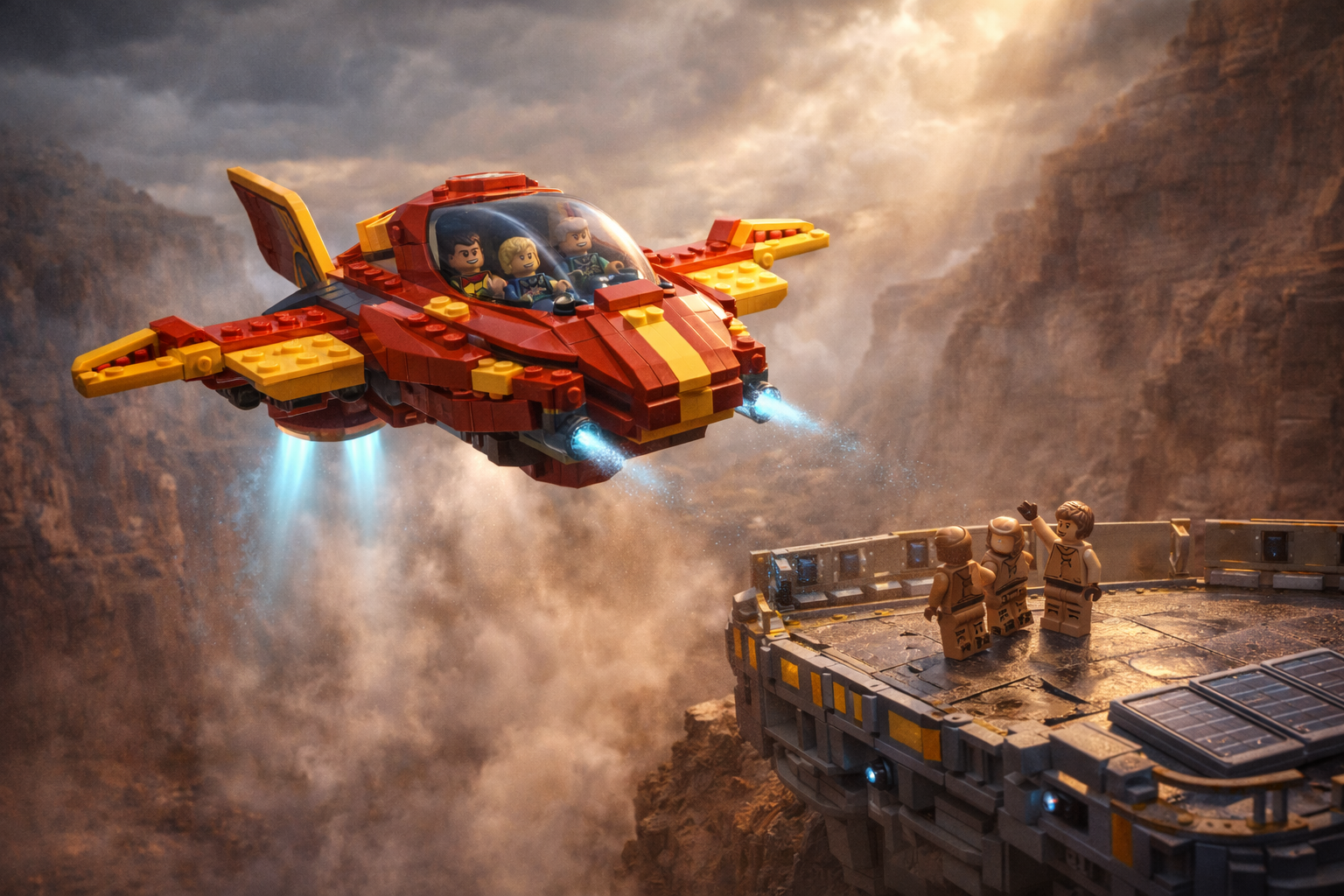
Brick-built rescue ship lifts off from a canyon outpost as young minifigure pilots help stranded researchers escape an incoming storm.

The ship had a habit of gleaming even when the sky didn’t.

As it skimmed low over the canyon walls, its red hull caught what little sunlight filtered through the clouds and scattered it outward, turning gray air into something warmer. The effect wasn’t accidental. Whoever had painted the ship had believed—very firmly—that if you flew into trouble, you should bring a little color with you.

Inside the cockpit, three voices talked at once.

“Altitude steady,” said Tavi, hands tight on the controls, eyes locked forward.
“Wind shear’s picking up on the left,” called Jun from the sensor seat.
“And the beacon is definitely down there,” added Koro, leaning too far toward the forward viewport and pointing at nothing specific.

Tavi didn’t look away from the canyon. “I know it’s down there. That’s why we’re here.”

The canyon opened beneath them like a long, twisting scar across the planet’s surface—layers of orange and rust-colored stone carved by storms older than any map. Somewhere near the bottom, a research outpost had gone silent during a routine survey flight. No distress call. No explosion. Just quiet.

Quiet was worse.

“Remember,” Jun said, adjusting the scanner. “We’re not here to be heroes. We’re here to help.”

Koro grinned. “Helping is heroic.”

Jun rolled her eyes, but she smiled too.

The ship dipped lower, engines humming in a steady, confident rhythm. It wasn’t a warship. It wasn’t fast in a straight line. But it handled turns like it was born in places exactly like this.

The canyon narrowed.

“Hold on,” Tavi said.

They dropped.

The outpost clung to the canyon wall like it had grown there—metal platforms bolted into stone, solar panels folded inward, lights dim but still active. A small transport lay half-tipped on a landing pad, one stabilizer snapped clean through.

Jun leaned closer to the scanner. “Life signs. Three. Faint, but steady.”

Relief swept through the cockpit.

“See?” Koro said. “Quiet isn’t always bad.”

“Quiet is still quiet,” Tavi replied, angling the ship toward the pad. “Let’s keep it that way.”

The wind surged as they approached, slamming into the canyon walls and rebounding unpredictably. The ship shuddered once, then corrected itself.

“Manual landing?” Jun asked.

Tavi nodded. “Manual landing.”

Koro fastened his harness tighter. “I like it better when you say that confidently.”

“I always say it confidently.”

“That’s what worries me.”

The ship touched down with a soft jolt, landing gear flexing but holding. Dust billowed up around them, swirling like fog before settling back into the canyon’s depths.

For a moment, nothing happened.

Then a hatch on the outpost slid open.

A figure waved both arms wildly.

They didn’t rush out.

That was the first lesson their mentor had drilled into them: moving fast is not the same as moving smart.

Tavi powered down the engines and sealed the ship. Jun ran another scan. Koro checked the emergency kits twice, then checked them again just to be sure.

When they stepped onto the platform, the wind tugged at their jackets and tried to steal their words.

“You came,” said the outpost lead, voice cracking with relief. “We thought—well, we hoped someone would notice.”

“We noticed,” Jun said gently.

The situation became clear quickly. A sudden electrical surge—caused by a rare mineral reaction in the canyon walls—had knocked out the outpost’s long-range comms and crippled the transport. Repairs were possible, but not before nightfall.

And nightfall, down here, meant storms.

“Can you fly us out?” one of the researchers asked, eyes darting to the clouds already thickening above.

Tavi glanced back at the ship.

It could carry them. Barely.

“We can,” she said. “But it’s going to be tight.”

Koro’s grin returned. “Tight is still possible.”

Jun met Tavi’s eyes. A silent question passed between them.

Tavi nodded.

“Let’s load up,” she said. “Before the canyon decides otherwise.”

They were halfway through boarding when the wind changed.

Not stronger.

Different.

The ship rocked, landing gear screeching as a gust slammed into the platform from below. Warning lights flickered inside the cockpit.

Jun shouted over the wind, “Storm front just accelerated! We’ve got minutes—maybe less!”

The researchers scrambled aboard, fear sharp but controlled. Tavi sealed the hatch and sprinted for the pilot’s seat.

The ship lifted unevenly, engines straining as crosswinds clawed at its sides.

“Stabilizers aren’t happy,” Koro reported, gripping the console. “They’re arguing with gravity.”

Tavi adjusted the controls, jaw set. “Then tell them gravity doesn’t get a vote today.”

They rose just above the platform when a violent downdraft slammed them sideways.

The canyon wall rushed up in the viewport.

Jun gasped. “Tavi—!”

“I see it!”

Tavi pulled hard, cutting thrust at the last second and rolling the ship sideways instead of up. The move was risky—counterintuitive—but it worked. The ship slid past the rock face with meters to spare, hull scraping just enough to remind them how close they’d come.

Silence filled the cockpit for half a breath.

Then Koro let out a shaky laugh. “That was… educational.”

Jun exhaled slowly. “Let’s not learn that again.”

They climbed.

The canyon widened, winds smoothing out as they broke through the storm’s upper edge. Sunlight caught the ship’s hull again, turning red into gold.

Behind them, the canyon vanished into cloud.

Inside the cabin, the rescued researchers sat strapped in, eyes wide but smiling.

“You didn’t panic,” one of them said. “You worked together.”

Tavi glanced at Jun and Koro, then back to the controls. “That’s how we fly.”

Koro leaned back in his seat, finally relaxing. “Also, the ship helps.”

Jun laughed. “Don’t let it hear you say that.”

The ship leveled out, engines settling into a calm, steady hum.

Below them, the storm raged on—but it couldn’t reach them anymore.

As the horizon opened ahead, Tavi felt something warm settle in her chest—not pride, exactly. Something quieter.

Confidence.

They hadn’t won a battle. They hadn’t saved the world.

They’d done something better.

They’d shown up.

This is an original work of fiction created by Brick Crossing, inspired by the design themes of LEGO® set 75384.
LEGO® is a trademark of the LEGO Group, which does not sponsor, authorize, or endorse Brick Crossing or this content.