Posted on

The Machine That Wouldn’t Stay Hidden

Brick-built speeder carrying two minifigures races across an icy scrapyard as enemy vehicles appear in the distance.

The scrapyard sat where the ice forgot to move.

Beyond it, the frozen sheet stretched flat and endless, pale as bone beneath a low, colorless sky. Behind it, jagged hills broke the wind just enough for wreckage to collect—frames, hull plates, engines stripped of purpose and half-buried where storms had dropped them and never come back.

Time didn’t visit often here. When it did, it came slowly.

That’s why we worked there.

The speeder rested on a patch of cleared ice between two skeletal transport frames, its mismatched body catching the light in uneven flashes. Nothing about it matched anything else. The front was sharp and narrow, scavenged from something built for speed. The stabilizers were wider, older, their edges scarred and patched. Power lines ran where they shouldn’t, reinforced by hand-cut brackets and stubborn hope.

Kess lay on their back beneath the engine housing, hands deep in the machine, breath fogging the air. Every few seconds, they tapped twice on the hull.

“Again,” Kess said.

Rin flipped the switch.

The engine coughed, whined, then surged—clean this time, strong enough to send a vibration through the ice. Snow skittered away from the runners in little bursts.

Kess grinned from under the machine. “Told you it’d hold.”

“Hold doesn’t mean fly,” Rin said.

Kess slid out, sat up, and wiped their gloves on their jacket. “It will.”

They’d been building it for weeks, pulling parts from wrecks no one remembered the names of. Old patrol craft. Cargo sleds. A racer that had clearly lost a fight with a mountain. Kess remembered where every piece came from. Not because they wrote it down—but because they listened to machines the way some people listened to stories.

This one wanted to move.

The others knew it too. You could feel it in the way the speeder leaned forward slightly even at rest, like it was impatient with being still.

“We shouldn’t test it today,” Vale said, scanning the horizon. “Weather’s wrong.”

The sky was clear, but the wind had a sharper edge to it. The kind that carried sound farther than it should.

Kess stood and looked out across the ice sheet. Nothing moved. No tracks. No shadows. Just the quiet that came when the world thought it was alone.

“That’s why we do it today,” Kess said. “Before anyone remembers this place exists.”

Rin hesitated, then nodded. “Short run.”

They didn’t know how far “short” would last.

Kess climbed into the cockpit, settling into the seat like it had been shaped around them. Controls lit up unevenly—some new, some ancient, some repurposed from systems that had never meant to work together. Kess ran a hand across them once, almost gently.

“Keep eyes on the ridge,” they said.

The engine rose to a clean, eager hum.

The speeder lifted.

Not smoothly—never smoothly—but decisively, runners clearing the ice as the machine surged forward. Kess angled it out across the sheet, acceleration stacking fast, the wind tearing sound away behind them.

For the first few seconds, it was perfect.

The ice blurred. The speeder responded like it understood intent, banking when Kess leaned, correcting before commands finished forming. The patched stabilizers held. The engine sang.

Kess laughed into the wind.

Then the ice ahead fractured—not physically, but visually—as movement cut across it.

Dark shapes crested the far ridge, kicking up plumes of snow. Not wreckage. Not wildlife.

Vehicles.

Too clean. Too organized.

Rin’s voice cracked through the comm. “Kess—pull up. Now.”

Kess pulled.

A streak of light cut through the air where the speeder had been a second before, burning a line into the ice. Another followed. Then another.

They were being fired on.

Kess rolled the speeder hard, diving low, skimming so close to the surface that ice shards rattled against the hull. The machine screamed in protest, then adapted, power redistributing through pathways Kess had hoped would never be tested this way.

The shapes behind them fanned out.

An enemy force—not named, not announced—just present, deliberate, and very real.

Vale shouted something over the channel, but it was lost under the rising roar of pursuit.

Kess didn’t think.

They flew.

The speeder cut sideways between two ice ridges barely wide enough to pass through. Fire scorched the walls behind them. Kess dumped power to the rear stabilizers, then surged forward again, the machine responding like it was alive—unbalanced, dangerous, brilliant.

“Left!” Rin yelled.

Kess was already there.

They skimmed low, then climbed hard, pulling into a steep arc that sent the speeder flipping end over end before leveling out again. The engine howled. Warning lights flashed. Kess ignored them all.

A shot grazed the stabilizer. The speeder shuddered.

“Hold together,” Kess muttered. “Just a little longer.”

Ahead, the ice sheet opened into nothing—flat, exposed, deadly.

Behind them, the enemy closed in.

Then the sky changed.

A distant rumble rolled across the ice, deeper than engines, layered and heavy. Shapes appeared high above—larger craft, moving fast, their silhouettes unmistakably coordinated.

Reinforcements.

The enemy force hesitated.

That was all Kess needed.

They cut power sharply, dropping low and sliding across the ice, then punched the engine again at an angle no one sensible would choose. The speeder veered, then surged forward, threading a line through chaos and light as the sky erupted behind them.

Explosions bloomed—controlled, precise. The enemy scattered.

Kess didn’t look back.

They pushed the speeder until the world narrowed to speed and control and the thin line of survival carved by instinct and skill. The machine held—not because it was perfect, but because it was understood.

The scrapyard came back into view like a memory snapping into place.

Kess brought the speeder down hard, skidding across ice and debris, finally sliding to a stop between the wrecks where it belonged.

Silence fell in waves.

Rin and Vale were already running toward them when the cockpit opened. Kess climbed out, hands shaking now that the danger had passed, breath coming fast and bright.

“That wasn’t a test run,” Vale said.

“No,” Kess replied. “It wasn’t.”

Footsteps followed—heavier, measured.

Figures emerged from the edge of the yard, their presence calm and unmistakable. Not enemies. Not quite allies yet. They looked at the speeder first, then at Kess.

One of them nodded slowly.

“You built that?” they asked.

Kess swallowed. “Yes.”

“And you flew it like that,” the figure continued, “under pressure.”

Kess nodded again.

The figure glanced back toward the sky, where distant lights still moved, holding the line. “You’re young,” they said. “You’re not supposed to be ready.”

They looked back at Kess.

“But you are.”

The wind swept across the scrapyard, carrying snow and the distant echo of engines fading into patrol patterns.

Kess looked at the speeder—patched, imperfect, brilliant.

They looked at their friends.

Then they looked back at the figures waiting at the edge of the forgotten place.

The ice sheet stretched on, unchanged.

But the quiet was gone.

And Kess stepped forward, leaving the scrapyard behind.

This is an original work of fiction created by Brick Crossing, inspired by the design themes of LEGO® set 75414.
LEGO® is a trademark of the LEGO Group, which does not sponsor, authorize, or endorse Brick Crossing.
Posted on

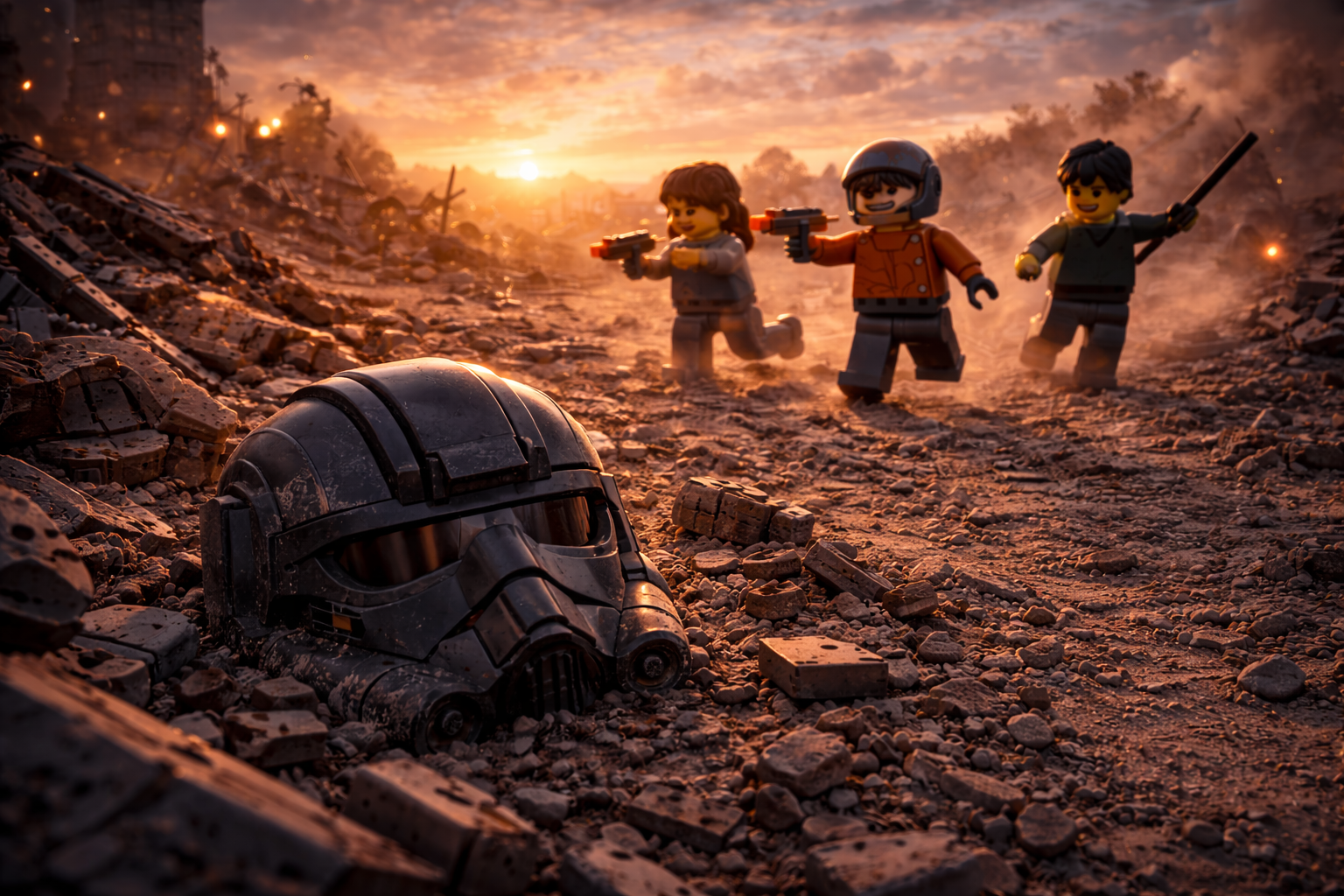
The Helmet That Chose a Side

Brick-built black and gray helmet half-buried in rubble as minifigure children play nearby in a ruined field.

The game begins the same way every time: with Toma yelling, “Incoming!” and the rest of us dropping behind whatever the world offers as cover.

Today it’s a rib of twisted metal half-buried in ash-gray dirt. Yesterday it was a broken cart in the orchard. Tomorrow it’ll be a stone wall, or a ditch, or the shadow of the water tower. We don’t need a real battlefield to make one—just space, just breath, just the way our hearts speed up when we decide the air is dangerous.

Except this time, the air is different.

The old field beyond the village isn’t really a field anymore. It’s a place people avoid, where the soil looks scorched in patches and the grass grows in strange, stubborn lines. Everyone calls it “the burn,” like naming it makes it smaller.

We came anyway, because we were bored, and because we were brave in the careless way you can be when you haven’t lived long enough to understand what bravery costs.

And because we found something.

“Hold the line!” Sera shouts, her voice cracking a little with excitement. She’s crouched behind a chunk of concrete, using a stick as her “signal wand,” the way she saw the transit officers do during last year’s festival. “No one crosses the ridge!”

Jax—who isn’t actually named Jax but insisted we call him that during games because it “sounds like a pilot”—leans over the metal rib and squints into the smoke-colored distance like he’s seeing enemies between the trees. “I see movement,” he says. “Two… maybe three.”

“There’s nothing there,” I whisper.

He doesn’t look at me. “That’s what they want you to think.”

Theo, the smallest of us, is pressed flat against the ground, cheeks dusty, hands planted like he’s bracing for an explosion that hasn’t happened yet. “Do the stompers come now?” he asks, eyes wide, half terrified, half thrilled.

Toma makes the sound effects because Toma always does. He rumbles his throat low and drags a rock across another rock to make it feel like something huge is shifting out there. “They’re close,” he says in a voice that isn’t quite his. “You can feel it.”

We can feel something, actually—faint vibrations, a weird buzz that sometimes seems to come up through the soles of our shoes. Sera says it’s just wind through hollow metal. Toma says it’s the ground remembering.

I don’t know what I think. I just know the burn feels like it’s holding a story in its ribs, and we keep poking it like it might answer.

Jax lifts a hand to his head, as if he’s adjusting a visor. Except he isn’t.

Because the visor is real.

The helmet sits on the broken slab beside him, catching the last sunlight in dull, curved surfaces. It’s heavier than it looks—he proved that earlier by nearly dropping it on his foot and swearing so hard Sera threatened to tell his mother. The front is smooth, the faceplate dark, the lines clean in a way that doesn’t match the messy ruin around it. A piece of a world that wasn’t ours, left behind like someone forgot it mattered.

We found it under a sheet of bent metal, wrapped in ash and silence. Toma had dug it out with his hands like he was unearthing treasure. Theo had reached out and then pulled back as if it might bite.

Sera didn’t touch it at first. She stared at it like it was a question.

Then she said, “It’s a pilot helmet.”

Jax said, “It’s my pilot helmet.”

And that was that.

Now it sits between us and the sky, a silent referee of our pretend war.

“Alright,” Sera says, slapping her stick against the concrete like it’s a clipboard. “We’re pinned. We need a runner.”

Everyone looks at me.

I didn’t volunteer, but nobody ever does. The runner is the one who has to cross open ground, the one who has to risk being “tagged” by imaginary fire. The runner is the one who gets remembered in the retelling.

“You’re fastest,” Toma says, like it’s a compliment and not a sentence.

“I’m not—” I start.

Jax puts on the helmet.

The sound of it settling over his head changes everything. It isn’t loud. Just a soft thunk, a finality, like a door closing. He lifts his chin, and the dark faceplate reflects the burn field in a warped curve.

He becomes someone else.

“Runner,” he says, voice deeper because he thinks the helmet deserves a deeper voice. “On my mark.”

Theo’s eyes go even wider. “He looks real,” he whispers.

“He’s still Jax,” I whisper back.

But I’m not sure it’s true, not in the way we usually mean it.

Sera points her stick toward the far side of the field where the ruin thickens into a line of broken beams and half-sunk panels. “Your target is the tower,” she says. “You plant the signal, and we push forward.”

“The tower is fake,” I say.

Sera’s expression is serious enough to make my stomach tighten anyway. “Everything is fake,” she replies. “That’s the point.”

Toma makes another rumble sound. “They’re moving,” he says.

Jax turns his helmeted head slowly, as if tracking something tall and unseen. Then he raises a hand. “Now.”

I run.

The burn field rushes up under my feet—grit, ash, scattered pebbles that shift under every step. The air tastes metallic. Wind snaps at my sleeves. I can hear the others behind me, shouting instructions and threats and warnings like they’re reading from a script only kids can see.

“Incoming!” Toma yells.

“Down!” Sera shouts.

“Too late!” Jax adds, and makes a sharp sound like a laser blast with his mouth.

I throw myself into a slide behind a broken panel and grit scrapes my palms. I laugh—just a little—because sliding is fun and because I didn’t get “hit.”

Then the ground really vibrates.

Not the soft imagined kind. A clear, unmistakable shudder that ripples through the metal around me. A loose bolt rolls and clicks against the panel. Dust lifts off the ground in a thin puff.

I freeze.

So does everyone else. Even Toma stops making sounds.

For a second, the burn field is quiet enough that I hear a bird call from somewhere far away. A normal sound, like the world is trying to remind us it still exists.

“What was that?” Theo says, voice small.

Sera doesn’t answer. She’s staring at the helmet.

Jax—helmet still on—slowly turns his head toward the deeper ruins beyond our play zone. His shoulders square, the way they do when the game gets serious.

“Maybe it’s them,” he says softly.

“That’s dumb,” Toma says, but he doesn’t sound convinced.

Another vibration comes, lighter this time, as if something shifted far away and the earth politely informed us.

Sera steps forward, stick lowered. “Okay,” she says, trying to keep her voice steady. “New rule.”

We all look at her.

“No going past the beam line,” she says, pointing to the jagged skeleton of a fallen frame farther into the burn. “That’s the edge of the map.”

“We always—” Toma begins.

“No,” Sera cuts in. “Not today.”

For a moment, none of us argue. We just listen to the wind moving through the hollow metal, making it sing in long, low notes. It doesn’t sound like a warning exactly.

It sounds like a memory.

Jax walks toward the edge of the map anyway.

Not far. Just a few steps, slow and deliberate, helmet reflecting the burnt field and the orange sky. The faceplate makes him unreadable, which is unfair, because it means we can’t tell if he’s scared.

“Jax,” I call from behind the panel. “Don’t.”

He stops.

In the fading light, the helmet looks less like a toy and more like a relic. Like it belongs to a person who wasn’t playing.

Jax reaches up and lifts it off.

His hair is flattened. His cheeks are dusty. He looks like himself again—almost.

“It smells like smoke inside,” he says quietly, like he’s surprised.

Theo takes a step closer. “Can I—”

“No,” Sera says immediately, then softens. “Not yet.”

Toma, who hates seriousness, clears his throat and forces the game back into place. “Okay,” he says loudly. “The stompers are retreating! We won!”

“We didn’t win,” I say before I can stop myself.

They all look at me.

I point toward the beam line, toward the deeper ruin where the vibrations came from, where the air seems to hold its breath. “We just… stopped.”

Sera’s eyes narrow, thoughtful. “Sometimes,” she says, “stopping is winning.”

That sounds like something a grown-up would say. It makes all of us uncomfortable.

Jax sets the helmet on the concrete again, carefully this time. Like it’s fragile. Like it’s listening.

Then he raises a hand in a sloppy salute. “Pilot’s grounded,” he declares, trying to brighten it.

Theo laughs, relieved.

Toma makes a triumphant rumble noise.

And the game tries to restart.

But the burn field doesn’t feel like it’s letting us go.

Sera points her stick toward the beam line again, voice back in command mode. “New mission,” she says. “We retreat to the village. We tell no one. We come back tomorrow.”

“Tomorrow,” Toma repeats, a little too quickly.

Jax picks up the helmet.

He doesn’t put it on this time. He cradles it against his chest like a secret you can carry.

As we start walking back, the streetlights of the village blink on one by one in the distance. Warm. Normal. Safe.

Behind us, the burn field hums again—so faint we could pretend it’s wind.

But the helmet in Jax’s arms feels heavier with every step.

And none of us says what we’re all thinking:

Tomorrow, the game might not stay a game.

This is an original work of fiction created by Brick Crossing, inspired by the design themes of LEGO® set 75429.
LEGO® is a trademark of the LEGO Group, which does not sponsor, authorize, or endorse Brick Crossing.