Posted on

The Machine That Wouldn’t Stay Hidden

Brick-built speeder carrying two minifigures races across an icy scrapyard as enemy vehicles appear in the distance.

The scrapyard sat where the ice forgot to move.

Beyond it, the frozen sheet stretched flat and endless, pale as bone beneath a low, colorless sky. Behind it, jagged hills broke the wind just enough for wreckage to collect—frames, hull plates, engines stripped of purpose and half-buried where storms had dropped them and never come back.

Time didn’t visit often here. When it did, it came slowly.

That’s why we worked there.

The speeder rested on a patch of cleared ice between two skeletal transport frames, its mismatched body catching the light in uneven flashes. Nothing about it matched anything else. The front was sharp and narrow, scavenged from something built for speed. The stabilizers were wider, older, their edges scarred and patched. Power lines ran where they shouldn’t, reinforced by hand-cut brackets and stubborn hope.

Kess lay on their back beneath the engine housing, hands deep in the machine, breath fogging the air. Every few seconds, they tapped twice on the hull.

“Again,” Kess said.

Rin flipped the switch.

The engine coughed, whined, then surged—clean this time, strong enough to send a vibration through the ice. Snow skittered away from the runners in little bursts.

Kess grinned from under the machine. “Told you it’d hold.”

“Hold doesn’t mean fly,” Rin said.

Kess slid out, sat up, and wiped their gloves on their jacket. “It will.”

They’d been building it for weeks, pulling parts from wrecks no one remembered the names of. Old patrol craft. Cargo sleds. A racer that had clearly lost a fight with a mountain. Kess remembered where every piece came from. Not because they wrote it down—but because they listened to machines the way some people listened to stories.

This one wanted to move.

The others knew it too. You could feel it in the way the speeder leaned forward slightly even at rest, like it was impatient with being still.

“We shouldn’t test it today,” Vale said, scanning the horizon. “Weather’s wrong.”

The sky was clear, but the wind had a sharper edge to it. The kind that carried sound farther than it should.

Kess stood and looked out across the ice sheet. Nothing moved. No tracks. No shadows. Just the quiet that came when the world thought it was alone.

“That’s why we do it today,” Kess said. “Before anyone remembers this place exists.”

Rin hesitated, then nodded. “Short run.”

They didn’t know how far “short” would last.

Kess climbed into the cockpit, settling into the seat like it had been shaped around them. Controls lit up unevenly—some new, some ancient, some repurposed from systems that had never meant to work together. Kess ran a hand across them once, almost gently.

“Keep eyes on the ridge,” they said.

The engine rose to a clean, eager hum.

The speeder lifted.

Not smoothly—never smoothly—but decisively, runners clearing the ice as the machine surged forward. Kess angled it out across the sheet, acceleration stacking fast, the wind tearing sound away behind them.

For the first few seconds, it was perfect.

The ice blurred. The speeder responded like it understood intent, banking when Kess leaned, correcting before commands finished forming. The patched stabilizers held. The engine sang.

Kess laughed into the wind.

Then the ice ahead fractured—not physically, but visually—as movement cut across it.

Dark shapes crested the far ridge, kicking up plumes of snow. Not wreckage. Not wildlife.

Vehicles.

Too clean. Too organized.

Rin’s voice cracked through the comm. “Kess—pull up. Now.”

Kess pulled.

A streak of light cut through the air where the speeder had been a second before, burning a line into the ice. Another followed. Then another.

They were being fired on.

Kess rolled the speeder hard, diving low, skimming so close to the surface that ice shards rattled against the hull. The machine screamed in protest, then adapted, power redistributing through pathways Kess had hoped would never be tested this way.

The shapes behind them fanned out.

An enemy force—not named, not announced—just present, deliberate, and very real.

Vale shouted something over the channel, but it was lost under the rising roar of pursuit.

Kess didn’t think.

They flew.

The speeder cut sideways between two ice ridges barely wide enough to pass through. Fire scorched the walls behind them. Kess dumped power to the rear stabilizers, then surged forward again, the machine responding like it was alive—unbalanced, dangerous, brilliant.

“Left!” Rin yelled.

Kess was already there.

They skimmed low, then climbed hard, pulling into a steep arc that sent the speeder flipping end over end before leveling out again. The engine howled. Warning lights flashed. Kess ignored them all.

A shot grazed the stabilizer. The speeder shuddered.

“Hold together,” Kess muttered. “Just a little longer.”

Ahead, the ice sheet opened into nothing—flat, exposed, deadly.

Behind them, the enemy closed in.

Then the sky changed.

A distant rumble rolled across the ice, deeper than engines, layered and heavy. Shapes appeared high above—larger craft, moving fast, their silhouettes unmistakably coordinated.

Reinforcements.

The enemy force hesitated.

That was all Kess needed.

They cut power sharply, dropping low and sliding across the ice, then punched the engine again at an angle no one sensible would choose. The speeder veered, then surged forward, threading a line through chaos and light as the sky erupted behind them.

Explosions bloomed—controlled, precise. The enemy scattered.

Kess didn’t look back.

They pushed the speeder until the world narrowed to speed and control and the thin line of survival carved by instinct and skill. The machine held—not because it was perfect, but because it was understood.

The scrapyard came back into view like a memory snapping into place.

Kess brought the speeder down hard, skidding across ice and debris, finally sliding to a stop between the wrecks where it belonged.

Silence fell in waves.

Rin and Vale were already running toward them when the cockpit opened. Kess climbed out, hands shaking now that the danger had passed, breath coming fast and bright.

“That wasn’t a test run,” Vale said.

“No,” Kess replied. “It wasn’t.”

Footsteps followed—heavier, measured.

Figures emerged from the edge of the yard, their presence calm and unmistakable. Not enemies. Not quite allies yet. They looked at the speeder first, then at Kess.

One of them nodded slowly.

“You built that?” they asked.

Kess swallowed. “Yes.”

“And you flew it like that,” the figure continued, “under pressure.”

Kess nodded again.

The figure glanced back toward the sky, where distant lights still moved, holding the line. “You’re young,” they said. “You’re not supposed to be ready.”

They looked back at Kess.

“But you are.”

The wind swept across the scrapyard, carrying snow and the distant echo of engines fading into patrol patterns.

Kess looked at the speeder—patched, imperfect, brilliant.

They looked at their friends.

Then they looked back at the figures waiting at the edge of the forgotten place.

The ice sheet stretched on, unchanged.

But the quiet was gone.

And Kess stepped forward, leaving the scrapyard behind.

This is an original work of fiction created by Brick Crossing, inspired by the design themes of LEGO® set 75414.
LEGO® is a trademark of the LEGO Group, which does not sponsor, authorize, or endorse Brick Crossing.
Posted on

76908 – Pink Slips at Midnight

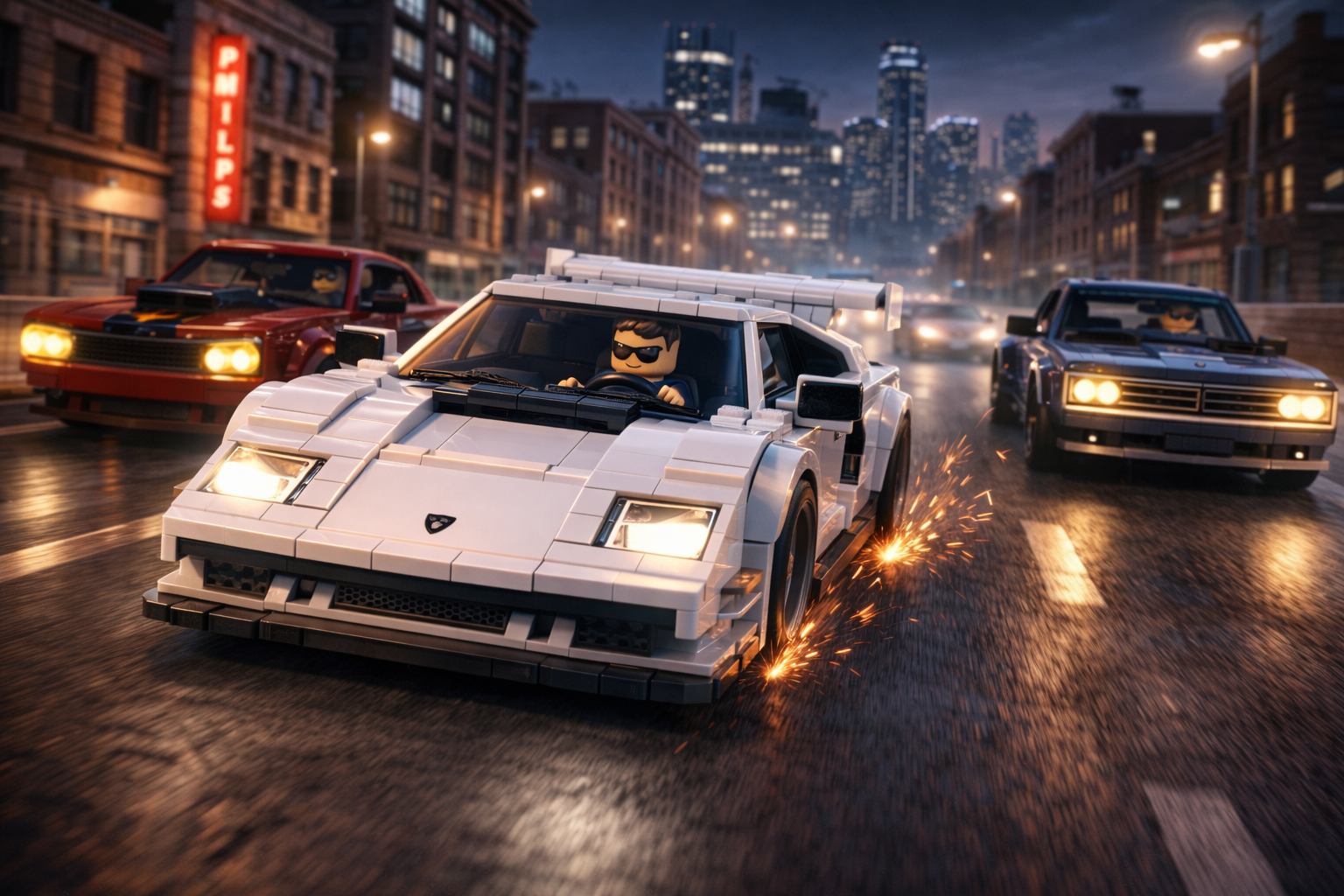
White brick-built Lamborghini Countach races through downtown streets at night alongside muscle cars, driven by a minifigure.

Detroit didn’t sleep—it waited.

Streetlights hummed above empty lanes, casting long reflections across rain-dark pavement. Old brick buildings rose like silent witnesses, their windows black, their murals half-lit and watching. Somewhere in the distance, a train horn echoed low and lonely, threading through the city like a warning.

At the edge of an abandoned plaza, cars gathered.

Most were loud even at rest—wide American muscle machines crouched low on fat tires, engines rumbling impatiently, paint glowing in deep reds, blues, and blacks. They looked heavy. Powerful. Built to win through force.

Then there was the white car.

It sat slightly apart from the others, sharp-edged and unmistakable, its shape all angles and confidence. Clean. Low. Almost unreal under the streetlights, like it didn’t belong to this city at all.

Inside, the driver rested both hands on the wheel and stared straight ahead.

Tonight wasn’t about money.

Tonight was about slips.

The driver stepped out, door swinging upward, and the conversations nearby dipped just enough to notice. He wasn’t from Detroit. Everyone could tell. His jacket was clean. His car even cleaner.

A man with a thick jacket and a scarred grin approached, holding a stack of folded papers.

“Winner keeps driving,” he said. “Loser walks.”

No one laughed.

One by one, drivers pulled documents from pockets and glove boxes. Titles. Ownership papers. Futures, folded thin enough to fit in a hand.

The white car’s driver hesitated for half a second—just long enough to feel it—then added his slip to the pile.

The papers were sealed in an envelope and handed off to someone no one argued with.

Engines fired.

The muscle cars thundered awake, their sound filling the plaza, shaking windows and nerves alike. The white car answered differently—higher, sharper, slicing clean through the noise instead of adding to it.

The race route wasn’t marked.

Everyone knew it anyway.

Down Jefferson. Past the river. Through the warehouse district. A hard left under the old overpass. Finish somewhere only the lead car would recognize.

The starter raised one hand.

Dropped it.

Tires screamed.

The pack launched forward, metal surging into motion as the city rushed up to meet them. The white car slipped between two muscle cars instantly, its acceleration clean and effortless, engine singing where the others roared.

Detroit blurred.

Streetlights streaked overhead. Painted lines vanished beneath spinning wheels. The road tightened, narrowed, challenged. The muscle cars fought the turns, weight shifting hard as they muscled through corners with brute strength.

The white car danced.

It cut clean lines through intersections, braking late, accelerating early, trusting precision over power. A red muscle car surged beside it on a straight, engine bellowing, forcing the white car toward the curb.

The driver didn’t flinch.

He waited.

At the next corner, he turned in smoothly, letting the heavier car overshoot. Tires chirped. Sparks flew as metal scraped concrete. The white car slipped through untouched.

Warehouse walls rose on both sides now, close enough to feel. Shadows swallowed headlights. The sound of engines echoed wildly, making distance impossible to judge.

A blue muscle car took the lead.

For now.

The white car tucked in behind it, close enough to read the reflection of its own headlights off the other car’s bumper. Wind tore across the windshield. The driver’s focus narrowed until there was nothing else—no city, no crowd, no consequences.

Just the line.

The overpass loomed ahead, massive and dark, concrete pillars flashing past like a countdown. The road split beyond it—two possible routes, only one correct.

The blue muscle car swerved left.

The driver of the white car smiled.

He dropped a gear and surged forward, engine screaming as he pulled alongside, the city exploding into motion around them.

Headlights vanished into the darkness beyond the overpass.

And somewhere behind them, an envelope waited to decide who would still have a car when the night ended.

This is an original work of fiction created by Brick Crossing, inspired by the design themes of LEGO® set 76908.
LEGO® is a trademark of the LEGO Group, which does not sponsor, authorize, or endorse Brick Crossing.
Posted on

76924 – The Road That Keeps Its Secrets

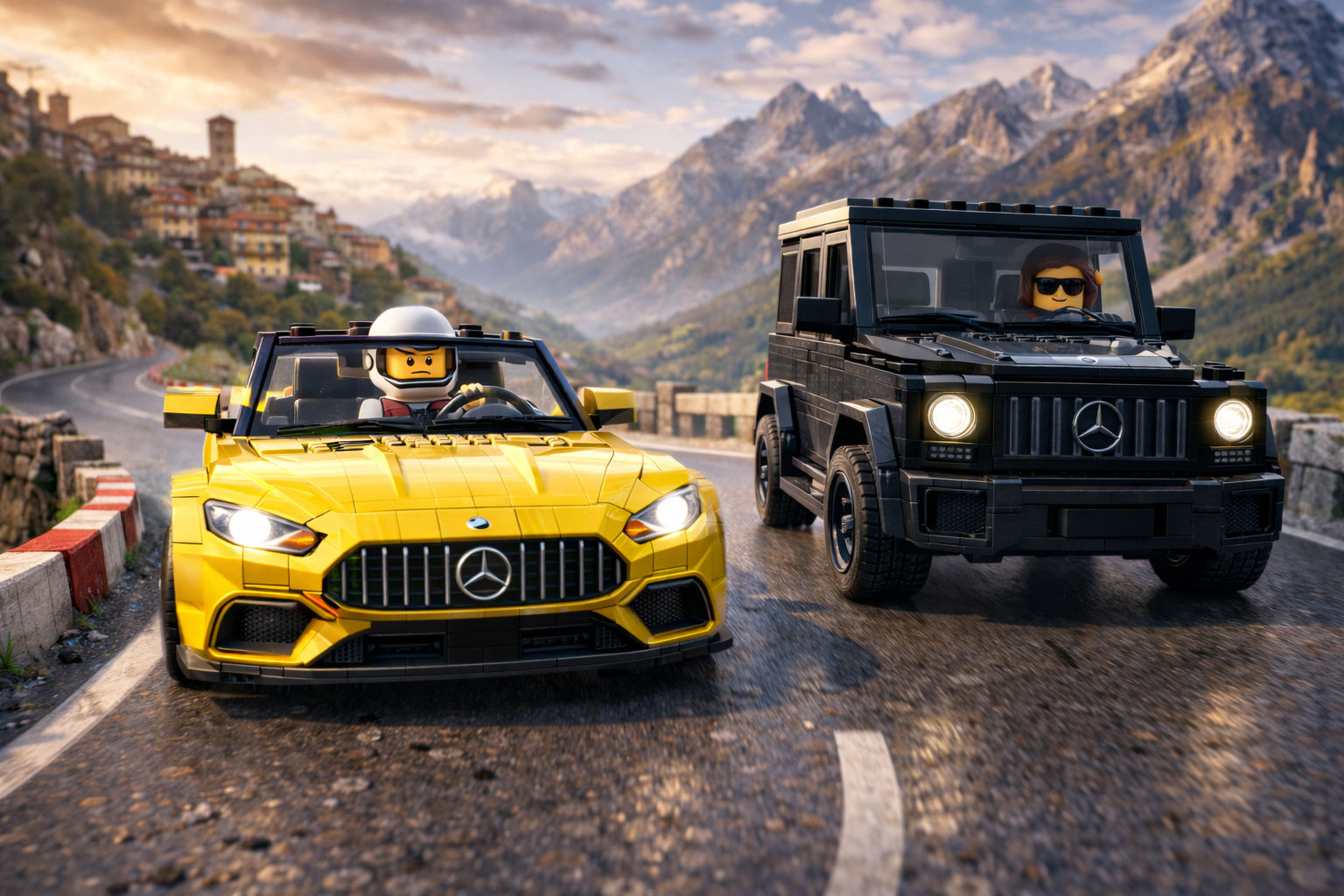
Yellow brick-built convertible race car and black brick-built SUV driven by minifigures on an Italian mountain road.

The mountain road rose out of the village like a dare.

It twisted upward through stone and shadow, cutting across cliffs where the drop vanished into mist. Old buildings clustered far below, their tiled roofs glowing softly in the early light. The road above them was narrow, unforgiving—lined with guardrails, rock walls, and nothing else.

At the start line, a low silver convertible waited, engine humming with barely contained energy. Its shape was tight and sharp, built to attack corners and vanish into the next turn before anyone could blink.

Behind the barriers stood its driver, helmet tucked under one arm, eyes fixed on the climb ahead. This was Luca’s race. He knew every bend, every shift point, every place the mountain tried to trick you.

A short distance away, parked near the team trucks, stood a very different machine.

Tall. Black. Solid.

Beside it leaned Sofia, arms crossed, sunglasses catching the light. She wasn’t racing today. She was watching. Waiting. The SUV behind her looked ready for anything the mountain could throw at it—and everything that came after.

Luca climbed into the racer and pulled the harness tight. The engine answered instantly, sharp and eager, echoing off the stone walls like a challenge shouted into the valley.

The crowd pressed closer. Flags waved. Someone counted down with raised fingers.

The lights changed.

The racer launched forward, tires biting hard as the road narrowed almost immediately. The first corner came fast—blind and uphill. Luca turned in without hesitation, trusting memory and instinct more than sight.

The mountain demanded precision.

Left. Right. Brake. Accelerate.

Stone walls flashed past inches from the wheels. The open cockpit filled with wind and sound, the engine’s note bouncing back from the cliffs. This wasn’t about straight-line speed. It was about choosing the perfect line and never letting go.

Higher up, the air cooled. Shadows stretched across the road. The racer surged out of corners, engine singing, every movement sharp and deliberate.

Below, Sofia watched the timing screens flicker. She followed Luca’s progress corner by corner, her expression calm but focused. She knew this mountain too—just in a different way.

She knew where the road went after the race ended.

The racer burst into view near the summit and crossed the finish line in a flash of silver and sound. The crowd erupted, cheers rolling down the mountain like thunder.

Luca eased off the throttle, heart still racing, hands buzzing with leftover energy. He guided the car down a narrow service road toward the paddock, brakes ticking as they cooled.

That’s when he saw it.

The black SUV waited near a stone wall overlooking the valley, engine off, stance confident. Sofia stood beside it now, helmetless, smiling as the racer rolled in.

“Still standing,” she said.

“Barely,” Luca replied, climbing out of the cockpit.

The mountain stretched behind them, silent again, as if nothing had happened. Luca pulled off his gloves and looked back up the road he’d just conquered. Speed had ruled up there—but only for a while.

He walked toward the SUV.

Sofia handed him a bottle of water, then climbed into the passenger seat. Luca took the driver’s side. The door closed with a solid, reassuring sound—nothing like the light snap of the racer.

The engine started low and steady.

Different kind of power.

The SUV rolled away from the paddock and into the village streets below. Stone buildings slipped past. The road widened. The mountain loosened its grip.

Ahead lay winding roads, fading sunlight, and the long drive home.

Luca adjusted the steering with ease. Sofia leaned back, watching the cliffs slide by.

The race was over.

The road, however, was just beginning.

This is an original work of fiction created by Brick Crossing, inspired by the design themes of LEGO® set 76924.
LEGO® is a trademark of the LEGO Group, which does not sponsor, authorize, or endorse Brick Crossing.

Posted on

76925 – When the Lights Take Over

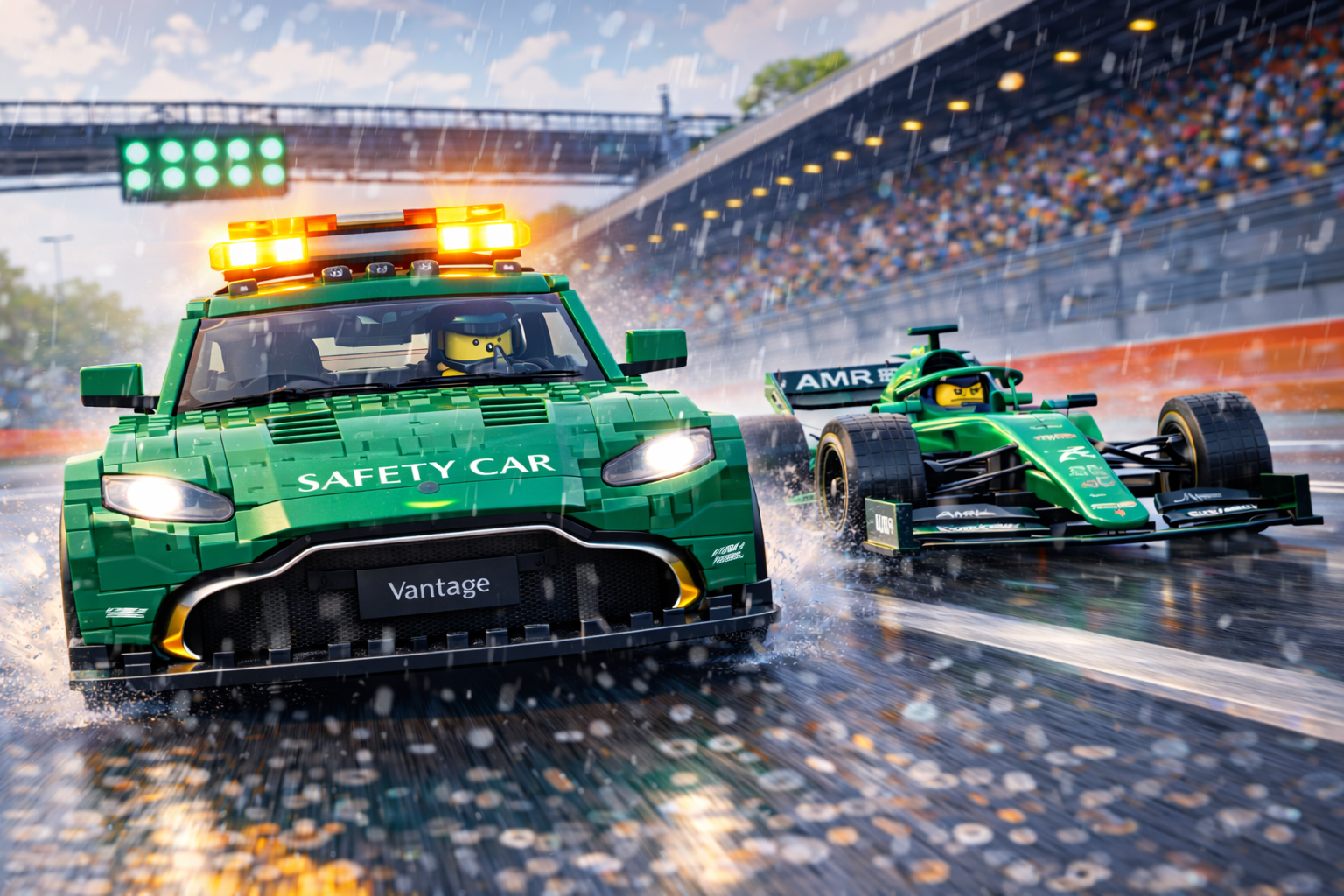
Brick-built safety car with flashing lights leads a Formula-style race car on a wet track, driven by minifigures during a rainy racing scene.

Morning arrived fast at the circuit. The sun climbed above the grandstands, flashing across metal rails and glass panels, turning the track into a long silver streak. The air buzzed with expectation, even before a single engine started.

Two cars waited in the pit lane, side by side but built for different purposes. One crouched low, sharp and sleek, every line shaped to cut through air as if it barely existed. The other stood taller, broader, marked by a light bar stretching across its roof—calm, visible, impossible to ignore.

Around them, crews moved with purpose. Tool carts rolled. Visors snapped shut. Radios crackled with short updates. Today wasn’t about luck. It was about readiness.

At the far end of the lane, the track stretched forward like a challenge.

The drivers climbed in. Harnesses clicked tight. Gloves wrapped firmly around steering wheels worn smooth by practice. For a moment, everything stilled.

Then the engines fired.

Sound surged through the pit lane, deep and thrilling, echoing off the barriers and waking the empty seats above. The low car trembled with energy, eager to break free. The taller car answered with a steadier roar, confident and controlled.

They rolled out together.

The pit exit opened onto the circuit, and suddenly the world widened. Corners flowed into straights. Painted lines blurred at the edges. Even at controlled speed, the track demanded attention.

The first laps were clean. Fast curves tested courage. Braking zones demanded precision. Each turn felt like a question, and each answer came faster than the last.

On the third lap, everything changed.

A flash of movement ahead. A burst of smoke near the barrier.

Yellow flags waved.

The low car slowed instantly. The taller car surged forward, slipping into the lead. Its light bar ignited, amber flashes cutting through the air like a signal flare.

This was its moment.

The safety car took control of the circuit. Speed dropped, but tension climbed. Behind it, the racing car followed closely, engine humming, waiting.

They passed the trouble spot carefully. A car sat stranded at an angle, crew members already rushing in, their movements fast but focused. The system worked because everyone trusted it.

Rain began without warning.

First a few drops. Then more. The track darkened, reflections spreading across the asphalt. The circuit looked different now—slick, unpredictable, alive in a new way.

Inside the safety car, the driver adjusted smoothly, eyes scanning mirrors and corners. Every decision mattered. Too slow, and the race would lose its rhythm. Too fast, and control would vanish.

Behind, the racing car felt the change instantly. Tires searched for grip. Steering grew lighter. The thrill sharpened.

Radio chatter increased. Short commands. Clear answers.

They rounded the final section of the lap, rain tapping harder now, lights blazing against the gray sky. The safety car guided them through, holding the balance between caution and excitement.

Everyone knew what was coming next.

At the final bend, the safety car’s lights went dark.

The track seemed to pause.

Then the safety car peeled away, slipping toward the pit lane, its job done.

The racing car surged forward, engine screaming as water sprayed behind it. Speed returned all at once—louder, faster, more alive than before.

The straight rushed toward the horizon.

And the race truly began.

This is an original work of fiction created by Brick Crossing, inspired by the design themes of LEGO® set 76925.
LEGO® is a trademark of the LEGO Group, which does not sponsor, authorize, or endorse Brick Crossing.