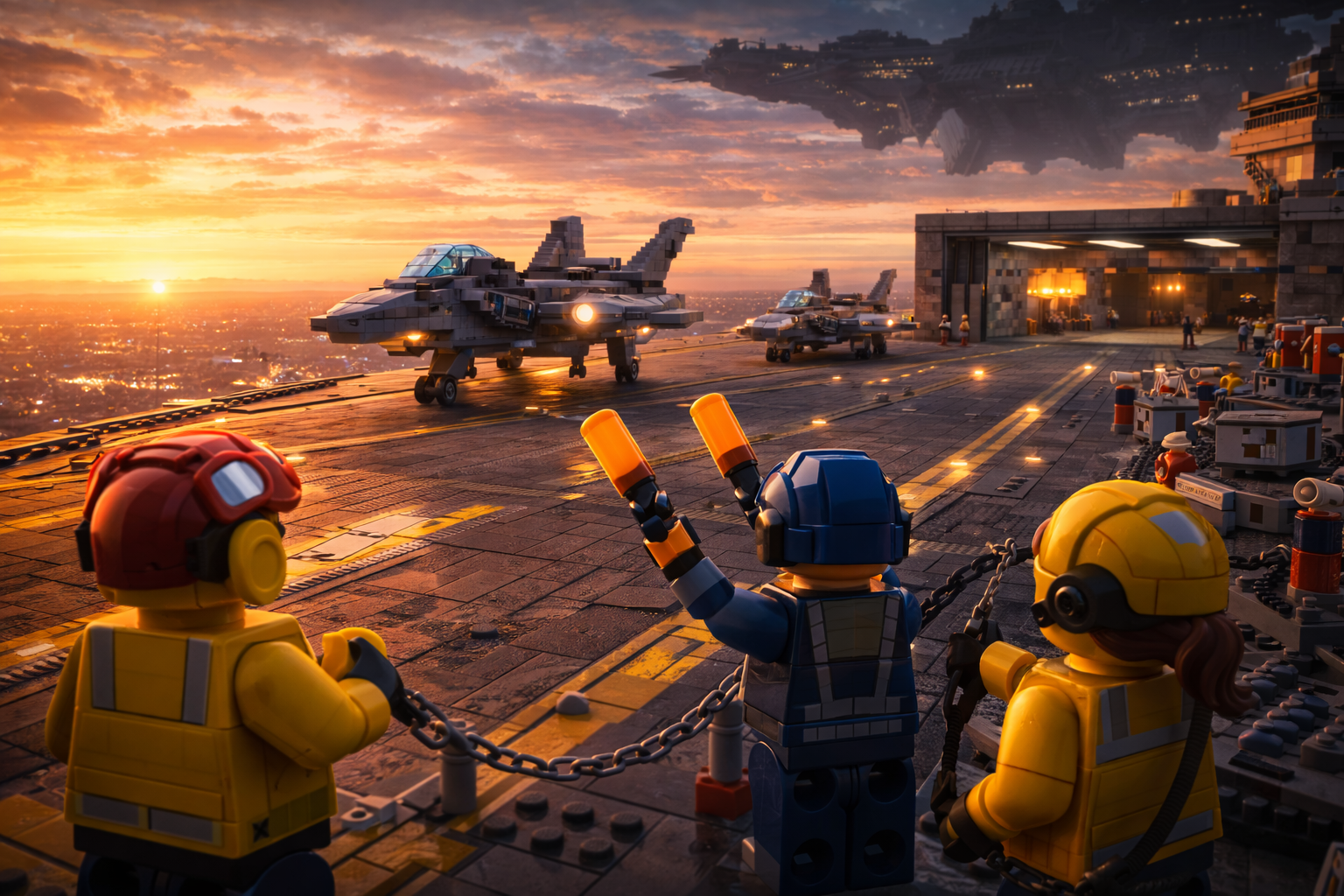
Sunset made everything on the flight deck look like it belonged in a postcard—right up until you noticed the danger.
The sky was a slow burn of orange and violet, smeared across the horizon like paint dragged with a thumb. The clouds below were darker, bruised at the edges, and the city lights far beneath them blinked on one by one as if the world was trying to catch up to the height.
Up here, nothing caught up. It either worked or it didn’t.
The deck stretched wide and flat, a floating runway held up by engines you never saw and vibrations you always felt. Yellow lines cut through the gray plating, guiding vehicles, crews, and aircraft into a choreography that could not afford mistakes. Wind slapped at loose straps and snapped flags hard enough to sting your ears.
We were three deep in our shift, and our whole world was the deck.
Jax stood at the edge of the landing zone, wands of light in each hand, visor down, chin set like he’d carved it from the same metal as the ship. Mina checked the tether lines near the maintenance carts, fast fingers working knots and clips like they were music. I—Rory—kept my eyes on the deck readouts, the wind, the lights, and the one thing we weren’t supposed to say out loud:
Something big was coming.
It started with the change in comms.
Normally, the channel was a steady stream of short calls—fuel, clearance, taxi, brake check. It was noise you learned to understand without thinking, like rain against a roof.
Then the noise thinned. Messages became clipped. Coded. Pauses stretched longer than they should have.
“Deck crew, status,” the tower voice said.
“Green,” Jax answered instantly.
Mina didn’t look up from her work. “Green,” she repeated under her breath, like saying it out loud made it true.
The ship vibrated differently, too. A slight shift in pitch through the soles of our boots. Not rough—controlled—but a reminder that the entire platform was making a decision about where to be in the sky.
A service cart rolled by with a sealed crate strapped down like it was the most precious thing aboard. Nobody joked about it. Nobody even stared too long.
I watched the horizon instead.
Far out, where the last band of sunlight met the blue-black of approaching night, a point of light appeared—then another. A formation. Tight. Fast. Not civilian.
Jax angled his helmet toward me.
“You seeing that?” he asked.
“Yeah,” I said. “And it’s coming in hot.”
The tower voice returned. “Prepare for priority landing. Clear the deck. Full readiness.”
Priority meant no mistakes. It meant whatever was incoming mattered more than our schedule, our comfort, our confidence.
Mina clipped the last tether and sprinted, moving like the wind itself had taught her. She grabbed a coil of line that could turn deadly if it snapped loose at the wrong time. Jax stepped into position at the landing zone, light wands up, body squared to the sky like he could negotiate with speed.
I moved to the control panel at the edge of the deck, fingers hovering over toggles that controlled the lights—guidance strips, hazard markers, emergency beacons. My screen flickered with altitude and wind shear data.
The crosswind ticked higher.
The ship held steady anyway.
Because it had to.
The approaching aircraft cut through the sunset glow and dropped lower. As it crossed into the deck’s airspace, the wind it carried hit us like a wave. Loose grit skittered across the deck. Straps snapped. The smell of fuel sharpened.
Jax signaled with sharp, confident motions—down, left, steady, steady—his wands painting instructions in bright arcs.
The aircraft responded instantly.
It landed hard, precise, wheels biting the deck. The sound was a metallic scream that turned into a rumble, then into a steady roll as it taxied forward.
Mina and I moved in together, exactly as trained. Chocks in. Tethers on. Hands fast. Eyes faster.
The canopy didn’t open.
The aircraft’s engine didn’t fully power down.
That wasn’t normal.
A second aircraft lined up behind it, then a third. The deck filled quickly with machines that looked like they’d been built to arrive under pressure and leave before anyone asked why.
The tower voice came through again, lower now. “Deck crew, maintain positions. No unauthorized approach. Stand by.”
Jax’s visor turned slightly toward me, just enough for me to feel the question.
What kind of mission needs this many landings at sunset?
Then the answer arrived in the form of a tremor through the deck.
Not from an engine.
From somewhere deeper.
The hangar doors below the deck—massive segmented plates—shifted open with a groan, like the ship itself was exhaling. Warm air rolled up, carrying the smell of oil, metal, and something else—ozone, sharp and clean, like a storm about to break.
Something down there powered up.
The deck lights flickered once.
Mina froze mid-step. “That’s not us,” she said quietly.
“No,” I agreed. “That’s not us.”
We weren’t supposed to look down into the hangar when the priority shutters were moving.
But everyone did.
Because the sound wasn’t subtle. It was the kind of sound that made your bones feel like they’d been tapped from the inside. Heavy machinery aligning. Locks disengaging. A low thrumming that climbed in pitch as if a giant heart was speeding up.
Inside the hangar, crews in darker gear moved fast, silhouettes against floodlights. Equipment rolled into position. Crates were unsealed. A shape—tall, angular—shifted behind a row of maintenance stands.
Mina leaned closer to me, her voice barely audible over the wind. “Do you think it’s… one of the assets?”
We didn’t use that word often. It was what people said when they didn’t want to say what they really meant: something powerful, something classified, something that made the ship more than just metal and engines.
Jax stepped toward us, keeping his body between our line of sight and the hangar opening like he could block curiosity.
“Eyes up,” he snapped. “You want to keep your clearance? Eyes up.”
We obeyed, because we always did.
But the deck was changing.
The sunset was fading, and the ship’s lights grew brighter in response, cutting white lines into the dusk. The air cooled quickly. The wind intensified, whipping loose paper into the sky like startled birds.
The first aircraft finally powered down.
The canopy opened with a hiss.
A pilot climbed out—helmet on, visor reflective, face hidden. They didn’t look at us. They didn’t wave. They walked straight to the edge of the deck where a transport team waited, and disappeared down a stairwell.
The second aircraft didn’t stop at all.
It rolled, turned, and launched again—taking off into the darkening sky as if delivering something, or escaping it.
I watched its lights shrink into the distance.
Then I noticed the city below.
It wasn’t just lights anymore. There were pulses—flashes too bright and too regular to be normal. In the far distance, a bloom of purple-white lit up the horizon for half a second and vanished.
Mina saw it too. “That’s not lightning,” she said.
“No,” I repeated. “That’s not lightning.”
The tower voice returned, tighter than before. “All crew, brace. Course correction. Stand by for possible turbulence.”
The ship tilted—just a fraction—enough to make my stomach shift. The deck readouts jumped. Wind shear spiked.
Jax planted his boots wider, steadying himself like he could anchor the ship by force of will. “Hold your lines!” he yelled. “Hold everything!”
A deep vibration rolled through the deck, stronger than anything we’d felt all day.
The hangar doors below began to close—fast. Too fast.
Whatever was happening down there, it was moving from “prepare” to “now.”
Mina grabbed my sleeve, hard. “Rory,” she said, and for the first time all shift, her voice cracked. “Tell me you feel that.”
I did.
The air pressure shifted. The hair on my arms lifted. The deck lights flared bright and steadied, as if the ship was pulling power from somewhere else.
And the aircraft nearest us—still tethered—gave a sudden warning chirp, its systems reacting to something in the air.
Something approaching.
Jax raised his wands again, reflexively, scanning the sky like the incoming threat might be visible in the sunset.
But the horizon was empty.
Then a shadow passed across the deck—too large to belong to a cloud.
We all looked up at the same time.
Above us, the sky darkened by a moving shape that didn’t belong to the day or the night.
The wind slammed into the deck. Straps snapped tight. The ship groaned, correcting itself midair.
Jax lifted one wand higher, as if he could guide whatever it was away from us by sheer command.
Mina held the tether line with both hands, knuckles pale.
I stared at the shadow and tried to understand its size.
The tower voice cut through the comms, urgent and sharp:
“Brace. Brace. Brace—”
And then the hangar doors sealed with a final metallic snар, shutting out whatever had been waking below.
The ship lurched.
The sunset vanished behind steel and shadow—
—and the deck went weightless for a heartbeat.
This is an original work of fiction created by Brick Crossing, inspired by the design themes of LEGO® set 76295.
LEGO® is a trademark of the LEGO Group, which does not sponsor, authorize, or endorse Brick Crossing.