Posted on

Where the Water Slows

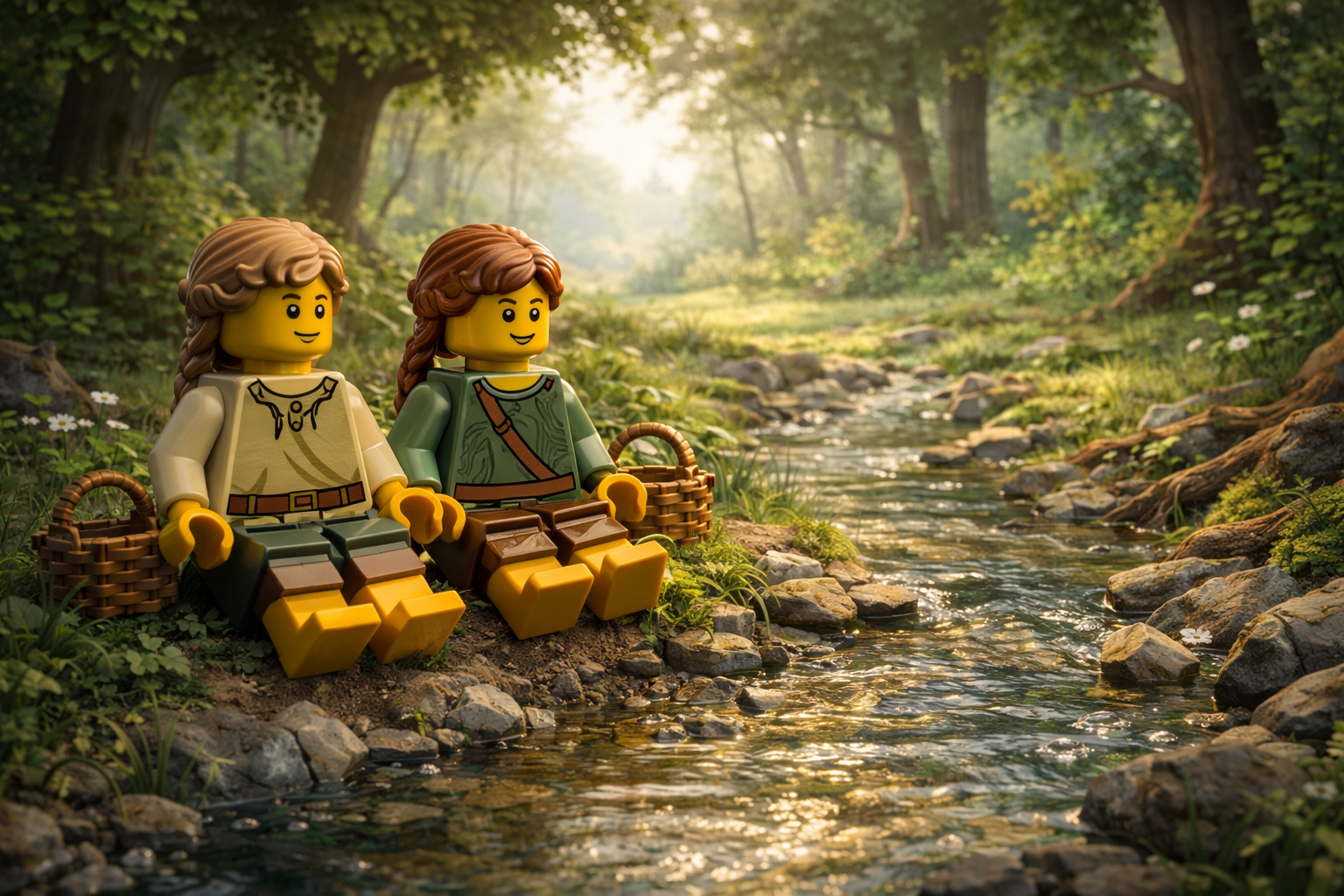
Two minifigure girls sit beside a forest stream in a brick-built clearing, unaware of what they are about to discover.

The stream didn’t rush here.

It curved gently around smooth stones and roots, slowing as it left the forest and entered the open land beyond. Sunlight filtered through the trees in thin, patient bands, catching on ripples and turning them into moving lines of gold. It was the kind of place adults forgot to watch closely—not because it wasn’t important, but because it felt safe.

That’s why Elia and Noor liked it.

They came with a basket and a promise to be back before dusk. The basket was mostly an excuse. The promise was real.

They sat on the bank with their boots off, feet numb in the cold water, tossing pebbles and arguing quietly about whose throw made the better sound. The forest behind them hummed with insects and distant birds. The fields beyond the clearing lay empty, furrowed and waiting, like they had been for months.

Since the night everything changed.

Elia skipped a flat stone and watched it hop twice before sinking. “Dad used to fish here,” she said, not looking at Noor.

“I know,” Noor replied. “He said the water listens.”

Elia snorted softly. “That’s not a thing.”

“He said it was,” Noor insisted. “He said if you’re quiet, it tells you when to leave.”

Elia rolled her eyes but didn’t throw another stone. The stream moved on, unconcerned with their argument.

They heard it before they saw it—a faint hum, low and steady, like a breath held too long. It didn’t belong to the forest or the fields. It hovered between sounds, subtle enough to be missed if you weren’t listening for reasons to be afraid.

Noor froze. “Do you hear that?”

Elia nodded slowly. “Yeah.”

The sound grew clearer as it drifted into the clearing from upstream, rounding the bend where the trees leaned close together. Leaves parted. Sunlight caught on smooth metal.

Something floated above the water.

It was a small cradle—round-edged, dark, worn smooth in places like it had been held often. It hovered just high enough to clear the stones, moving gently with the current as if the stream had decided to carry it without touching.

Inside it sat a child.

Not like them.

Smaller. Quieter. Green-skinned, with wide, curious eyes that reflected the light like polished glass. Large ears twitched slightly as the cradle drifted closer, responding to sounds only the child seemed to hear.

The hum softened when the cradle reached the shallows near the bank, settling into a hover that barely stirred the water.

Elia stood up so fast she slipped, catching herself on a tree root. “Noor,” she whispered urgently. “There’s—there’s a baby.”

Noor stared, heart pounding so hard she was sure the child could hear it. “It’s not a baby,” she said, unsure why she felt that mattered. “It’s… different.”

The child looked at them. Not startled. Not afraid.

Just watching.

Elia took a step back toward the trees. “We should tell someone.”

Noor didn’t move. “Who?”

They both knew the answer.

The outpost had people—grandparents, younger children, those who couldn’t fight. But the ones who made decisions were gone. Their father among them. Away, chasing the forces that had torn through the village months ago and left burned fields and quiet nights behind.

The child in the cradle made a small sound, not quite a cry. The cradle dipped slightly, adjusting itself.

Elia swallowed. “What if it’s… dangerous?”

Noor shook her head, even though she didn’t know why. “It’s just a kid.”

The forest shifted. A bird burst from the undergrowth, wings loud in the sudden silence. Elia flinched.

“Someone else could find it,” she said. “Someone who wouldn’t—”

“Wouldn’t what?” Noor asked.

Elia didn’t finish the sentence.

The hum changed—lower now, strained. The cradle wobbled, drifting sideways toward a cluster of rocks.

Without thinking, Noor stepped into the stream and reached out.

The water was cold enough to sting, but her hand found the edge of the cradle easily. It was warmer than she expected. Solid. Real.

The child’s eyes widened slightly.

“Hi,” Noor said, softly, because loud felt wrong. “You shouldn’t be out here alone.”

The child tilted its head. One small hand lifted and reached—not for Noor’s face, but for the stream. Its fingers brushed the surface, sending ripples outward in neat, concentric circles.

Elia watched the water respond. Not splashing. Not recoiling.

Listening.

The sound came back sharper this time—not the hum of the cradle, but something farther off. Engines. Voices. The wrong kind of noise.

Elia’s head snapped up. “Noor. Hide it.”

“What?”

“Hide the cradle. Now.”

The forest edge rustled. Shadows moved where the trees thinned, where the path led back toward the outpost road. Shapes passed between trunks—too tall, too fast, scanning the clearing with purpose.

Searchers.

Elia dropped to her knees and grabbed Noor’s sleeve. “Please.”

Noor hesitated only a second. She guided the cradle toward the overhang where roots formed a natural alcove in the bank. The cradle followed, responsive, hovering lower as if it understood urgency.

The child made another small sound—uncertain now.

“It’s okay,” Noor whispered, even as her hands shook. “We’ve got you.”

Elia crouched beside her, pulling a fallen branch and a curtain of leaves across the opening. From the clearing, it looked like nothing more than shadow and water.

The hum dimmed.

Footsteps approached. Voices murmured—sharp, impatient. A figure paused at the edge of the stream, boots crunching on gravel.

Elia held her breath so long her chest hurt.

The figure leaned forward, scanning the water. For a terrifying moment, Elia was sure they could hear her heartbeat. The stream moved on, slow and steady, reflecting nothing unusual.

After a long moment, the footsteps retreated.

The voices faded.

The forest exhaled.

Noor slumped back against the bank, knees pulled to her chest. Elia stayed frozen a heartbeat longer, then crawled closer to the alcove.

The child looked up at them, calm restored as if fear had never touched it.

Noor laughed quietly, a sound halfway between relief and disbelief. “Did you see that? It didn’t even cry.”

Elia wiped her eyes with her sleeve. “It knew.”

They sat there until the light shifted and the insects changed their song. When the clearing felt safe again, Noor carefully guided the cradle back into the open.

The child lifted one hand and touched Noor’s finger, skin warm and surprisingly strong. Noor felt a strange stillness spread through her, like the world had paused to pay attention.

Elia watched, awe and worry twisting together. “We can’t keep it,” she said. “We’re just kids.”

Noor met her gaze. “We can keep it safe. Just for now.”

Elia thought of their father’s empty chair. The fields waiting. The nights when the village lights stayed low.

She nodded. “Just for now.”

They walked back toward the outpost together, the cradle floating quietly between them. The forest closed behind, the stream returning to its patient curve.

At the edge of the clearing, the child looked back once—ears twitching, eyes reflecting the last light like stars caught in water.

Elia squeezed Noor’s hand.

Above them, clouds drifted slowly across the sky, hiding whatever watched from farther away.

The danger hadn’t ended.

But tonight, something small was safe.

And sometimes, that was enough.

This is an original work of fiction created by Brick Crossing, inspired by the design themes of LEGO® set 75403.
LEGO® is a trademark of the LEGO Group, which does not sponsor, authorize, or endorse Brick Crossing.
Posted on

The Helmet That Chose a Side

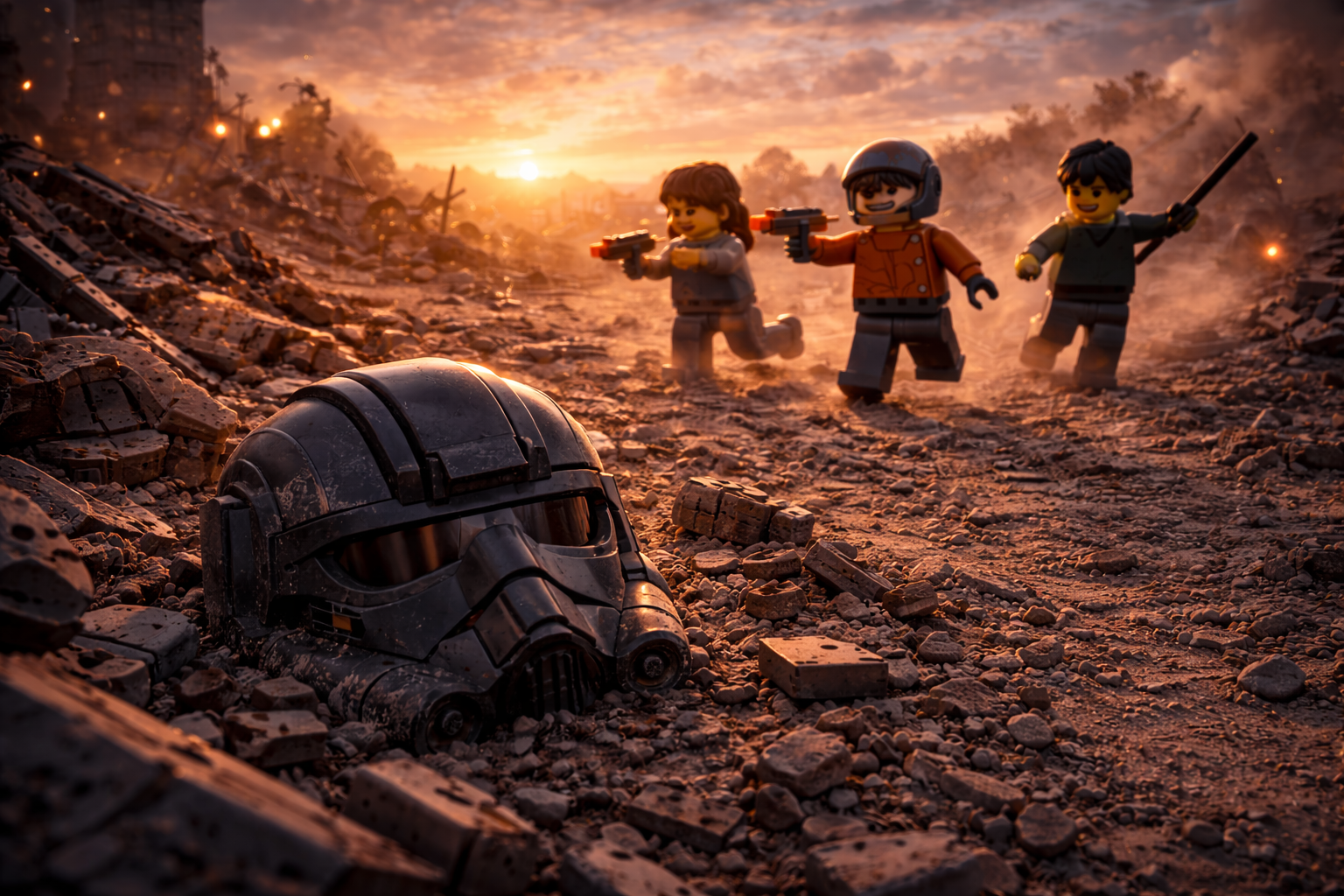
Brick-built black and gray helmet half-buried in rubble as minifigure children play nearby in a ruined field.

The game begins the same way every time: with Toma yelling, “Incoming!” and the rest of us dropping behind whatever the world offers as cover.

Today it’s a rib of twisted metal half-buried in ash-gray dirt. Yesterday it was a broken cart in the orchard. Tomorrow it’ll be a stone wall, or a ditch, or the shadow of the water tower. We don’t need a real battlefield to make one—just space, just breath, just the way our hearts speed up when we decide the air is dangerous.

Except this time, the air is different.

The old field beyond the village isn’t really a field anymore. It’s a place people avoid, where the soil looks scorched in patches and the grass grows in strange, stubborn lines. Everyone calls it “the burn,” like naming it makes it smaller.

We came anyway, because we were bored, and because we were brave in the careless way you can be when you haven’t lived long enough to understand what bravery costs.

And because we found something.

“Hold the line!” Sera shouts, her voice cracking a little with excitement. She’s crouched behind a chunk of concrete, using a stick as her “signal wand,” the way she saw the transit officers do during last year’s festival. “No one crosses the ridge!”

Jax—who isn’t actually named Jax but insisted we call him that during games because it “sounds like a pilot”—leans over the metal rib and squints into the smoke-colored distance like he’s seeing enemies between the trees. “I see movement,” he says. “Two… maybe three.”

“There’s nothing there,” I whisper.

He doesn’t look at me. “That’s what they want you to think.”

Theo, the smallest of us, is pressed flat against the ground, cheeks dusty, hands planted like he’s bracing for an explosion that hasn’t happened yet. “Do the stompers come now?” he asks, eyes wide, half terrified, half thrilled.

Toma makes the sound effects because Toma always does. He rumbles his throat low and drags a rock across another rock to make it feel like something huge is shifting out there. “They’re close,” he says in a voice that isn’t quite his. “You can feel it.”

We can feel something, actually—faint vibrations, a weird buzz that sometimes seems to come up through the soles of our shoes. Sera says it’s just wind through hollow metal. Toma says it’s the ground remembering.

I don’t know what I think. I just know the burn feels like it’s holding a story in its ribs, and we keep poking it like it might answer.

Jax lifts a hand to his head, as if he’s adjusting a visor. Except he isn’t.

Because the visor is real.

The helmet sits on the broken slab beside him, catching the last sunlight in dull, curved surfaces. It’s heavier than it looks—he proved that earlier by nearly dropping it on his foot and swearing so hard Sera threatened to tell his mother. The front is smooth, the faceplate dark, the lines clean in a way that doesn’t match the messy ruin around it. A piece of a world that wasn’t ours, left behind like someone forgot it mattered.

We found it under a sheet of bent metal, wrapped in ash and silence. Toma had dug it out with his hands like he was unearthing treasure. Theo had reached out and then pulled back as if it might bite.

Sera didn’t touch it at first. She stared at it like it was a question.

Then she said, “It’s a pilot helmet.”

Jax said, “It’s my pilot helmet.”

And that was that.

Now it sits between us and the sky, a silent referee of our pretend war.

“Alright,” Sera says, slapping her stick against the concrete like it’s a clipboard. “We’re pinned. We need a runner.”

Everyone looks at me.

I didn’t volunteer, but nobody ever does. The runner is the one who has to cross open ground, the one who has to risk being “tagged” by imaginary fire. The runner is the one who gets remembered in the retelling.

“You’re fastest,” Toma says, like it’s a compliment and not a sentence.

“I’m not—” I start.

Jax puts on the helmet.

The sound of it settling over his head changes everything. It isn’t loud. Just a soft thunk, a finality, like a door closing. He lifts his chin, and the dark faceplate reflects the burn field in a warped curve.

He becomes someone else.

“Runner,” he says, voice deeper because he thinks the helmet deserves a deeper voice. “On my mark.”

Theo’s eyes go even wider. “He looks real,” he whispers.

“He’s still Jax,” I whisper back.

But I’m not sure it’s true, not in the way we usually mean it.

Sera points her stick toward the far side of the field where the ruin thickens into a line of broken beams and half-sunk panels. “Your target is the tower,” she says. “You plant the signal, and we push forward.”

“The tower is fake,” I say.

Sera’s expression is serious enough to make my stomach tighten anyway. “Everything is fake,” she replies. “That’s the point.”

Toma makes another rumble sound. “They’re moving,” he says.

Jax turns his helmeted head slowly, as if tracking something tall and unseen. Then he raises a hand. “Now.”

I run.

The burn field rushes up under my feet—grit, ash, scattered pebbles that shift under every step. The air tastes metallic. Wind snaps at my sleeves. I can hear the others behind me, shouting instructions and threats and warnings like they’re reading from a script only kids can see.

“Incoming!” Toma yells.

“Down!” Sera shouts.

“Too late!” Jax adds, and makes a sharp sound like a laser blast with his mouth.

I throw myself into a slide behind a broken panel and grit scrapes my palms. I laugh—just a little—because sliding is fun and because I didn’t get “hit.”

Then the ground really vibrates.

Not the soft imagined kind. A clear, unmistakable shudder that ripples through the metal around me. A loose bolt rolls and clicks against the panel. Dust lifts off the ground in a thin puff.

I freeze.

So does everyone else. Even Toma stops making sounds.

For a second, the burn field is quiet enough that I hear a bird call from somewhere far away. A normal sound, like the world is trying to remind us it still exists.

“What was that?” Theo says, voice small.

Sera doesn’t answer. She’s staring at the helmet.

Jax—helmet still on—slowly turns his head toward the deeper ruins beyond our play zone. His shoulders square, the way they do when the game gets serious.

“Maybe it’s them,” he says softly.

“That’s dumb,” Toma says, but he doesn’t sound convinced.

Another vibration comes, lighter this time, as if something shifted far away and the earth politely informed us.

Sera steps forward, stick lowered. “Okay,” she says, trying to keep her voice steady. “New rule.”

We all look at her.

“No going past the beam line,” she says, pointing to the jagged skeleton of a fallen frame farther into the burn. “That’s the edge of the map.”

“We always—” Toma begins.

“No,” Sera cuts in. “Not today.”

For a moment, none of us argue. We just listen to the wind moving through the hollow metal, making it sing in long, low notes. It doesn’t sound like a warning exactly.

It sounds like a memory.

Jax walks toward the edge of the map anyway.

Not far. Just a few steps, slow and deliberate, helmet reflecting the burnt field and the orange sky. The faceplate makes him unreadable, which is unfair, because it means we can’t tell if he’s scared.

“Jax,” I call from behind the panel. “Don’t.”

He stops.

In the fading light, the helmet looks less like a toy and more like a relic. Like it belongs to a person who wasn’t playing.

Jax reaches up and lifts it off.

His hair is flattened. His cheeks are dusty. He looks like himself again—almost.

“It smells like smoke inside,” he says quietly, like he’s surprised.

Theo takes a step closer. “Can I—”

“No,” Sera says immediately, then softens. “Not yet.”

Toma, who hates seriousness, clears his throat and forces the game back into place. “Okay,” he says loudly. “The stompers are retreating! We won!”

“We didn’t win,” I say before I can stop myself.

They all look at me.

I point toward the beam line, toward the deeper ruin where the vibrations came from, where the air seems to hold its breath. “We just… stopped.”

Sera’s eyes narrow, thoughtful. “Sometimes,” she says, “stopping is winning.”

That sounds like something a grown-up would say. It makes all of us uncomfortable.

Jax sets the helmet on the concrete again, carefully this time. Like it’s fragile. Like it’s listening.

Then he raises a hand in a sloppy salute. “Pilot’s grounded,” he declares, trying to brighten it.

Theo laughs, relieved.

Toma makes a triumphant rumble noise.

And the game tries to restart.

But the burn field doesn’t feel like it’s letting us go.

Sera points her stick toward the beam line again, voice back in command mode. “New mission,” she says. “We retreat to the village. We tell no one. We come back tomorrow.”

“Tomorrow,” Toma repeats, a little too quickly.

Jax picks up the helmet.

He doesn’t put it on this time. He cradles it against his chest like a secret you can carry.

As we start walking back, the streetlights of the village blink on one by one in the distance. Warm. Normal. Safe.

Behind us, the burn field hums again—so faint we could pretend it’s wind.

But the helmet in Jax’s arms feels heavier with every step.

And none of us says what we’re all thinking:

Tomorrow, the game might not stay a game.

This is an original work of fiction created by Brick Crossing, inspired by the design themes of LEGO® set 75429.
LEGO® is a trademark of the LEGO Group, which does not sponsor, authorize, or endorse Brick Crossing.

Posted on

The Lesson That Looked Back

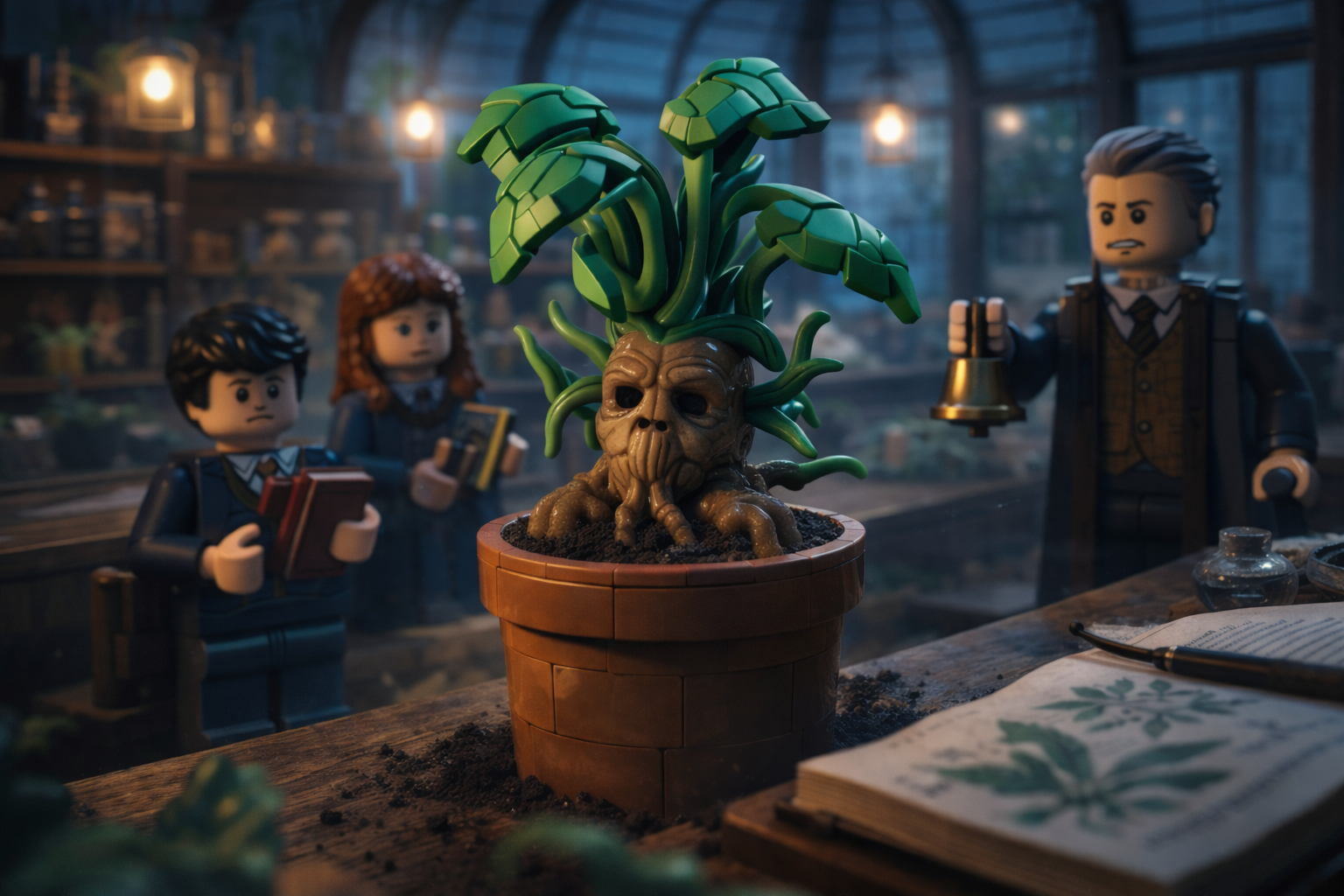
Brick-built humanoid plant in a pot observed by a professor and students in a dim botanical classroom.

The classroom was built like a greenhouse that forgot it was supposed to be gentle.

Glass panes arched overhead in black iron ribs, fogging at the edges where warm air met the cold outside. Shelves climbed the walls in careful tiers—jars of seeds, pressed leaves in labeled frames, clay pots with soil dark as coffee grounds. A long demonstration table ran down the center, scarred with years of careful cutting and cautious mistakes.

Somewhere beneath the floorboards, pipes clicked softly, feeding heat into the room like a slow heartbeat.

Students filed in with notebooks and half-zipped jackets, voices low, shoulders brushing as they took their places. Most of them had the same look when they entered this wing: curiosity, yes—but also the quiet awareness that something in here might be alive in a way they weren’t prepared for.

At the far end of the room, under a cloth the color of storm clouds, a pot sat alone.

No label. No warning.

Just a shape beneath fabric, as if the thing under it didn’t like being named.

Professor Ardent arrived exactly when the bell finished ringing—no earlier, no later—as if time itself stepped aside for him. He was tall, sleeves rolled to the elbow, hands stained faintly green in the creases no soap ever reached. His eyes were bright in a way that made some students sit up straighter without meaning to.

He set a leather case on the table. Inside: pruning shears, a narrow trowel, a pair of thick gloves, and a small bell of tarnished brass.

The class watched the bell more than the tools.

“You’ve learned the ordinary rules,” Ardent said, voice calm and steady. “Light, water, soil chemistry. How to read leaves like weather.”

He walked to the cloth-covered pot and stopped as if listening for something.

“And you’ve learned,” he added, “that some life prefers not to be read at all.”

A few students exchanged glances. Someone’s pen clicked nervously.

Ardent laid his gloves on the table instead of putting them on. That, more than anything, tightened the room.

“This specimen,” he said, “doesn’t respond to sunlight the way you expect. It doesn’t grow toward warmth. It grows toward attention.”

A laugh almost happened—then died before it could become real.

At the second row, a student named Juno leaned forward, eyes narrowed. Juno liked puzzles. Juno believed the world could be understood if you stared long enough.

Beside Juno sat Mateo, who had the opposite instinct: if something felt wrong, he trusted that feeling and kept his distance. He tucked his hands under his notebook as if the desk was suddenly too exposed.

Ardent’s fingers found the edge of the cloth.

“Today,” he said, “you will practice observation without assumption.”

He lifted the fabric.

The pot held a plant unlike anything in the room.

Its leaves were thick and curled, like green hands caught mid-motion. Its stem rose sturdy, but not stiff—more like a spine than a stalk. At the base, half-buried in soil, a pale shape pressed upward: rounded, knotted, and eerily familiar in the way driftwood can resemble a face if you catch it at the wrong angle.

A hush fell over the class.

The plant did not sway with the classroom’s warm air currents.

It was still.

Then—slowly—it turned.

Not a dramatic snap, not the twitch of a vine. A gradual, deliberate rotation, as if it had decided to face the room. As if it had chosen an audience.

Juno’s breath caught. Mateo’s pen slid from his fingers and tapped against the desk.

Ardent didn’t react. He didn’t flinch, didn’t smile, didn’t warn them away. He watched the plant the way a navigator watches the horizon: without surprise, but with respect.

“Note what you feel,” he said. “Not what you think.”

A student in the back whispered, “It’s looking at us.”

“It has no eyes,” Ardent replied, not unkindly. “And yet.”

The plant’s leaves unfurled a fraction, revealing veins that ran in patterns too organized to be random—like fingerprints. Like maps.

Juno raised a hand, then lowered it, then raised it again. “Professor… what is it?”

Ardent tapped the brass bell once, very softly.

The plant stopped moving.

Silence thickened, heavy as damp soil.

“You may call it whatever you want,” he said. “Names are doors. Some doors should remain closed until you understand what’s on the other side.”

He nodded toward the nearest table. “Sketch. Do not touch. Do not speak to it. Not yet.”

The class began to draw, pencils scratching in quick, uncertain lines. But the room had shifted. It wasn’t just a classroom anymore; it was a threshold.

Mateo tried to focus on leaf shape and stem thickness, but his eyes kept sliding back to that pale form at the base—the almost-face in the soil. He told himself it was roots. He told himself it was coincidence.

The longer he looked, the less he believed himself.

Juno’s sketch was careful, almost reverent. Juno leaned closer, searching for logic in the veins, the symmetry, the way the plant held itself like a person holding a secret.

A bead of condensation slipped down the glass overhead and tapped onto the table with a tiny sound like a countdown.

Ardent walked between desks, pausing behind students, correcting a line here, a proportion there. He stopped behind Mateo and spoke quietly.

“You’re pulling away,” he said.

Mateo swallowed. “I just—don’t like it.”

Ardent nodded once, as if that was the correct answer on a test no one knew they were taking. “Dislike is useful. It keeps you honest.”

Then he moved on.

At the front, the plant shifted again.

Just enough to make the leaves angle toward Juno.

Juno froze, pencil hovering.

It wasn’t moving randomly. It was moving with purpose.

And purpose, in a thing that shouldn’t have it, made the air feel thinner.

Ardent returned to the demonstration table and opened his leather case fully, spreading the tools as if preparing for a delicate operation.

“Observation is the first skill,” he said. “The second is restraint.”

He lifted the brass bell but didn’t ring it. He held it instead, listening to the room, to the plant, to the quiet fear gathering in corners.

“Some specimens,” he continued, “react to touch as a trap reacts to pressure. Others react to attention. They learn the rhythm of your breath. They learn your habits.”

Mateo felt his pulse in his fingertips. Juno didn’t blink.

Ardent set the bell down and, for the first time, took a step closer to the pot.

The plant leaned toward him.

Not fast. Not aggressive.

Like recognition.

Ardent’s voice lowered. “If you ever find something like this outside these walls—if you ever uncover it in a forgotten garden, a sealed room, a place where no one has walked in years—remember this.”

He placed one finger on the rim of the pot.

The plant’s leaves lifted.

The pale shape at the base pressed higher through the soil, and for an instant the suggestion of a mouth—only a curve, only shadow—seemed to form.

The classroom went absolutely still.

Ardent did not remove his finger.

“Do not assume it wants what you want,” he said. “And do not assume it wants what you fear.”

Juno’s pencil dropped. The sound was small, but it landed like a stone in deep water.

The plant turned its “face” toward the class.

Not toward Ardent.

Toward them.

A ripple moved through its leaves, as if it was taking inventory of every person in the room.

Then—without warning—the glass overhead shuddered.

Not from wind. Not from weather.

From a low vibration that seemed to come from the plant itself, a hum felt more than heard.

Ardent’s eyes sharpened.

His hand went to the bell.

He lifted the bell, ready to strike—

And the plant leaned forward, leaves spreading like hands reaching for the edge of the world.

The hum deepened.

The lights flickered once.

Then went steady again.

Ardent hesitated.

And in that half-second, the plant decided to move.

This is an original work of fiction created by Brick Crossing, inspired by the design themes of LEGO® set 76433.
LEGO® is a trademark of the LEGO Group, which does not sponsor, authorize, or endorse Brick Crossing.