Posted on

The Lesson That Looked Back

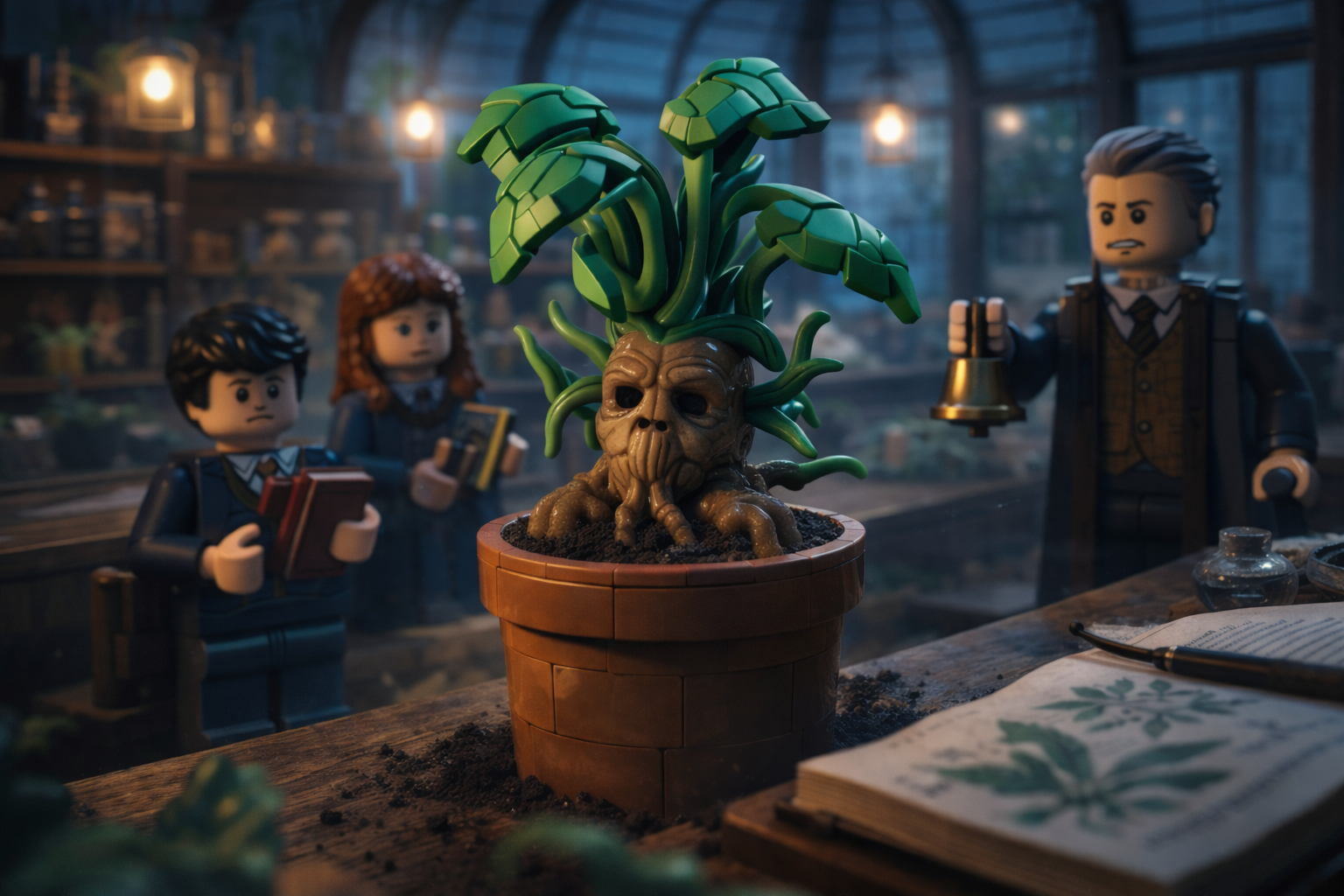
Brick-built humanoid plant in a pot observed by a professor and students in a dim botanical classroom.

The classroom was built like a greenhouse that forgot it was supposed to be gentle.

Glass panes arched overhead in black iron ribs, fogging at the edges where warm air met the cold outside. Shelves climbed the walls in careful tiers—jars of seeds, pressed leaves in labeled frames, clay pots with soil dark as coffee grounds. A long demonstration table ran down the center, scarred with years of careful cutting and cautious mistakes.

Somewhere beneath the floorboards, pipes clicked softly, feeding heat into the room like a slow heartbeat.

Students filed in with notebooks and half-zipped jackets, voices low, shoulders brushing as they took their places. Most of them had the same look when they entered this wing: curiosity, yes—but also the quiet awareness that something in here might be alive in a way they weren’t prepared for.

At the far end of the room, under a cloth the color of storm clouds, a pot sat alone.

No label. No warning.

Just a shape beneath fabric, as if the thing under it didn’t like being named.

Professor Ardent arrived exactly when the bell finished ringing—no earlier, no later—as if time itself stepped aside for him. He was tall, sleeves rolled to the elbow, hands stained faintly green in the creases no soap ever reached. His eyes were bright in a way that made some students sit up straighter without meaning to.

He set a leather case on the table. Inside: pruning shears, a narrow trowel, a pair of thick gloves, and a small bell of tarnished brass.

The class watched the bell more than the tools.

“You’ve learned the ordinary rules,” Ardent said, voice calm and steady. “Light, water, soil chemistry. How to read leaves like weather.”

He walked to the cloth-covered pot and stopped as if listening for something.

“And you’ve learned,” he added, “that some life prefers not to be read at all.”

A few students exchanged glances. Someone’s pen clicked nervously.

Ardent laid his gloves on the table instead of putting them on. That, more than anything, tightened the room.

“This specimen,” he said, “doesn’t respond to sunlight the way you expect. It doesn’t grow toward warmth. It grows toward attention.”

A laugh almost happened—then died before it could become real.

At the second row, a student named Juno leaned forward, eyes narrowed. Juno liked puzzles. Juno believed the world could be understood if you stared long enough.

Beside Juno sat Mateo, who had the opposite instinct: if something felt wrong, he trusted that feeling and kept his distance. He tucked his hands under his notebook as if the desk was suddenly too exposed.

Ardent’s fingers found the edge of the cloth.

“Today,” he said, “you will practice observation without assumption.”

He lifted the fabric.

The pot held a plant unlike anything in the room.

Its leaves were thick and curled, like green hands caught mid-motion. Its stem rose sturdy, but not stiff—more like a spine than a stalk. At the base, half-buried in soil, a pale shape pressed upward: rounded, knotted, and eerily familiar in the way driftwood can resemble a face if you catch it at the wrong angle.

A hush fell over the class.

The plant did not sway with the classroom’s warm air currents.

It was still.

Then—slowly—it turned.

Not a dramatic snap, not the twitch of a vine. A gradual, deliberate rotation, as if it had decided to face the room. As if it had chosen an audience.

Juno’s breath caught. Mateo’s pen slid from his fingers and tapped against the desk.

Ardent didn’t react. He didn’t flinch, didn’t smile, didn’t warn them away. He watched the plant the way a navigator watches the horizon: without surprise, but with respect.

“Note what you feel,” he said. “Not what you think.”

A student in the back whispered, “It’s looking at us.”

“It has no eyes,” Ardent replied, not unkindly. “And yet.”

The plant’s leaves unfurled a fraction, revealing veins that ran in patterns too organized to be random—like fingerprints. Like maps.

Juno raised a hand, then lowered it, then raised it again. “Professor… what is it?”

Ardent tapped the brass bell once, very softly.

The plant stopped moving.

Silence thickened, heavy as damp soil.

“You may call it whatever you want,” he said. “Names are doors. Some doors should remain closed until you understand what’s on the other side.”

He nodded toward the nearest table. “Sketch. Do not touch. Do not speak to it. Not yet.”

The class began to draw, pencils scratching in quick, uncertain lines. But the room had shifted. It wasn’t just a classroom anymore; it was a threshold.

Mateo tried to focus on leaf shape and stem thickness, but his eyes kept sliding back to that pale form at the base—the almost-face in the soil. He told himself it was roots. He told himself it was coincidence.

The longer he looked, the less he believed himself.

Juno’s sketch was careful, almost reverent. Juno leaned closer, searching for logic in the veins, the symmetry, the way the plant held itself like a person holding a secret.

A bead of condensation slipped down the glass overhead and tapped onto the table with a tiny sound like a countdown.

Ardent walked between desks, pausing behind students, correcting a line here, a proportion there. He stopped behind Mateo and spoke quietly.

“You’re pulling away,” he said.

Mateo swallowed. “I just—don’t like it.”

Ardent nodded once, as if that was the correct answer on a test no one knew they were taking. “Dislike is useful. It keeps you honest.”

Then he moved on.

At the front, the plant shifted again.

Just enough to make the leaves angle toward Juno.

Juno froze, pencil hovering.

It wasn’t moving randomly. It was moving with purpose.

And purpose, in a thing that shouldn’t have it, made the air feel thinner.

Ardent returned to the demonstration table and opened his leather case fully, spreading the tools as if preparing for a delicate operation.

“Observation is the first skill,” he said. “The second is restraint.”

He lifted the brass bell but didn’t ring it. He held it instead, listening to the room, to the plant, to the quiet fear gathering in corners.

“Some specimens,” he continued, “react to touch as a trap reacts to pressure. Others react to attention. They learn the rhythm of your breath. They learn your habits.”

Mateo felt his pulse in his fingertips. Juno didn’t blink.

Ardent set the bell down and, for the first time, took a step closer to the pot.

The plant leaned toward him.

Not fast. Not aggressive.

Like recognition.

Ardent’s voice lowered. “If you ever find something like this outside these walls—if you ever uncover it in a forgotten garden, a sealed room, a place where no one has walked in years—remember this.”

He placed one finger on the rim of the pot.

The plant’s leaves lifted.

The pale shape at the base pressed higher through the soil, and for an instant the suggestion of a mouth—only a curve, only shadow—seemed to form.

The classroom went absolutely still.

Ardent did not remove his finger.

“Do not assume it wants what you want,” he said. “And do not assume it wants what you fear.”

Juno’s pencil dropped. The sound was small, but it landed like a stone in deep water.

The plant turned its “face” toward the class.

Not toward Ardent.

Toward them.

A ripple moved through its leaves, as if it was taking inventory of every person in the room.

Then—without warning—the glass overhead shuddered.

Not from wind. Not from weather.

From a low vibration that seemed to come from the plant itself, a hum felt more than heard.

Ardent’s eyes sharpened.

His hand went to the bell.

He lifted the bell, ready to strike—

And the plant leaned forward, leaves spreading like hands reaching for the edge of the world.

The hum deepened.

The lights flickered once.

Then went steady again.

Ardent hesitated.

And in that half-second, the plant decided to move.

This is an original work of fiction created by Brick Crossing, inspired by the design themes of LEGO® set 76433.
LEGO® is a trademark of the LEGO Group, which does not sponsor, authorize, or endorse Brick Crossing.
Posted on

76431 – Chapter 2: Residue of Quiet

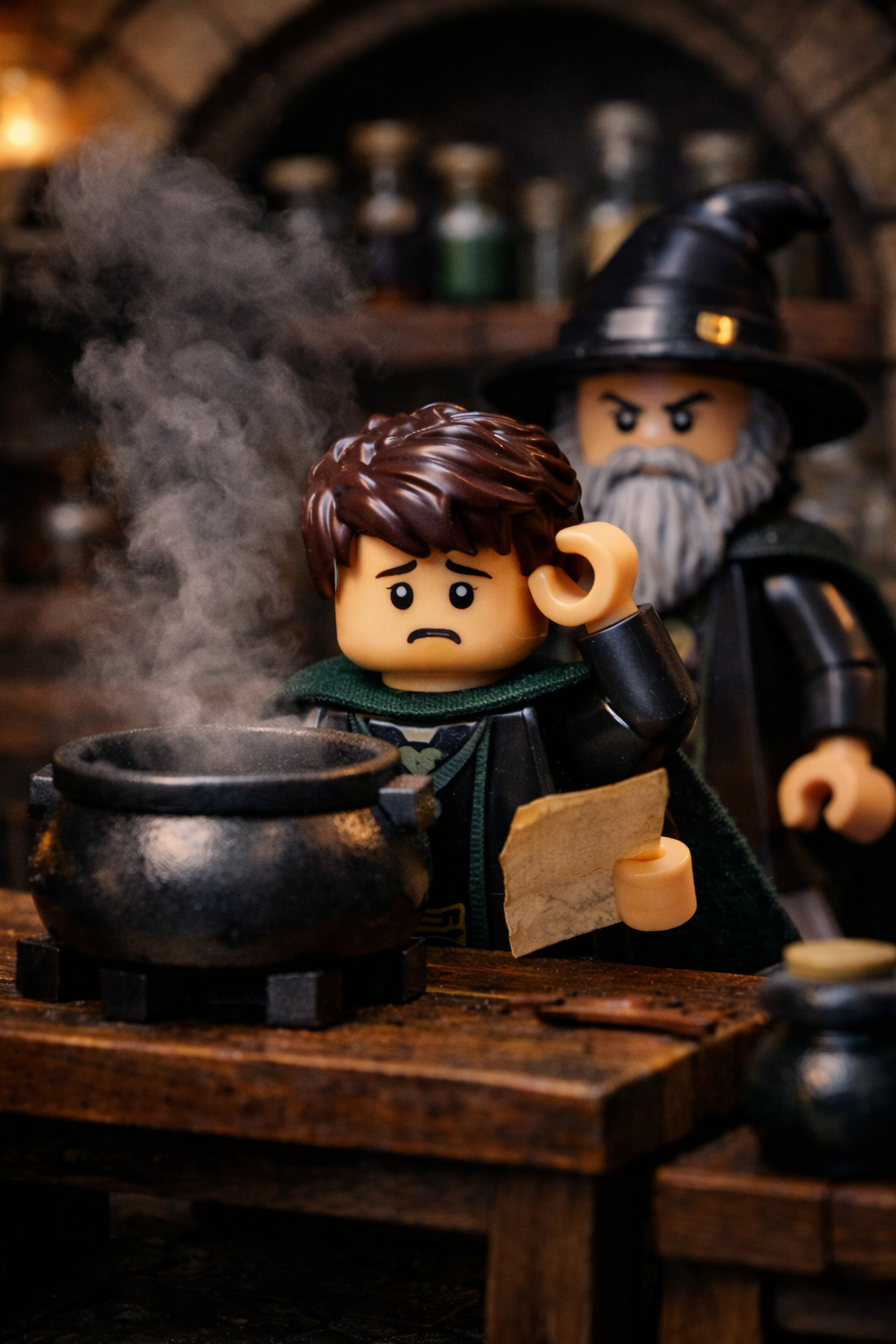
Minifigure student holding a parchment beside a smoking cauldron in a stone potion classroom, with a professor standing behind

Morning did not reach the lower halls all at once. It filtered, diluted by stone, arriving as a suggestion rather than a declaration. The lamps along the stairwell burned lower than usual, their green glass filmed with soot from last night’s work. Footsteps echoed cautiously, as if the stone itself were listening for what had been left behind.

The potions hall smelled changed. The usual chorus of herbs and minerals carried a thin, unfamiliar note—clean, almost metallic, like rain striking hot iron. Cauldrons sat where they had been abandoned, emptied but not silent. A faint haze clung near the ceiling, reluctant to leave.

The professor stood alone at the dais, ledger open now, pages turned to a place long memorized. They did not read. Their fingers traced a shallow groove in the wood, worn by years of leaning, waiting.

Students entered more quietly than before. Cloaks were clasped tighter. Conversations stalled and fell away. Eyes went to the center table, where the night before the smoke had learned how to stand.

The cauldron there was clean. Too clean. Its iron surface reflected the lamps with a clarity that felt improper. The student who had brewed it hovered nearby, uncertain whether to claim the space or retreat from it.

“Begin again,” the professor said, without preamble. “Same measure. Same restraint.”

Ingredients were redistributed, identical to the night before. The leaf, however, did not appear.

A murmur rippled, quickly swallowed. Students set to work, slower this time. Granules whispered against stone bowls. Resin fell by careful drop. Flames were coaxed, not commanded.

At the center table, the student paused longer than the rest. They stirred, then stopped. Waited. The smoke rose pale and tentative, unsure whether it would be allowed to remember.

The professor moved through the rows, closer now, their presence pressing against the work like a weather change. They paused beside one cauldron where the mixture trembled, adjusted nothing, and moved on. The tremble steadied anyway.

On the shelves, a jar ticked softly. Another answered. No one looked.

The smoke across the room varied—some thin and obedient, some thick with stubborn intent. None yet found that singular line.

At the center table, the smoke began to fold inward again, repeating the old motion as if retracing steps in the dark. The student’s hands tightened on the spoon. Their partner shook their head, just once.

“Do not chase it,” the professor said, voice low but immediate. “Let it decide.”

The student released the spoon. It rested against the cauldron’s rim, vibrating faintly. The smoke wavered, thinned, then surged—too fast. It darkened, the metallic note sharpening into something almost audible.

A hiss cut through the hall.

Flames leapt. Someone swore under their breath. The smoke at the center table collapsed, plunging back into the cauldron with a sound like breath forced from lungs. The room exhaled in startled unison.

The professor was there in a step, hand raised—not to stop the reaction, but to mark it. “There,” they said. “That is the difference.”

They reached into their sleeve and withdrew the leaf halves at last, still separate, veins dull now. They held them above the cauldron, close enough that heat curled their edges.

“Balance is not a trick you repeat,” the professor continued. “It is a conversation. You spoke too loudly.”

They let the leaf halves fall.

The reaction did not resume. Instead, the liquid cleared, settling into a depthless calm. The metallic scent faded, replaced by something softer, almost kind. The smoke rose again—not straight, not proud, but steady enough to be trusted.

The professor nodded once.

Pens scratched as notes were taken. Names still were not spoken.

As the class dispersed, the student at the center table lingered. When they finally stepped away, the cauldron chimed—just once—without heat or hand.

The sound followed them up the stairs, fading before it could be understood.

This is an original work of fiction created by Brick Crossing, inspired by the design themes of LEGO® set 76431.
LEGO® is a trademark of the LEGO Group, which does not sponsor, authorize, or endorse Brick Crossing.

Posted on

76431 – Chapter 1: The Measure of Smoke

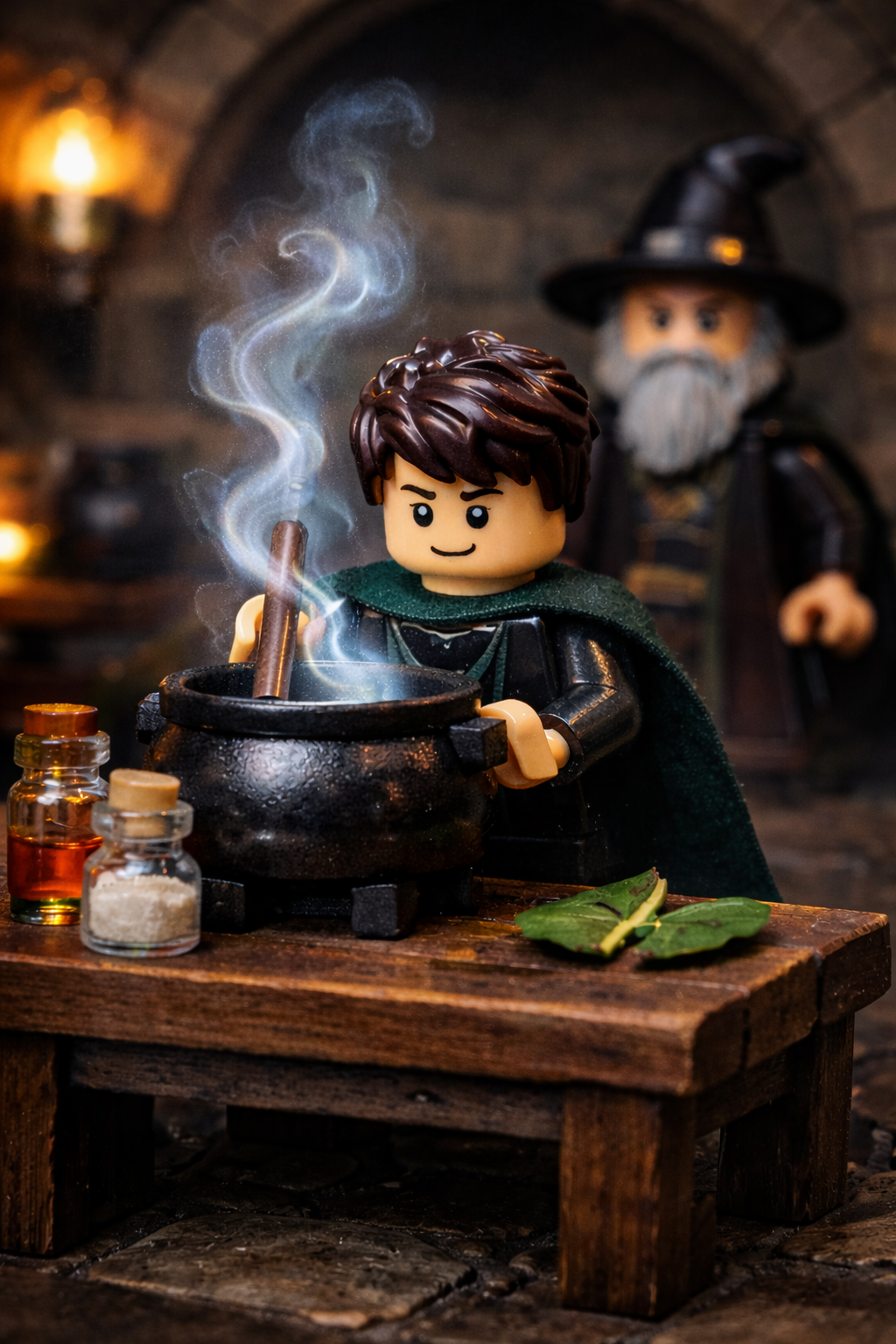
Minifigure student stirring a cauldron as pale smoke rises in a stone-walled potion classroom, with a professor watching in the background

The stairwell fell away into stone coolness, each step polished by generations of careful feet. Lamps burned low along the walls, their light caught in green glass and bent into softer hues. Below, the air thickened with mineral damp and the faint sweetness of crushed leaves. The hall waited, patient as a held breath.

A vaulted chamber opened at the stair’s end, ribbed with arches and lined by long tables worn smooth. Cauldrons sat in disciplined rows, black iron bellies dull with use. Shelves rose along the walls, crowded with jars—petals pressed flat as bookmarks, powders ground fine as ash, liquids that glimmered when no one was looking. At the far end, a teaching dais stood like a judge’s bench, scarred and steady.

Students filtered in, cloaks whispering. They took their places with the careful choreography of those who knew the room watched back. The lamps dimmed another notch. Somewhere, water dripped, counting time.

The professor arrived without announcement, a presence rather than a footfall. They set a leather-bound ledger upon the dais and did not open it. Their gaze moved along the tables, weighing hands, measuring posture, noting which eyes followed the cauldrons and which sought the shelves.

“Tonight,” the professor said, voice even as poured oil, “you will brew for balance. Not strength. Not speed. Balance.” A pause. “It will resist you.”

A ripple moved through the room. Balance was treacherous. It demanded patience and punished vanity.

Ingredients were distributed: a slate bowl of pale granules that smelled of rain; a vial of amber resin, warm to the touch; a bundle of roots, knotted and stubborn. A final item arrived last—a single leaf, dark-veined, cut into precise halves. The professor placed one half on each table, keeping the other half back.

“Do not begin,” they added, eyes narrowing, “until the smoke agrees with you.”

Flames were coaxed beneath cauldrons, blue tongues licking iron. Water warmed. Students crushed granules, measured resin by drop, teased fibers from roots. The first wisps of smoke rose, thin and white. It curled uncertainly, testing the air.

At one table, a student hesitated, fingers hovering over the cauldron. Their partner leaned in, whispering a count. Across the hall, someone rushed the resin, and the smoke darkened, sulking.

The professor moved between tables, silent as a shadow. They stopped once, adjusted a flame by the width of a fingernail, then continued. No praise. No rebuke.

The leaf halves waited.

As minutes stretched, the smoke began to change—thickening, thinning, responding to heat and hand alike. In some cauldrons it rose straight and proud. In others it sagged, restless. The students’ breathing fell into patterns, matching the slow rhythm of stir and pause. The hall seemed to lean closer.

“Now,” the professor said softly, and the word traveled farther than it should have.

Leaves slipped into cauldrons. The smoke answered.

At the center table, the smoke folded inward, not rising but pooling, a small storm contained by iron. It shimmered, colors chasing each other through gray. The student there froze, spoon mid-stir.

“Hold,” the professor said, sudden and sharp.

The hall stilled. Flames guttered lower as if obeying. The smoke at the center table thickened again, then—impossibly—thinned to a thread. It wavered, seeking equilibrium.

The professor approached, produced the second half of the leaf, and held it above the cauldron. “Balance,” they murmured, not to the student but to the smoke itself.

The leaf did not fall. It hovered, caught in the current, edges trembling. A breath passed. Another. Then the leaf split—no, unfolded—its veins lighting faintly as it became something else, a mirror of its other half yet not the same. The smoke steadied, rising in a single, calm column.

A sound escaped the room, collective and small.

The professor withdrew their hand. “Remember this,” they said, voice low. “The measure is not force. It is listening.”

At the far tables, mixtures corrected themselves or failed outright. One cauldron belched a dark plume that collapsed into itself, leaving only a bitter smell and a student blinking in surprise. Another shimmered, then went clear as glass.

The ledger on the dais opened at last. A pen scratched. Names were not read aloud.

As the lamps brightened, the professor’s gaze lingered on the steady column of smoke at the center table. It thinned, precise, as if memorizing the room.

Somewhere behind the shelves, a jar chimed once—unprompted.

The smoke held its line.

This is an original work of fiction created by Brick Crossing, inspired by the design themes of LEGO® set 76431.
LEGO® is a trademark of the LEGO Group, which does not sponsor, authorize, or endorse Brick Crossing.