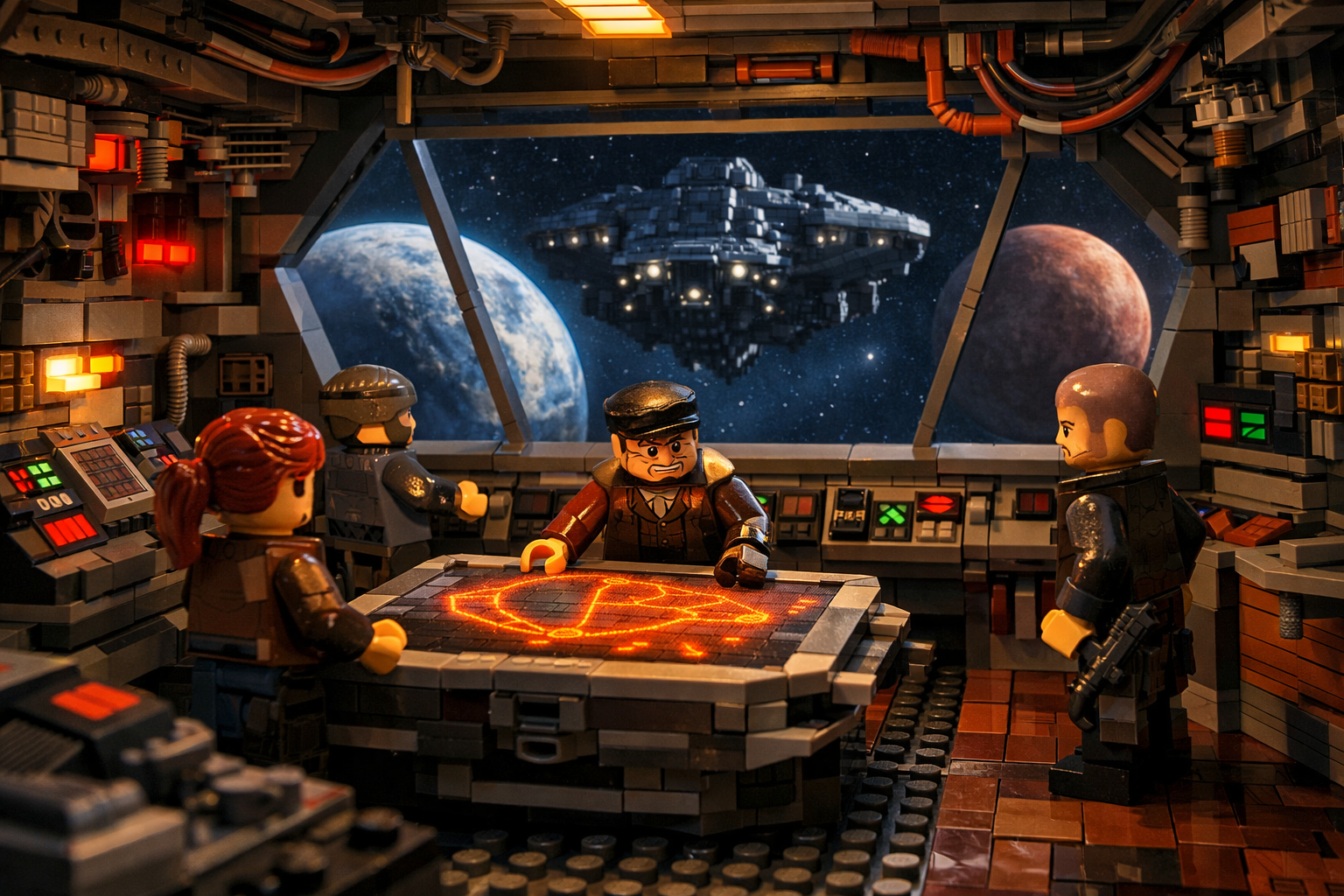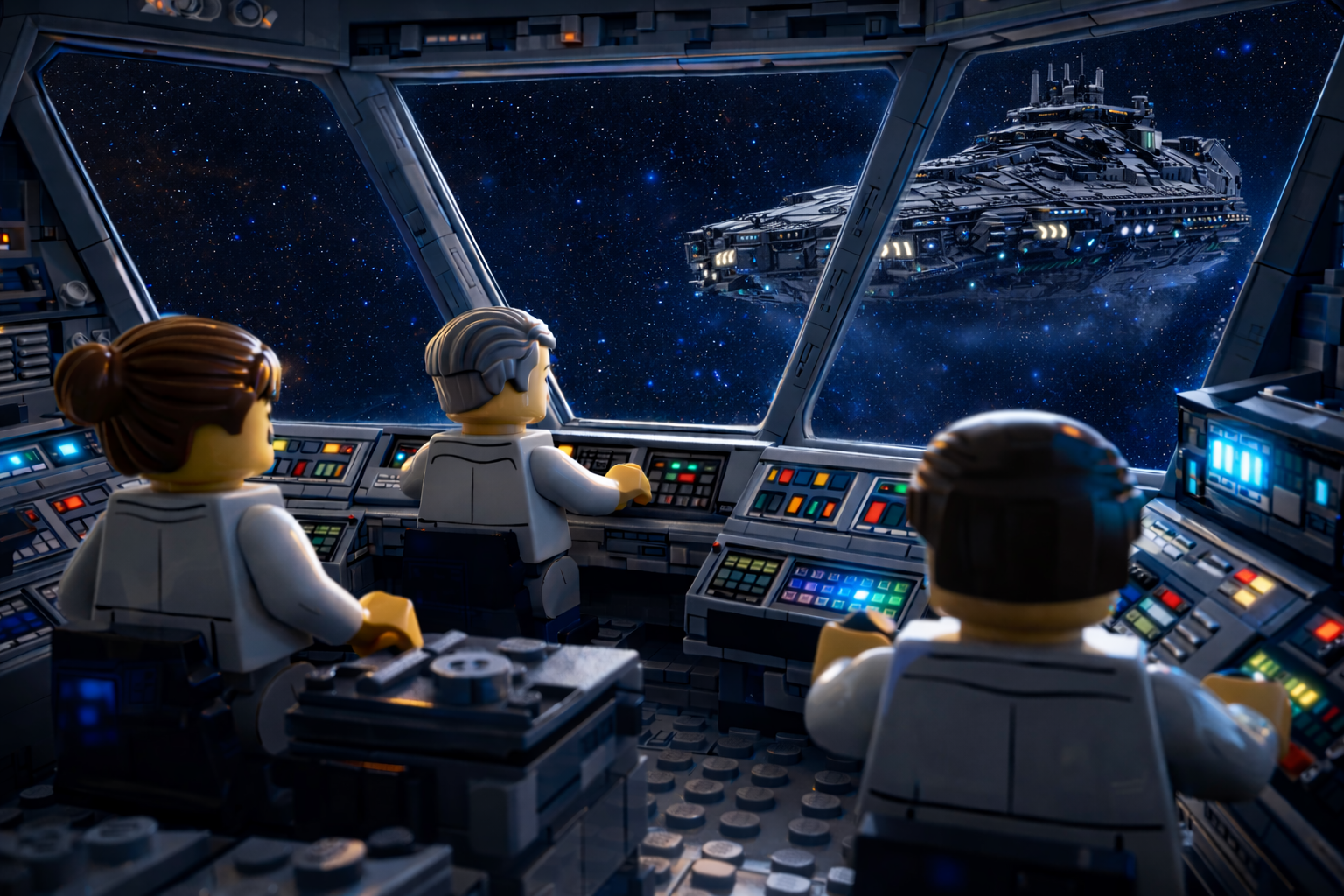
The diplomatic vessel drifted through starlight like a blade turned sideways—long, pale hull catching the cold in clean facets. Running lights were dimmed to a disciplined whisper. Ahead, a ribbon of scattered debris marked an old trade lane, the kind captains trusted because it had been trusted before.
Inside, the command deck was all angles and restraint: a narrow bridge with consoles set in tidy banks, handholds placed where bodies would reach in a hurry, and a forward viewport that made space look closer than it was. The crew spoke softly, not out of fear, but out of habit. Important ships learned to keep their voices low.
Captain Maera Dain stood at the center rail with her hands behind her back, posture steady enough to convince the room that steadiness was a choice. Her eyes moved over readouts without lingering—heat output, drive pressure, comm silence, external scan. The ship ran clean. Clean was a kind of prayer.
Then the stars ahead briefly blinked—not from distance, but from interruption—and the prayer broke.
“Contact.” The sensor officer’s voice was clipped, too controlled. “Wake signature, aft quadrant. Massive.”
Lieutenant Hal Marr, navigation, leaned in over his console as if proximity would change the numbers. “That’s not a patrol. That’s… that’s a wall.”
Maera didn’t turn. “Range.”
“Closing.” The sensor officer swallowed. “Fast.”
In the forward viewport, nothing changed. Space stayed silent, indifferent. But on the tactical display, a shape resolved from a smear into geometry—an enemy ship with lines that didn’t negotiate. Its signature was too clean, too confident, like a threat that had been polished.
“Transponder?” Maera asked.
“None,” comms replied. “No hails. No queries. No—” She stopped as a new warning tone bit into the bridge. “No courtesy.”
A dull tremor ran through the deck plating—subtle, but everyone felt it. The ship’s spine tightening.
Chief Engineer Orin Pell’s voice crackled up from below, threaded with static. “Bridge, I’m seeing a spike on the aft field. They’re painting us.”
Maera’s jaw set. “They’ve found us.”
Hal’s fingers hovered above the course controls. “Captain, we can dump into the debris ribbon. Mask our profile.”
“Do it,” Maera said. “Quietly.”
The ship angled, thrusters feathering. On the viewport, the debris lane widened—broken panels, fractured struts, glittering fragments that spun slowly like lazy knives. The diplomatic vessel slid toward it with the measured grace of something built for halls and hearings, not hunts.
“Comms,” Maera said, eyes still forward. “Send the packet.”
The comms officer hesitated only once. “Encrypted burst?”
“Yes. Short. If we die, I want the universe to at least know why.”
A single pulse of light left the ship—so quick it might have been imagination. Then silence returned, heavier than before.
They entered the debris lane. Metal fragments drifted past the viewport, close enough to see scoring, old burn marks, the quiet archaeology of past violence. The ship’s external lights remained low. The crew held their breath without meaning to.
“Thermal signature is down,” Orin reported. “We’re as cold as we can get without losing life support.”
“Good,” Maera murmured. “Stay alive.”
For a moment, the enemy ship’s icon on the tactical display wavered—its lock uncertain, its distance less definite. A small exhale moved through the bridge like wind.
Then the enemy ship corrected.
It didn’t slow. It didn’t circle. It simply came in after them, cutting through the debris lane as if the lane belonged to it. Objects that would have torn the diplomatic ship open were deflected by its forward field with casual cruelty, fragments flashing aside like sparks.
Hal’s voice went thin. “They’re not avoiding anything.”
“They don’t have to,” the sensor officer said. “Their field strength is triple ours.”
The ship trembled again—stronger this time. A warning light on the overhead panel flared: INCOMING.
“Brace!” Maera snapped.
The first impact was not an explosion, but a pressure—a lancing compression that struck the aft shields and shoved the whole vessel forward. Consoles flickered. A thin line of sparks ran like lightning across a junction panel. Someone swore, low and involuntary.
Orin’s voice surged through the comm. “Aft shields down ten percent in one hit. Captain, that wasn’t a warning. That was a measurement.”
Maera’s gaze locked on the tactical display. The enemy ship held distance with precision, matching their every adjustment. It didn’t need to close to kill them. It simply needed patience.
“Captain,” Hal said, “if we stay in the debris, we get carved up. If we leave, they get a clean shot.”
Maera’s hands unclasped behind her back. She gripped the rail. “Options.”
Silence answered first—the kind of silence that reveals how few options exist.
Then the comms officer spoke. “We have diplomatic codes. We can broadcast—”
“No,” Maera said, sharper than intended. “They already chose what we are.”
The sensor officer’s eyes widened. “Captain, I’m seeing a second lock. They’re targeting our drive cluster.”
Maera’s mouth tightened. “They want us intact.”
Hal looked up. “Boarding?”
“Or worse,” Maera replied. She turned at last, and the crew saw something in her expression that wasn’t fear—something colder, older. “They don’t chase a ship like this for cargo.”
Orin cut in again, breathless. “Bridge, if they shear the drive, we’ll tumble. We’ll still be alive when they reach us.”
The bridge lights dimmed as power rerouted. Somewhere in the ship, a door sealed with a heavy, final thud.
Maera leaned toward Hal’s console. “Plot for the ridge.”
Hal blinked. “The ridge?” He glanced at the nav display, where a jagged cluster of dark masses hung in space—an ancient field of shattered rock and metallic ice, dense enough to distort sensors. “That’s not debris. That’s—”
“A graveyard,” Maera finished. “And a place even a superior ship might hesitate.”
Hal’s fingers moved. The ship adjusted course, pushing hard now. The diplomatic vessel’s engines brightened slightly despite the effort to remain cold.
The enemy ship answered with another strike.
This one hit closer. The deck lurched. A crew member slammed into a console; another caught them by the shoulder before they fell. The viewport’s edge fractured with a spiderweb crack—transparent layers holding, barely.
“Report,” Maera demanded.
“Aft shields at sixty-eight,” the sensor officer said. “Drive cluster holding. Hull integrity—” She swallowed. “Holding.”
Maera nodded once. No comfort, no promise. Only motion.
As they approached the ridge, the stars seemed to thin. Shadow thickened between scattered boulders the size of towers. Ice crystals drifted like slow snow, catching the faint light and reflecting it in fractured, unreliable glints.
“Take us in,” Maera said.
Hal’s voice tightened. “Captain, our turning radius—”
“Take us in anyway.”
The ship slid into the graveyard field, close to the rocks, so close the bridge crew could see textures—pitted surfaces, seams of frozen metal, old impacts that looked like scars. The hull groaned as the ship’s field strained against micro-collisions.
For a few seconds, the enemy ship’s lock broke. Their tactical display turned fuzzy, uncertain. The enemy icon wavered.
The crew breathed again—just once.
Then the enemy ship entered the field after them.
It didn’t hesitate. It didn’t lose control. It moved like it belonged among the dead, like it had practiced here.
Maera watched the icon stabilize behind them and felt something in her chest tighten—admiration, unwilling and bitter. “They’re better,” she said quietly.
Orin’s voice came up, low and grim. “Better machinery. Better fields. Better everything except—” He paused as if choosing words with care. “Except what they’re missing.”
Maera turned her head a fraction. “And what is that, Chief?”
Orin exhaled. “Imagination.”
Hal glanced up. “Captain, we can’t outgun them. We can’t outrun them. We can’t—”
“We can mislead them,” Maera said.
On the forward console, a small panel blinked: AUXILIARY SYSTEMS. A map of internal compartments showed a sealed unit deep in the ship’s belly—an older module, rarely used. A diplomatic vessel carried many kinds of rooms, not all of them public.
Maera pointed. “Pell. Can you vent the reserve coolant into the aft field? Not as heat. As… clutter.”
Orin hesitated. “That’s risky. It’ll bloom our signature.”
“Yes,” Maera said. “A bloom they can’t resist.”
Hal’s eyes widened as he began to understand. “A false drive burn.”
Maera nodded. “Make them think we’re desperate enough to sprint.”
Orin’s reply came after a beat. “I can do it. It’ll look like we’re pouring everything into the engines.”
“And while they adjust to intercept,” Maera said, “Hal takes us down.”
Hal stared. “Down?”
“Into the ridge,” Maera said, voice steady. “There’s a pocket ahead—void shadow. If we dive into it and kill all output, they’ll overshoot. For a moment, they’ll have speed but no sight.”
Hal’s hands hovered again—uncertain, reverent. “If we misjudge, we don’t overshoot. We shatter.”
Maera’s gaze fixed on the starless gap between two massive rocks ahead. “Then we won’t misjudge.”
Orin’s voice came back, suddenly all business. “Bridge, on your mark, Captain.”
Maera lifted her chin. “Mark.”
The ship’s systems complied with a kind of reluctant obedience. A surge of false output flared—numbers spiking, warnings chirping, engine glow brightening. The diplomatic vessel, for a heartbeat, looked like a fleeing animal finally breaking into a sprint.
The enemy ship reacted instantly. Its icon leapt forward, closing distance to cut them off.
“Now,” Maera said.
Hal cut thrust—hard. The ship dipped, nose tilting toward the shadow pocket. External lights went dimmer still. Nonessential systems dropped. The bridge grew darker, quieter, as if the ship were holding its breath.
The void pocket swallowed their signature.
For a fraction of time, there was nothing—no warnings, no impacts—only the distant, muffled thunder of the enemy ship’s passage.
A white blur crossed the viewport, fast enough to hurt the eyes. The enemy ship slid past the gap they’d occupied, overshooting by a hair, its forward fields igniting drifting ice into bright, useless halos.
The crew didn’t cheer. No one moved. Even relief felt dangerous.
Then the tactical display updated.
The enemy ship did not continue forward.
It stopped—not with thrusters, but with a shift of mass and field that shouldn’t have been possible in this space. It pivoted with inhuman economy, already turning back, already reacquiring.
Hal’s voice was a whisper. “They anticipated the trick.”
Maera’s mouth went dry. “They learned.”
Orin’s comm hissed. “Captain… they’re charging something. I don’t know what, but the aft sensors—”
The bridge lights flickered. The viewport crack spread another line, tiny but ominous.
Maera’s fingers tightened on the rail until her knuckles whitened. “Helm,” she said softly, “give me anything you’ve got left.”
Hal’s hands moved, and the diplomatic vessel began to slide deeper into the graveyard’s shadow, threading between dead stone and frozen metal like a needle through cloth.
Behind them, the enemy ship’s presence grew—silent, advanced, relentless.
Maera watched the starless gap ahead narrow into a slit, then widen again into unknown dark, and felt the ship’s frame shiver like a living thing.
The enemy ship’s charge reached a pitch the sensors could no longer translate into numbers—only warning tones and a rising, impossible quiet.
On the command deck, every face turned toward the viewport as if the next second might finally explain what kind of hunter they had invited into the dark.
And then the lights went out.
This is an original work of fiction created by Brick Crossing, inspired by the design themes of LEGO® set 75376.
LEGO® is a trademark of the LEGO Group, which does not sponsor, authorize, or endorse Brick Crossing.