Posted on

The Flaw That Waited

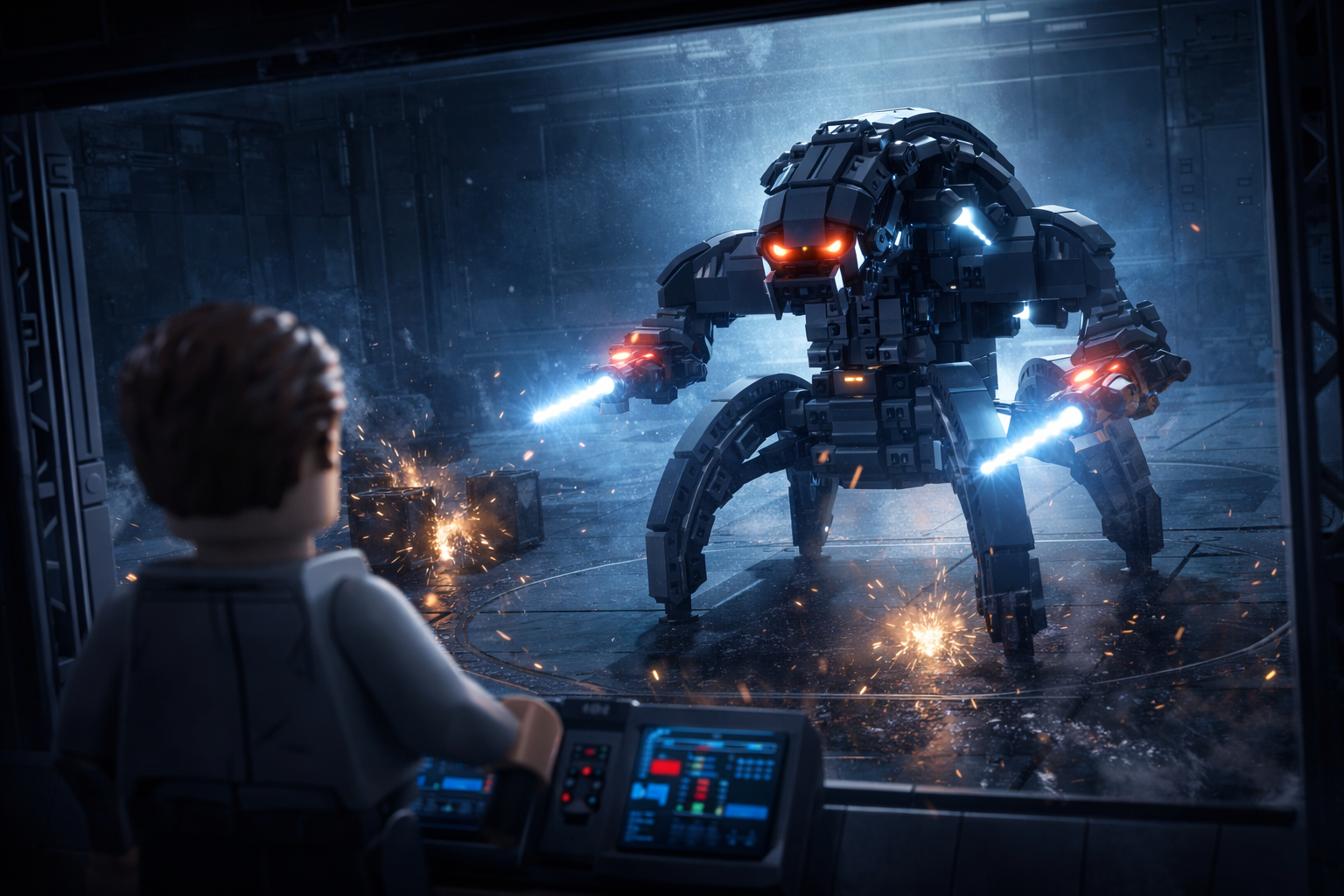
Brick-built rolling siege automaton rests inside a test chamber as an engineer watches from behind observation glass under dim laboratory lights.

The lab lights never truly turned off. They dimmed, they softened, they shifted from white to blue as the facility pretended to sleep—but the machines stayed awake, and so did the people who were told to build them.

Soren kept his hands steady as he aligned the last curved plate along the automaton’s chassis. The part clicked into place with a clean, satisfying sound that used to make him proud. Tonight it made him nauseous.

Behind the safety glass, the test chamber stretched wide and empty, its floor marked with concentric rings and impact-scored panels. The chamber looked like an arena without spectators. It smelled like sterile air and heated metal and the faint tang of ozone from charged fields.

The automaton sat in the center, compact in its resting posture—too compact for what it was capable of becoming.

On Soren’s wrist, his clearance band pulsed once: a silent reminder of who owned his time. On the console, a new message blinked: FINAL ACCEPTANCE TEST — SCHEDULED.

The machine was ready.

Sourced from his mind. Shaped by his hands. Paid for with his fear.

He hadn’t been hired for weapons.

He’d been hired for stability systems, for motion control, for field harmonics that kept mining platforms from shaking apart in high winds. He’d worked on rescue rigs once. Small things that lifted debris and saved people who couldn’t lift themselves.

Then an official in a crisp coat had visited his home with a polite smile and a folder of printed threats. Soren had been offered a choice that wasn’t a choice.

Build what they asked, and his family would be “protected.”

Refuse, and protection would be “reconsidered.”

His partner’s commute route had been described with uncomfortable accuracy. His younger sister’s clinic had been named. His father’s farm had been mentioned as if it were already ash.

Soren had signed the contract with a pen that shook.

After that, the facility became his world: corridors that swallowed sound, badges that tracked every step, cameras that watched even when they didn’t move. He was escorted to his workbench like a prisoner allowed the illusion of purpose.

The design brief had been deceptively simple:

A rolling siege automaton capable of rapid reconfiguration, personal shielding, and area denial.

Words that meant: unstoppable in a hallway. unapproachable in open ground. built to decide who gets to exist in a space.

Soren had built it anyway, because he could see his family’s faces every time he closed his eyes.

He had told himself a lie that fit neatly in his chest: If I build it well, it will end fights faster. If it ends faster, fewer people die.

Then he watched the simulation footage.

He saw it roll forward on the test floor, unfold with elegant speed, and raise a shimmering field around itself like a private storm. He saw the field flare and harden under impact, redirecting energy and shrapnel with indifferent efficiency. He saw the automaton advance without hesitation, its targeting systems choosing threats faster than humans could apologize for being in the wrong place.

In the footage, the “threats” were dummies.

In Soren’s mind, they were people.

The automaton didn’t care.

It wasn’t cruel.

It was obedient.

And obedience, Soren had learned, could be more terrifying than hatred.

A technician called from behind him. “Engineer Soren. They’re here.”

He didn’t turn immediately. He watched the automaton’s curved silhouette through the glass, the way it looked almost harmless when folded inward—like a shell.

Then he faced the door.

Three observers entered the lab: two armed escorts and a woman with a slate of data in her hands. The woman didn’t wear a uniform, but she moved like command, the air bending around her certainty.

“Final test,” she said. Not a greeting.

Soren nodded. “All systems are calibrated.”

Her gaze slid across the workbench, lingering on his tools as if she could see guilt in the oil stains. “The unit meets specification?”

“It exceeds it,” Soren said, and hated himself for sounding professional.

She stepped closer. “Then you understand what happens next.”

Soren’s throat tightened. “Field deployment.”

“Operational deployment,” she corrected. “Real targets.”

The word real landed like weight.

Soren glanced down at his hands. Grease under nails. Small cuts from sharp edges. Hands that had built rescue rigs and now built this.

He forced himself to ask the question he already knew the answer to.

“And my family?”

The woman’s smile was thin. “Safe. As long as you remain cooperative.”

An escort shifted, the quiet movement of someone reminding Soren that safety was temporary and conditional.

Soren nodded again because nodding was what people did when they were trapped.

The test chamber sealed with a hiss. Red status lights blinked. Speakers crackled.

“UNIT READY,” an automated voice announced.

Soren stood at the console, fingers hovering above the activation control. The observers watched from behind him. He could feel their attention like heat on the back of his neck.

This was the moment they would remember when the machine performed.

This was the moment Soren would remember when it didn’t.

He had added something.

Not a grand sabotage. Not a heroic failure. He wasn’t that brave. Bravery had consequences his family couldn’t afford.

He had added a flaw so small it looked like a rounding error: a tolerance shift in a joint actuator, a timing drift in the reconfiguration sequence—microscopic enough to pass diagnostics, significant enough to matter under stress.

It wouldn’t stop the automaton.

It might not even slow it.

But in the right moment, under sustained pressure, during a long advance, it could create a hesitation—a stutter in the folding motion, a brief instability in the field envelope.

A fraction of a second.

A window no one would notice unless they were desperate enough to watch for it.

Soren swallowed.

He pressed the control.

In the chamber, the automaton’s core lit with a cold pulse. It rose—smooth, controlled—then began to roll forward, compact and silent at first. It circled the ring markers as if measuring the world. Then a turret module unfolded, sensors rotating with predatory patience.

Targets rose from the floor panels: armored plates designed to mimic incoming fire.

The first impacts struck.

The automaton’s shield field flared to life—a shimmering dome that snapped into place with frightening speed. Energy splashed across it, dispersing outward like rain on glass. The machine didn’t retreat. It advanced, rolling straight into the barrage, field tightening, angles adjusting, the shield “learning” each strike and responding faster each time.

The observers murmured approval.

Soren tasted metal.

The automaton unfolded into its wider configuration, expanding its profile while maintaining the field. It fired.

The targets shattered.

It fired again.

The chamber filled with sparks and debris and the clean, clinical sound of dominance.

Soren watched for the flaw.

There—barely visible—during the third reconfiguration, the left joint paused a fraction longer than the right. The shield flickered at the edge, a momentary thinning that corrected itself before a casual viewer could register it.

But Soren saw it.

And for one single breath, he felt something like relief.

Not because the flaw was enough.

Because the flaw existed.

Because in a world where he had been forced to build a weapon, he had still managed to place one imperfect human fingerprint inside it—a quiet refusal hiding in the machine’s precision.

The woman beside him leaned in slightly. “Perfect,” she said.

Soren kept his face neutral. He kept his hands from shaking. He wanted to scream that nothing about this was perfect.

He said nothing.

The test ended. The automaton rolled back to the chamber’s center and folded into its compact posture again, becoming small, neat, almost innocuous.

A shell.

The chamber door opened. The escorts moved. The observers turned away, already thinking of deployment schedules and threat maps and how many lives could be rearranged by an obedient machine.

The woman paused at the lab door and looked back at Soren as if he were an object that had served its purpose.

“You did well,” she said.

Soren nodded because nodding kept his family alive.

When they were gone, he stood alone under the half-sleeping lab lights and stared at the automaton through the glass.

He imagined it in a real corridor. Real screams. Real impacts. Real people making choices they didn’t deserve to have to make.

He imagined the flaw, waiting.

Not as salvation.

As possibility.

Later, as the facility’s transport clamps locked around the automaton’s folded frame, Soren watched from a distance, unable to do anything but witness.

The crate’s seals engaged. The loading bay doors opened to night.

The machine left the lab that had birthed it.

Soren felt the weight of every future it might destroy.

And somewhere deep inside that folded shell, a tiny misalignment waited—patient, human, and almost certainly too small to matter.

The transport lights faded into the dark—

—and Soren closed his eyes as the world went quiet.

This is an original work of fiction created by Brick Crossing, inspired by the design themes of LEGO® set 75381.
LEGO® is a trademark of the LEGO Group, which does not sponsor, authorize, or endorse Brick Crossing.
Posted on

The Long Shadow

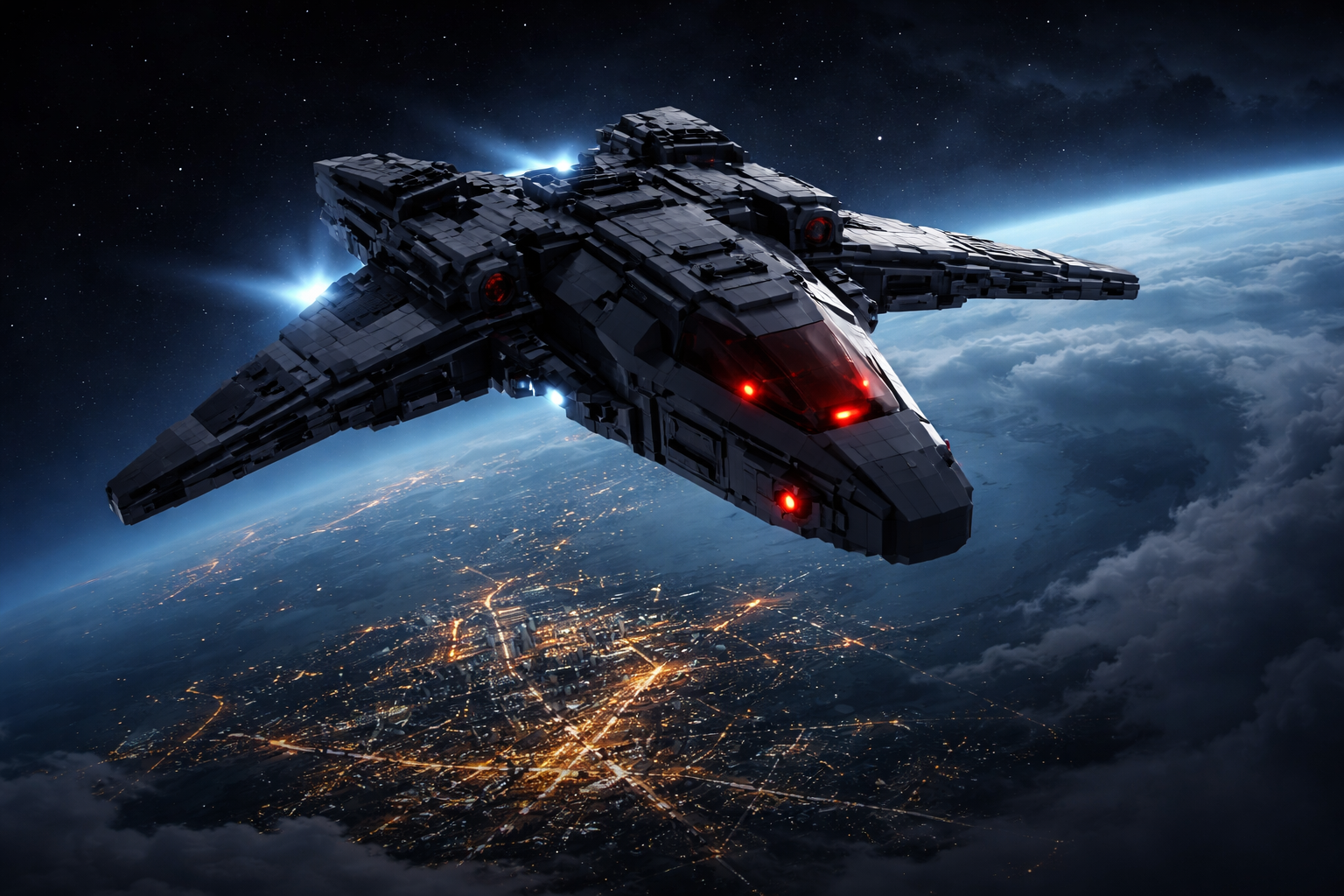
Brick-built stealth spacecraft hovers silently above a glowing city at night, barely visible against the darkness of space.

From high orbit, the city looked like a patient constellation—lines of light stitched across a dark hemisphere, pulsing in orderly rhythms that suggested comfort, routine, and control. Storm systems crawled at the planet’s edges, slow spirals of cloud that never quite touched the bright core.

Above it all, a craft hung in the black like a held breath.

Its hull didn’t catch starlight so much as refuse it. The surface swallowed reflections, bending the eye away in subtle ways that made it difficult to decide where the craft ended and space began. When it moved, it didn’t leave a trail—only the faint, momentary unease of noticing something you’d swear wasn’t there a second ago.

Inside, Vale sat alone with his hands resting lightly on the controls, as if gripping too hard might wake the world below.

He had been here for hours.

He could have been here for days.

Time behaved differently when you were waiting for someone else to make the first mistake.

The city’s defense grid was beautiful, in a predictable way.

Layers of radar and thermal sweeps, patrol arcs traced like clockwork, automated sentries that blinked at intervals engineered to prevent patterns from forming. Transponders chattered constantly—merchant traffic, security shuttles, maintenance crawlers, ceremonial flights whose only purpose was to reassure people that the sky belonged to them.

Vale watched it all from behind a veil of silence.

On the display, moving points of light drifted through the lanes. Vale’s ship didn’t mark itself. It marked others: their routines, their blind spots, the spaces between checks where certainty grew lazy.

A soft tone chimed once—an internal timer, not an alarm.

Vale inhaled, slow and controlled, and began a new scan pass. Not of the city. Of the defense crew.

A single shift supervisor, sleeping at his console again. A maintenance team rerouting power through a substation because a capacitor had been “acting strange.” An audit officer who kept delaying a security patch because it would inconvenience tomorrow’s ceremony.

People always thought the system mattered more than the people.

Systems didn’t break.

People did.

Vale’s gloved fingers moved, almost lazily, across a narrow panel. A sequence of silent queries flowed outward—not enough to trip defenses, not enough to register as intrusion. Just questions. Gentle ones. The kind that made the grid answer without realizing it was speaking.

The replies formed a map. Not of the city’s streets, but of its habits.

Vale leaned back a fraction.

There it was: a maintenance window scheduled to begin in seventeen minutes. A temporary thinning of the grid’s outer layer while power moved through alternate routes. The city would still be protected—on paper. In reality, it would be vulnerable in exactly one direction.

Vale smiled faintly, not out of joy. Out of recognition.

The world below had offered a door.

It didn’t know it had.

A voice crackled softly in Vale’s earpiece—encrypted, low bandwidth, close to the edge of hearing. “Confirm objective is still present.”

Vale didn’t answer immediately. He watched the city lights, the slow drift of clouds, the illusion of peace.

“Confirmed,” Vale said at last. “Cargo remains secured in the vault.”

“And the guards?”

“Confident,” Vale replied. “Which is another word for unprepared.”

A pause on the line, as if the other speaker was considering the cost of confidence.

“Bring it back,” the voice said. “No evidence. No attention.”

Vale’s eyes narrowed slightly. “Attention is a choice.”

Then he cut the channel.

Not because he didn’t trust the voice.

Because trust was a luxury. And luxury made you slow.

Vale checked their harness. Sealed his helmet. Adjusted the ship’s internal dampeners. Each motion precise, economical, ritual-like—not superstition, but discipline.

Seventeen minutes became twelve.

Vale began to fly.

The craft moved from its position above the planet with such controlled acceleration that there was no sense of “going.” It simply… wasn’t there anymore, and then it was somewhere else, slipping into the edge of the city’s sensor horizon like ink into water.

As the ship crossed into the outermost defense layer, Vale reduced output to near nothing. Engines dimmed. Heat sinks opened quietly, bleeding warmth into a reservoir that would hold it until the time came to release.

The grid swept.

Nothing detected.

A patrol shuttle passed beneath, its navigation lights bright and trusting. Vale watched it go, then slipped past its route with inches of distance that didn’t matter in space but mattered in principle.

The city’s orbit was full of movement. Vale belonged to none of it.

Maintenance window in three minutes.

Vale’s display flashed a soft warning: atmospheric entry corridor approaching. Normally, ships descended through controlled lanes—announced, verified, tracked.

Vale did not descend through a lane.

He slid into the shadow of a communications satellite and waited.

Below, the maintenance window began. A small cascade of systems shuffled priorities. Power diverted. Sensors blinked as they recalibrated. For thirty-two seconds, the grid was slightly less aware than it believed.

Thirty-two seconds was an eternity.

Vale angled the craft toward the opening and dove.

The hull shivered as thin atmosphere kissed it, friction trying to announce the ship’s existence in heat and light. The craft refused. Its surface swallowed the glow. Its shape cut through air as if the air was the one that should apologize.

Cloud layers rushed up. The city lights blurred behind mist. Vale adjusted course in micro-movements, threading between weather patterns that carried static enough to confuse sensors.

A faint pulse struck the craft’s side—an automated ping from a sky-lane checkpoint.

Vale held steady.

The ping passed, satisfied by the absence of response.

The ship crossed the last atmospheric layer and skimmed above the city’s outskirts, where industrial blocks sat like dark teeth and the air smelled of coolant and metal. Vale slowed, letting the craft become a shadow among shadows, then angled toward the heart.

The vault district rose ahead: a cluster of hardened towers, each layered with security fields and redundancies. The special cargo was inside the deepest one—a relic sealed for “public safety,” guarded not just by guns and cameras but by pride.

Vale’s ship drifted toward an unused service shaft on the tower’s underside—an intake left from construction days, now sealed by a simple plate and a sensor designed to catch lazy intruders.

Vale wasn’t lazy.

He released a small device from the ship’s belly. It fell silently, latched to the plate, and began to sing—too soft for human hearing, tuned instead to the sensor’s logic. The plate’s status read “secure.” The sensor agreed. The plate unlocked.

Vale guided the craft closer, just enough to align.

Then he cut the engines entirely.

The craft hung, inert, held by its own momentum and the thin forgiveness of physics. Vale unlatched the cockpit seal and moved to the deployment hatch with practiced calm.

Inside the suit, his breathing stayed slow.

Outside, the city’s air tasted like nothing through filters, but Vale imagined it anyway: the scent of busy lives, unaware they were about to lose something they didn’t even know they had.

The service shaft opened into darkness below. Far beneath, faint lights traced maintenance catwalks. Cameras rotated in steady arcs. Guards marched predictable routes, their boots echoing in a pattern that would be soothing if it weren’t so easy to memorize.

Vale clipped a line to the hatch frame and dropped into the shaft.

For the first time, the craft was truly alone above the city—silent, hidden, waiting.

Vale descended, body moving like a pendulum through cold air, past cables and beams and sealed panels. He passed within arm’s reach of a camera, timed their movement to its sweep, and continued down without a sound.

A door waited below—maintenance access to the vault’s underside. A keypad. A biometric lock. Two redundancies that existed mostly to make people feel safe.

Vale landed softly, unclipped the line, and stepped toward the door.

He placed a hand on the panel.

Not to force it.

To listen.

The keypad’s lights glowed faintly. The lock hummed. Behind the door, a pressure seal held a world of controlled air and controlled secrets.

Vale drew a slim tool from his belt—an elegant piece of metal with no markings. He pressed it into the panel seam.

The tool pulsed.

The door’s hum changed.

Somewhere above, far in the city’s sky, the maintenance window ended. The grid returned to full awareness like a waking mind, blinking, reassured, certain nothing had happened.

Vale smiled behind his visor.

Because nothing had happened yet.

The panel clicked.

The seal loosened.

And the door began to open.

A sliver of white light spilled into the shaft, slicing across Vale’s glove and the tool in his hand.

On the other side, footsteps paused—one guard, close enough to hear breathing if anyone breathed wrong.

Vale held perfectly still as the gap widened by millimeters.

Then the guard’s radio crackled with a routine message, and the footsteps turned away.

Vale slipped forward into the widening light—

—and the dark behind them closed like a mouth.

This is an original work of fiction created by Brick Crossing, inspired by the design themes of LEGO® set 75383.
LEGO® is a trademark of the LEGO Group, which does not sponsor, authorize, or endorse Brick Crossing or this content.