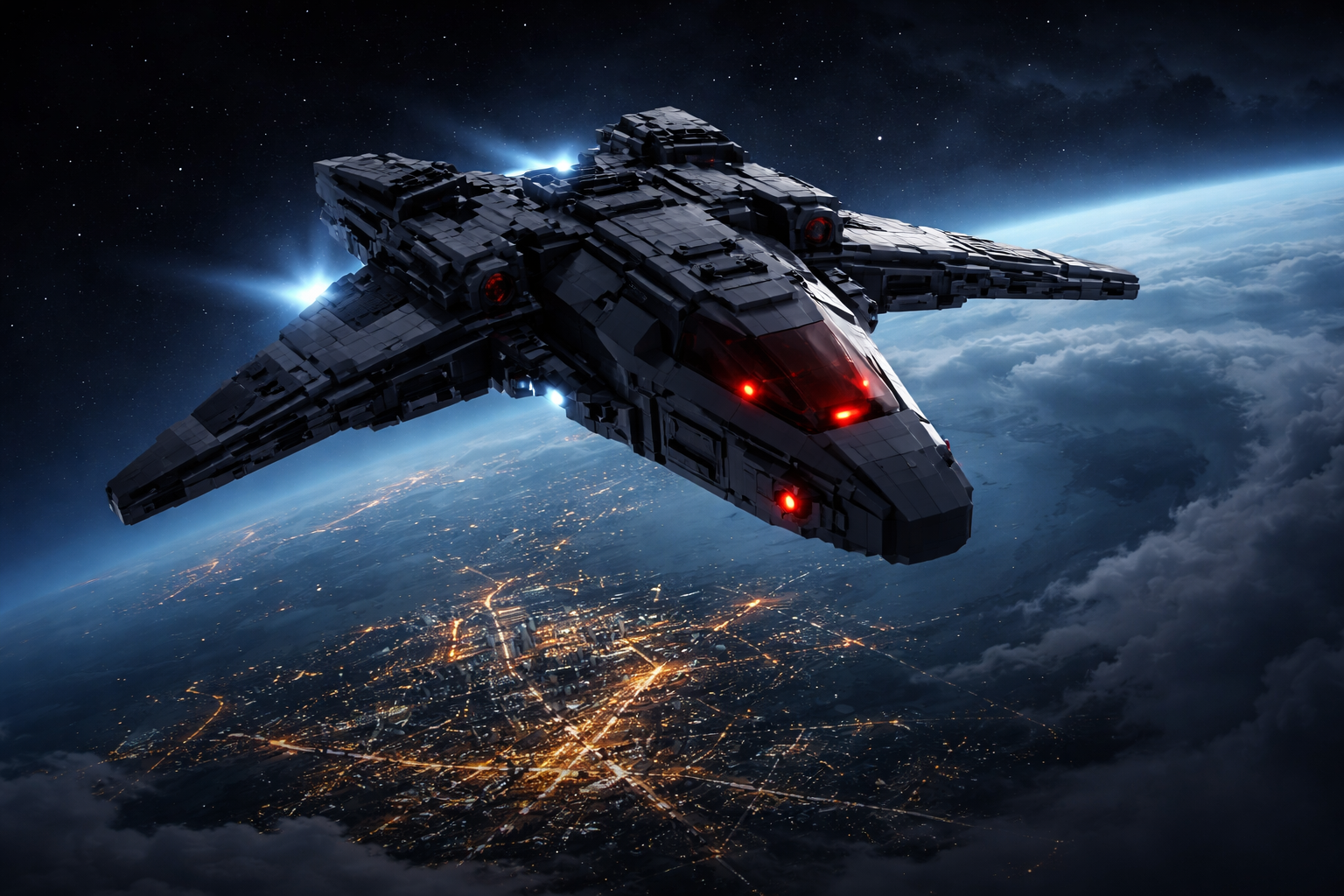
The lab lights never truly turned off. They dimmed, they softened, they shifted from white to blue as the facility pretended to sleep—but the machines stayed awake, and so did the people who were told to build them.
Soren kept his hands steady as he aligned the last curved plate along the automaton’s chassis. The part clicked into place with a clean, satisfying sound that used to make him proud. Tonight it made him nauseous.
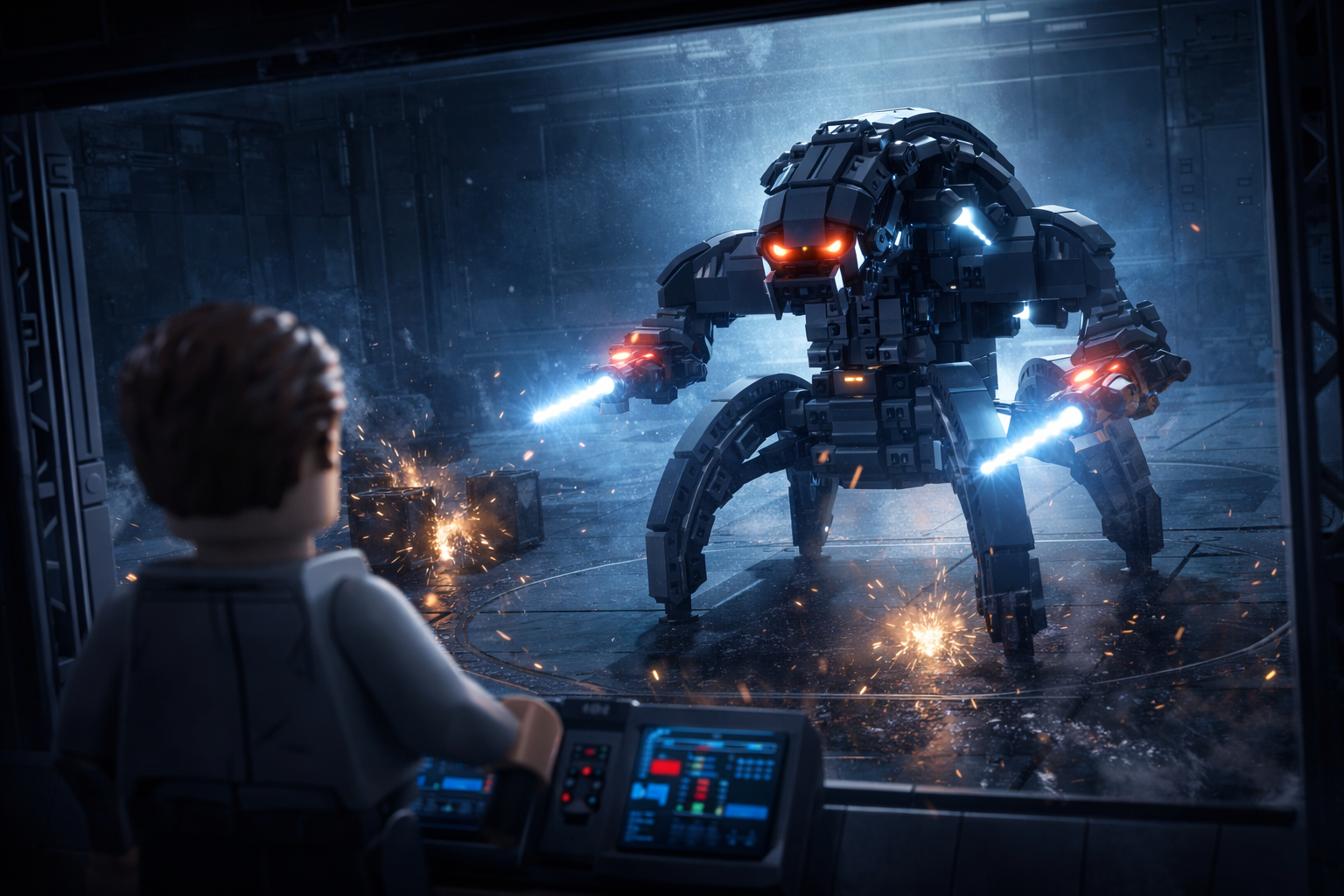
Behind the safety glass, the test chamber stretched wide and empty, its floor marked with concentric rings and impact-scored panels. The chamber looked like an arena without spectators. It smelled like sterile air and heated metal and the faint tang of ozone from charged fields.
The automaton sat in the center, compact in its resting posture—too compact for what it was capable of becoming.
On Soren’s wrist, his clearance band pulsed once: a silent reminder of who owned his time. On the console, a new message blinked: FINAL ACCEPTANCE TEST — SCHEDULED.
The machine was ready.
Sourced from his mind. Shaped by his hands. Paid for with his fear.
He hadn’t been hired for weapons.
He’d been hired for stability systems, for motion control, for field harmonics that kept mining platforms from shaking apart in high winds. He’d worked on rescue rigs once. Small things that lifted debris and saved people who couldn’t lift themselves.
Then an official in a crisp coat had visited his home with a polite smile and a folder of printed threats. Soren had been offered a choice that wasn’t a choice.
Build what they asked, and his family would be “protected.”
Refuse, and protection would be “reconsidered.”
His partner’s commute route had been described with uncomfortable accuracy. His younger sister’s clinic had been named. His father’s farm had been mentioned as if it were already ash.
Soren had signed the contract with a pen that shook.
After that, the facility became his world: corridors that swallowed sound, badges that tracked every step, cameras that watched even when they didn’t move. He was escorted to his workbench like a prisoner allowed the illusion of purpose.
The design brief had been deceptively simple:
A rolling siege automaton capable of rapid reconfiguration, personal shielding, and area denial.
Words that meant: unstoppable in a hallway. unapproachable in open ground. built to decide who gets to exist in a space.
Soren had built it anyway, because he could see his family’s faces every time he closed his eyes.
He had told himself a lie that fit neatly in his chest: If I build it well, it will end fights faster. If it ends faster, fewer people die.
Then he watched the simulation footage.
He saw it roll forward on the test floor, unfold with elegant speed, and raise a shimmering field around itself like a private storm. He saw the field flare and harden under impact, redirecting energy and shrapnel with indifferent efficiency. He saw the automaton advance without hesitation, its targeting systems choosing threats faster than humans could apologize for being in the wrong place.
In the footage, the “threats” were dummies.
In Soren’s mind, they were people.
The automaton didn’t care.
It wasn’t cruel.
It was obedient.
And obedience, Soren had learned, could be more terrifying than hatred.
A technician called from behind him. “Engineer Soren. They’re here.”
He didn’t turn immediately. He watched the automaton’s curved silhouette through the glass, the way it looked almost harmless when folded inward—like a shell.
Then he faced the door.
Three observers entered the lab: two armed escorts and a woman with a slate of data in her hands. The woman didn’t wear a uniform, but she moved like command, the air bending around her certainty.
“Final test,” she said. Not a greeting.
Soren nodded. “All systems are calibrated.”
Her gaze slid across the workbench, lingering on his tools as if she could see guilt in the oil stains. “The unit meets specification?”
“It exceeds it,” Soren said, and hated himself for sounding professional.
She stepped closer. “Then you understand what happens next.”
Soren’s throat tightened. “Field deployment.”
“Operational deployment,” she corrected. “Real targets.”
The word real landed like weight.
Soren glanced down at his hands. Grease under nails. Small cuts from sharp edges. Hands that had built rescue rigs and now built this.
He forced himself to ask the question he already knew the answer to.
“And my family?”
The woman’s smile was thin. “Safe. As long as you remain cooperative.”
An escort shifted, the quiet movement of someone reminding Soren that safety was temporary and conditional.
Soren nodded again because nodding was what people did when they were trapped.
The test chamber sealed with a hiss. Red status lights blinked. Speakers crackled.
“UNIT READY,” an automated voice announced.
Soren stood at the console, fingers hovering above the activation control. The observers watched from behind him. He could feel their attention like heat on the back of his neck.
This was the moment they would remember when the machine performed.
This was the moment Soren would remember when it didn’t.
He had added something.
Not a grand sabotage. Not a heroic failure. He wasn’t that brave. Bravery had consequences his family couldn’t afford.
He had added a flaw so small it looked like a rounding error: a tolerance shift in a joint actuator, a timing drift in the reconfiguration sequence—microscopic enough to pass diagnostics, significant enough to matter under stress.
It wouldn’t stop the automaton.
It might not even slow it.
But in the right moment, under sustained pressure, during a long advance, it could create a hesitation—a stutter in the folding motion, a brief instability in the field envelope.
A fraction of a second.
A window no one would notice unless they were desperate enough to watch for it.
Soren swallowed.
He pressed the control.
In the chamber, the automaton’s core lit with a cold pulse. It rose—smooth, controlled—then began to roll forward, compact and silent at first. It circled the ring markers as if measuring the world. Then a turret module unfolded, sensors rotating with predatory patience.
Targets rose from the floor panels: armored plates designed to mimic incoming fire.
The first impacts struck.
The automaton’s shield field flared to life—a shimmering dome that snapped into place with frightening speed. Energy splashed across it, dispersing outward like rain on glass. The machine didn’t retreat. It advanced, rolling straight into the barrage, field tightening, angles adjusting, the shield “learning” each strike and responding faster each time.
The observers murmured approval.
Soren tasted metal.
The automaton unfolded into its wider configuration, expanding its profile while maintaining the field. It fired.
The targets shattered.
It fired again.
The chamber filled with sparks and debris and the clean, clinical sound of dominance.
Soren watched for the flaw.
There—barely visible—during the third reconfiguration, the left joint paused a fraction longer than the right. The shield flickered at the edge, a momentary thinning that corrected itself before a casual viewer could register it.
But Soren saw it.
And for one single breath, he felt something like relief.
Not because the flaw was enough.
Because the flaw existed.
Because in a world where he had been forced to build a weapon, he had still managed to place one imperfect human fingerprint inside it—a quiet refusal hiding in the machine’s precision.
The woman beside him leaned in slightly. “Perfect,” she said.
Soren kept his face neutral. He kept his hands from shaking. He wanted to scream that nothing about this was perfect.
He said nothing.
The test ended. The automaton rolled back to the chamber’s center and folded into its compact posture again, becoming small, neat, almost innocuous.
A shell.
The chamber door opened. The escorts moved. The observers turned away, already thinking of deployment schedules and threat maps and how many lives could be rearranged by an obedient machine.
The woman paused at the lab door and looked back at Soren as if he were an object that had served its purpose.
“You did well,” she said.
Soren nodded because nodding kept his family alive.
When they were gone, he stood alone under the half-sleeping lab lights and stared at the automaton through the glass.
He imagined it in a real corridor. Real screams. Real impacts. Real people making choices they didn’t deserve to have to make.
He imagined the flaw, waiting.
Not as salvation.
As possibility.
Later, as the facility’s transport clamps locked around the automaton’s folded frame, Soren watched from a distance, unable to do anything but witness.
The crate’s seals engaged. The loading bay doors opened to night.
The machine left the lab that had birthed it.
Soren felt the weight of every future it might destroy.
And somewhere deep inside that folded shell, a tiny misalignment waited—patient, human, and almost certainly too small to matter.
The transport lights faded into the dark—
—and Soren closed his eyes as the world went quiet.
This is an original work of fiction created by Brick Crossing, inspired by the design themes of LEGO® set 75381.
LEGO® is a trademark of the LEGO Group, which does not sponsor, authorize, or endorse Brick Crossing.