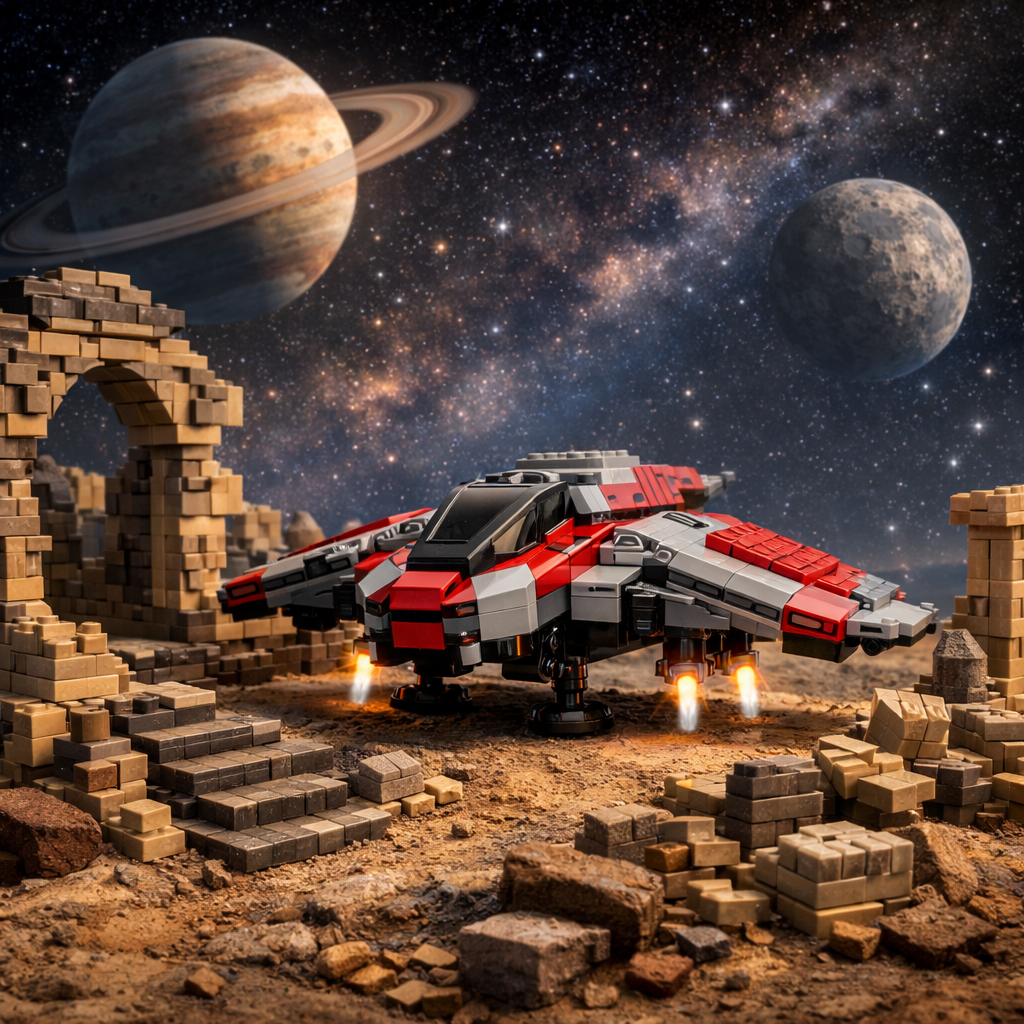
The ship moved the way a thought does—quiet, deliberate, almost reluctant to disturb the space around it.
Its hull cut a narrow path through the starfield, wings locked in a configuration meant less for speed than for balance. The engines emitted a steady, disciplined hum, tuned low enough that Rysa could hear her own breathing over it if she chose to listen.
She usually did.
Inside the cockpit, Rysa sat alone, hands resting lightly on the controls, posture straight without stiffness. Her movements were economical, practiced to the point of invisibility. No wasted gestures. No nervous checks. The ship responded before she asked it to.
That, too, was dangerous.
The nav display glowed with a long arc of plotted waypoints—worlds skirted but not entered, systems passed without comment. None of them were destinations. Only pauses between them.
Rysa had learned long ago not to linger.
Beyond the forward viewport, a planet rotated slowly into view. Its surface was fractured—vast deserts broken by old city scars, oceans reflecting starlight like polished stone. Once, it had been a center of learning. Or power. Or belief.
Once, many things had been gathered there.
Now, it was quiet.
The ship adjusted course automatically, dropping from transit into orbit with a softness that suggested respect.
Rysa exhaled.
THE WEIGHT OF SKILL
Rysa’s name no longer mattered in most places.
That had been true for a long time.
She had been trained by someone who believed discipline was a gift, and strength a responsibility. Someone who had taught her to listen before acting, to weigh intention against consequence, to move through conflict without becoming it.
That person had failed.
Or perhaps had succeeded too well.
Rysa did not dwell on the details. Dwelling was how grief turned into hesitation, and hesitation got people killed.
Her hands moved across the controls, initiating descent protocols. The ship’s wings adjusted, panels rotating with smooth, mechanical patience. Outside, the planet’s atmosphere caught the hull in bands of color—orange, then pale blue, then gray.
The ship did not shake.
It trusted her.
That trust pressed heavier than any accusation.
She touched down near the ruins of what sensors identified as an old complex—stone structures half-buried by time and sand, their geometry unmistakably deliberate. Not defensive. Not industrial.
Purposeful.
Rysa powered down the engines and sat in the silence that followed.
For a moment, she considered staying aboard.
She often did.
THE PLACE THAT REMEMBERED
The air outside was thin but breathable, carrying the scent of dust and old heat. The ruins rose in tiers, their surfaces etched with patterns worn smooth by centuries of wind. No banners. No markers. Nothing that claimed ownership.
That was how Rysa knew she was in the right place.
She moved through the complex slowly, boots crunching against fragments of fallen stone. The layout was familiar in a way that had nothing to do with memory and everything to do with intention—spaces designed for reflection, not command. For learning, not ruling.
Once, Rysa might have been greeted here.
Once, there would have been voices.
Now, there was only echo.
She stopped in a central chamber, its ceiling collapsed enough to let sunlight spill across the floor in uneven bands. At the center lay a circular platform, cracked but intact.
Rysa knelt beside it.
Her gloved hand hovered just above the stone, fingers twitching slightly—not in anticipation, but restraint.
She had been taught that power did not require proof.
So Rysa did not summon anything. Did not test the air. Did not reach.
She simply closed her eyes.
THE QUESTION THAT NEVER LEFT
Rysa had asked herself the same question on dozens of worlds, in different forms:
What does an order become when it no longer exists?
The answer was never simple.
Some believed the answer was revenge. Others chose erasure. Many tried to rebuild, copying rituals without understanding the reason behind them.
Rysa had chosen movement.
Movement kept her from turning bitter. Kept her from becoming the thing her teacher had.
But movement was also a kind of avoidance.
Her mentor had once told her that solitude sharpened purpose.
They had neglected to mention how heavy it became over time.
A gust of wind moved through the broken chamber, stirring dust into soft spirals. For a moment, the light shifted, and Rysa could almost imagine figures standing where the stone now lay empty—students listening, arguing, laughing.
She opened her eyes.
The vision faded.
Good.
Rysa rose to her feet, decision settling with quiet certainty. She did not belong to this place anymore. If she ever had.
Orders were not stone.
They were people.
And people needed help.
INTERRUPTION
The ship’s proximity alarm chimed—soft, insistent.
Rysa turned immediately, hand already moving toward the hilt at her side, senses sharpening not with panic but focus.
A small transport crested the horizon, engines sputtering unevenly. Its approach was careless, desperate. Damage scorched along its flank. No attempt at concealment.
Not a hunter.
A runner.
Rysa did not hide.
The transport landed hard near her ship, its ramp lowering with a hiss of strained hydraulics. Two figures stumbled out—one supporting the other, both clearly injured. They froze when they saw her, hands rising instinctively.
Rysa did not raise her weapon.
“Easy,” she said, voice calm, unadorned. “You’re safe. For now.”
They exchanged a glance—fear tempered by exhaustion.
“They’re coming,” one of them said. “We didn’t mean to—this place, we thought it was abandoned.”
“It is,” Rysa replied. “That’s why you’re here.”
The distant whine of engines confirmed it.
Rysa turned back toward her ship.
CHOICE WITHOUT AN ORDER
Rysa could leave.
That would be easy. Clean. Logical.
No one had told her to intervene. No council had assigned her to protect this place or these people. There was no doctrine that demanded her involvement.
But there had never been doctrine for this moment.
Only choice.
Rysa guided them aboard her ship with brisk efficiency, sealing the hatch as the first pursuer broke atmosphere—a gunship, angular and aggressive, weapons already charging.
The ship’s systems came alive under Rysa’s hands. Shields up. Engines primed. Wings adjusting.
The gunship fired.
Rysa did not return fire.
Instead, she rolled the ship into a tight arc, skimming low over the ruins. The gunship followed, confident in its superior armament.
Rysa smiled faintly.
Confidence was a familiar weakness.
She cut power abruptly, letting the ship drop behind a stone ridge. The gunship overshot, its targeting recalibrating too slowly.
Rysa surged upward, engines flaring, slipping past its blind spot and accelerating toward the upper atmosphere.
The gunship pursued—but not fast enough.
Within moments, she was gone, stars stretching into lines as the ship vanished into transit.
AFTER
The rescued figures sat quietly in the hold, wrapped in emergency blankets, staring at Rysa with a mixture of awe and confusion.
“You’re alone,” one of them said eventually. Not a question.
Rysa nodded.
“Why?” the other asked.
Rysa considered the answer.
“Because the order I belonged to is gone,” she said. “And because I haven’t decided what replaces it.”
They absorbed that in silence.
After a while, the first spoke again. “You didn’t have to help us.”
“No,” Rysa agreed. “I chose to.”
The ship hummed around them, steady and sure.
As the stars shifted outside the viewport, Rysa felt the familiar pull of the next place, the next need.
She did not know if she would ever stop moving.
But for now, movement was enough.
This is an original work of fiction created by Brick Crossing, inspired by the design themes of LEGO® set 75362.
LEGO® is a trademark of the LEGO Group, which does not sponsor, authorize, or endorse Brick Crossing.