Posted on

Where the Ground Finally Failed

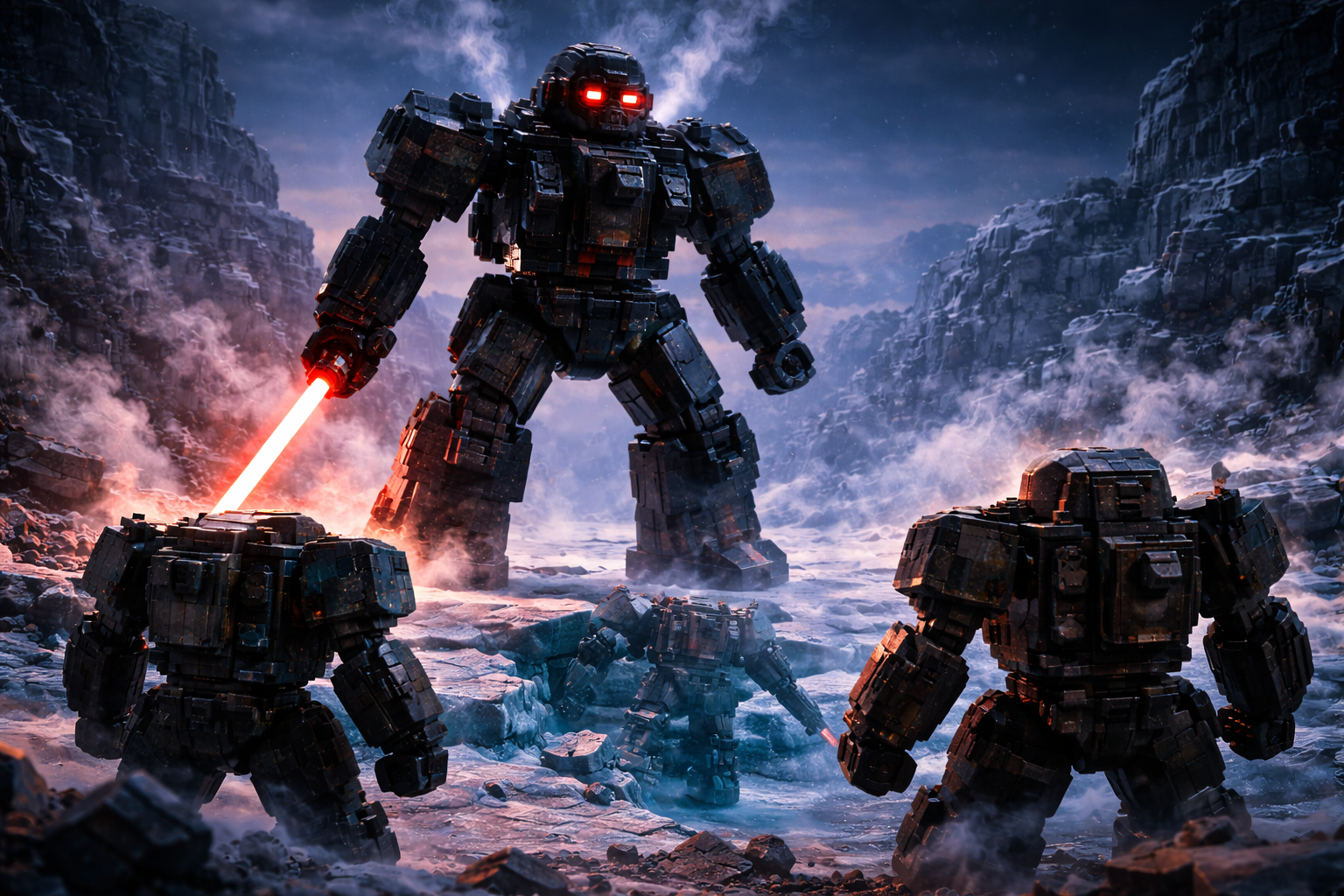
A towering brick-built mech confronts two smaller, battle-worn mechs on a frozen battlefield, steam rising as the ground fractures beneath overwhelming force.

The ground didn’t warn them this time.

That was the first sign something was wrong.

No tremor. No subtle shift in pressure. No sympathetic creak through the basalt shelf beneath Cairn Station. The ice lay still under the moon’s pale light, steam rising in its usual slow breaths, fissures glowing faintly like veins beneath skin.

Too calm.

Sergeant Lio stood at the observation slit, helmet tucked under one arm, eyes narrowed. After enough nights on this rock, stillness felt louder than motion.

“Anything?” Mira asked from behind him.

Lio shook his head. “That’s the problem.”

The outpost was quieter than it should’ve been after a fight. Repairs were underway, but even the clatter of tools seemed subdued, as if the station itself was listening.

Or waiting.

Below them, the fissure field bore fresh scars — collapsed ice plates, blackened steam vents, frozen wreckage half-swallowed by refreezing cracks. Proof that the ground had fought for them.

But the ground had limits.

The warning came not from below, but from above.

Kett’s voice cut through the comms, tight. “Contact. Single mass. High altitude descent.”

“One?” Mira frowned. “After what we did to them?”

Lio leaned closer to the slit. The stars above the ridge shifted — not clouds, not steam. A shadow moved against the sky, angular and deliberate.

Too deliberate.

“Bring up optics,” Lio said.

The image resolved slowly, reluctantly, like the sensors didn’t want to believe what they were seeing.

A mech.

Not a formation. Not a squad.

One.

It descended through the thin atmosphere on controlled thrusters, not burning, not rushing. Its silhouette was compact and brutal, armor layered thick and uninterrupted by the exposed compromises that defined every machine they owned.

No wasted lines. No patched seams.

It landed beyond the fissure field with a sound that wasn’t an impact, but a claim.

The ice did not crack.

The ground did not answer.

Mira swore under her breath. “That thing doesn’t care where it steps.”

Oren’s voice came in from the bay, strained. “Armor readings are… obscene. Power core’s stable. No venting. No hesitation.”

“They sent a message,” Kett said quietly.

Lio nodded. “They sent a solution.”

The mech took its first step forward.

Ice shattered — not unpredictably, not with the familiar spiderweb fractures — but cleanly, deliberately, as if the weight was calculated to break only what it chose.

Steam vented uselessly against its legs, dispersing without effect.

It wasn’t fighting the ground.

It was overruling it.

Mira watched the display, jaw tight. “We can’t bait that. We can’t fold ice under it.”

“No,” Lio said. “We can’t.”

The mech stopped at the edge of the fissure field. Its head unit angled slightly, scanning.

Considering.

Then it stepped forward again.

The ground failed.

Not catastrophically — worse. It complied. Plates fractured, but not enough. Vents burst, but too shallow. The mech adjusted in real time, compensators absorbing what should have thrown it off balance.

Every trick they’d learned… already accounted for.

Oren’s voice dropped. “It learned.”

Lio felt the weight of it settle in his chest. “No. It was built knowing.”

Behind them, another sound joined the wind — the slow activation hum of older machines being powered up out of habit more than hope.

Mira turned toward the bay doors. “We still fight.”

Lio didn’t answer immediately.

The mech in the distance raised one arm.

Not to fire.

To point.

At Cairn Station.

A targeting lock bloomed across their displays — clean, narrow, absolute.

Kett’s voice wavered. “It’s not advancing. It’s… measuring.”

Mira slammed her helmet on. “Then let’s give it something it can’t calculate.”

They moved anyway.

Old steel against new certainty.

The bay doors opened, spilling cold wind and steam across the floor. Mira’s mech limped out first, scars still fresh, joints complaining. Lio followed, heavier, slower, armor patched with the history of nights survived.

The fissure field lay between them and the enemy like a memory.

The mech watched them approach.

It did not move.

Mira fired first — not at the mech, but at the ice beneath it. Steam erupted. The ground convulsed.

The mech stepped sideways.

Perfectly.

Lio charged, driving his machine forward, slamming a heavy strike into a weak seam they’d used a dozen times before.

The ice collapsed.

The mech sank… half a meter.

Then stabilized.

It reached out and caught Lio’s mech mid-motion, fingers locking around armor that had held through wars.

Metal screamed.

Mira shouted his name.

The enemy mech didn’t crush him.

It lifted him.

Held him there.

A demonstration.

Then it released.

Lio’s mech hit the ice hard, systems flaring, armor caving in along the shoulder. He didn’t move.

Mira fired again, again, again — everything she had. Bolts splashed uselessly against layered plating that didn’t even glow.

The mech turned its head toward her.

And stepped forward.

For the first time since they’d arrived on this moon, the ground had nothing left to offer.

Inside his cockpit, Lio forced his systems back online, alarms screaming. He looked at the fissures, the steam, the ice they’d trusted.

Not betrayed — just outmatched.

“Fall back,” he said quietly.

Mira hesitated.

“That’s an order.”

She did, reluctantly, dragging her damaged mech back toward the outpost as the enemy machine advanced at a measured pace, never rushing, never panicking.

Behind them, the fissure field froze solid again — erased.

The mech stopped at the ridge line and stood there, watching the outpost lights flicker.

Not destroyed.

Warned.

When it finally turned away and ascended back into the sky, the ground remained silent.

Later, in the bay, Lio sat with his helmet in his hands. Oren worked wordlessly on crushed armor. Mira leaned against a crate, eyes distant.

Kett broke the silence. “So… what now?”

Lio looked at the scarred floor, the patched machines, the ground that had taught them everything it could.

“Now,” he said, “we stop pretending the ground will save us.”

Mira met his gaze. “Then what will?”

Lio stood slowly. “Each other.”

Outside, the moon breathed on.

But it no longer listened.

See Other Mech Related Stories:

Where the Ground Finally Failed is the 3rd story related to Mech’s. See below for the stories that came first.

This is an original work of fiction created by Brick Crossing, inspired by the design themes of LEGO® set 75368.
LEGO® is a trademark of the LEGO Group, which does not sponsor, authorize, or endorse Brick Crossing.
Posted on

What the City Still Demanded

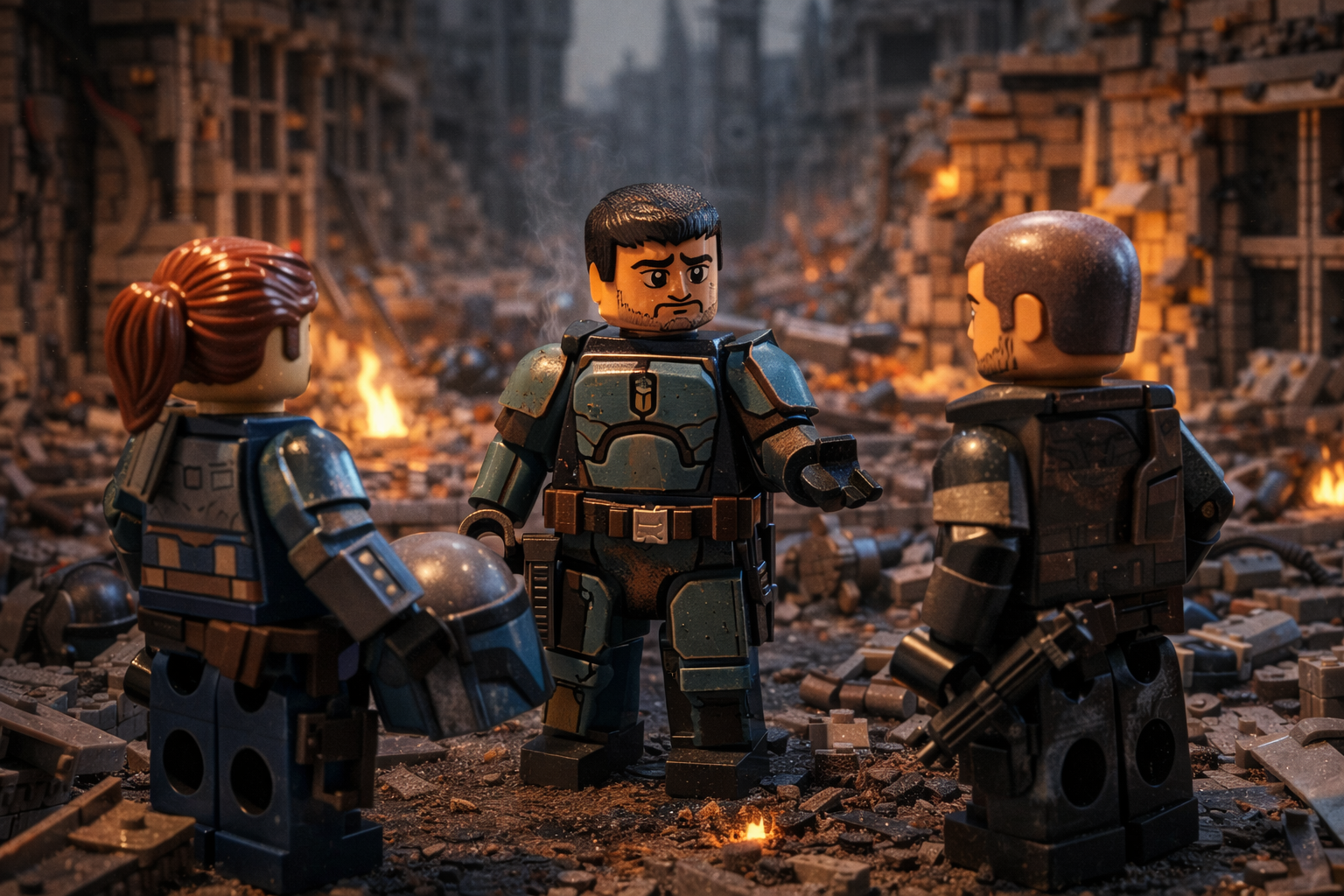
Brick-built armored figures stand face-to-face in a ruined city after a battle, smoke rising behind them as they confront the cost of survival.

The city was dead, but it had not finished asking for things.

Stone towers lay broken across one another like fallen giants, their edges snapped clean where old weapons had done their work with surgical indifference. Streets that once carried processions now carried dust, ash, and the occasional echo—sound that lingered too long because there was nowhere left to absorb it.

The squad moved low through the ruins, armor scraping softly against brick and shattered tile. They did not speak. Voices were liabilities here.

Rhen Tal led, visor angled downward, reading the ground the way some read stars. Footprints told stories. Scorch marks remembered arguments. The city kept records whether anyone asked it to or not.

Rhen raised a fist.

The line halted.

Above them, a fractured balcony sagged, its supports cracked but holding. To the left, an alley narrowed into a choke point between collapsed walls. To the right, an open plaza—too open, too honest.

Rhen tapped two fingers against his chest, then pointed left.

Ambush ground.

Behind him, Kala Vos shifted her weight, weapon cradled but not aimed. She didn’t like ambushes. Too close to traps. Too close to luck. But the city had already decided where the fight would happen.

Further back, Jarek Pell paused near a fallen statue, one hand brushing the engraved stone. The figure’s face was gone, shattered into anonymity. Jarek lingered a half-second longer than necessary before moving on.

Honor remembered. Survival moved.

They took positions without instruction.

Rhen climbed the broken stairwell, settling into shadow above the alley mouth. His armor blended with the ruin, colors dulled by dust and time. From here, he could see movement patterns, predict lines of advance.

Kala slipped behind a half-collapsed wall, sightline covering the plaza edge. She adjusted her grip, checked her power cell. Everything worked. That made her nervous.

Jarek crouched near the statue base, back to stone, eyes scanning the upper windows. “Too quiet,” he muttered, barely audible over the whisper of wind through rubble.

Kala didn’t look at him. “Cities don’t go quiet by accident.”

Rhen’s voice came through the squad channel, low and steady. “Contact incoming. Multiple. Not rushing.”

Figures emerged at the far end of the plaza—armored silhouettes moving with confidence that hadn’t been earned here. Their gear was newer. Cleaner. Their steps heavier, louder against broken stone.

“They think the city belongs to them,” Kala said.

“They think wrong,” Jarek replied.

The lead enemy raised a hand. The group slowed, spacing out. Professional. Careful.

Rhen felt a familiar tightening in his chest—not fear, not excitement, but something older. The pull between what he’d been taught and what the city required.

He marked targets silently. Left flank. Center mass. Rear guard.

“Wait,” Rhen said.

Kala exhaled through her nose. “If we wait much longer—”

“I know,” Rhen replied. “Wait.”

Below, the enemy squad advanced another ten meters. One of them kicked debris aside with casual disrespect.

Jarek’s fingers tightened on his trigger. He glanced again at the faceless statue beside him.

Honor had once lived here.

“Now,” Rhen said.

THE AMBUSH

The city answered first.

Rhen fired downward, his shot precise, controlled—no flourish, no waste. The lead enemy went down hard, armor ringing against stone. Kala’s fire followed an instant later, stitching the plaza edge with disciplined bursts that forced the rest into cover.

Jarek moved last, not because he was slow, but because he was choosing.

He rose from behind the statue and fired at the second rank, shots angled to herd rather than kill. The city’s broken geometry did the rest—ricochets, falling debris, panic.

The enemy scattered, formation breaking under pressure they hadn’t anticipated.

“Push,” Rhen ordered.

Kala vaulted the wall, landing light despite her armor. She advanced with purpose, weapon steady, eyes sharp. This was where survival lived—forward, aggressive, denying the enemy time to think.

A return shot clipped her shoulder plate, spinning her half a step. She grunted but stayed upright.

“Still breathing,” she said. “Barely offended.”

Jarek moved to cover her, firing from the hip, forcing the enemy back into the alley choke. His shots were fast, angry.

Too angry.

“Jarek,” Rhen snapped. “Control.”

Jarek didn’t answer.

Instead, he advanced into the alley, boots crunching over rubble, breathing hard. An enemy rose in front of him, weapon shaking.

For a heartbeat, they stared at each other.

The enemy was young. Scared. Alive.

Jarek hesitated.

The city did not.

A shot rang out from above—enemy fire from a window they’d missed. It struck the wall inches from Jarek’s head, spraying stone shards.

Kala fired upward instantly, silencing the threat.

Rhen dropped from his perch, landing between Jarek and the enemy without ceremony. He fired once.

The enemy fell.

Silence followed—not peaceful, just empty.

THE COST

They regrouped among the ruins, weapons lowered but not slung. Dust drifted through sunlight like ash remembering fire.

Kala checked Jarek’s faceplate. “You froze.”

Jarek looked away. “I remembered.”

Rhen removed his helmet, breathing the city’s stale air. “Memory gets you killed.”

Jarek met his eyes. “So does forgetting.”

The city creaked around them, old structures settling, making room for the dead.

Kala broke the tension first. “We won. That’s what matters.”

Rhen shook his head. “We survived. That’s not the same thing.”

He looked out over the plaza—new scorch marks layered over old ones, history repeating itself with different armor.

“This place doesn’t care why we fight,” Rhen said. “Only how.”

Jarek knelt by the fallen statue again, brushing dust from the broken engraving. “It used to.”

Kala softened, just slightly. “Maybe. But it doesn’t anymore.”

Rhen replaced his helmet. “Then we adapt.”

They moved on, deeper into the ruins, leaving the city to tally its losses.

Honor followed them like a shadow.

Survival walked ahead.

This is an original work of fiction created by Brick Crossing, inspired by the design themes of LEGO® set 75373.
LEGO® is a trademark of the LEGO Group, which does not sponsor, authorize, or endorse Brick Crossing.