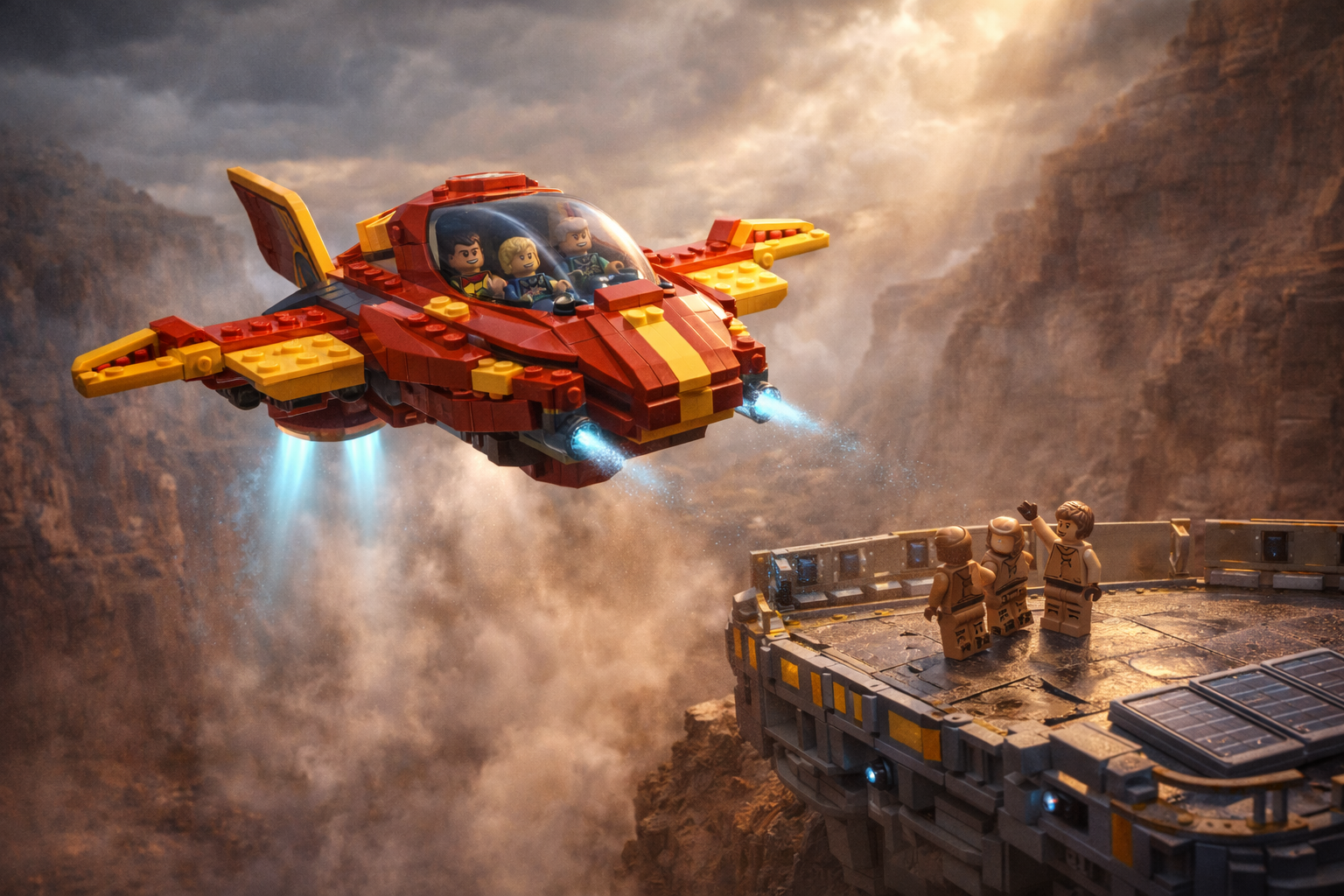
The ship had a habit of gleaming even when the sky didn’t.
As it skimmed low over the canyon walls, its red hull caught what little sunlight filtered through the clouds and scattered it outward, turning gray air into something warmer. The effect wasn’t accidental. Whoever had painted the ship had believed—very firmly—that if you flew into trouble, you should bring a little color with you.
Inside the cockpit, three voices talked at once.
“Altitude steady,” said Tavi, hands tight on the controls, eyes locked forward.
“Wind shear’s picking up on the left,” called Jun from the sensor seat.
“And the beacon is definitely down there,” added Koro, leaning too far toward the forward viewport and pointing at nothing specific.
Tavi didn’t look away from the canyon. “I know it’s down there. That’s why we’re here.”
The canyon opened beneath them like a long, twisting scar across the planet’s surface—layers of orange and rust-colored stone carved by storms older than any map. Somewhere near the bottom, a research outpost had gone silent during a routine survey flight. No distress call. No explosion. Just quiet.
Quiet was worse.
“Remember,” Jun said, adjusting the scanner. “We’re not here to be heroes. We’re here to help.”
Koro grinned. “Helping is heroic.”
Jun rolled her eyes, but she smiled too.
The ship dipped lower, engines humming in a steady, confident rhythm. It wasn’t a warship. It wasn’t fast in a straight line. But it handled turns like it was born in places exactly like this.
The canyon narrowed.
“Hold on,” Tavi said.
They dropped.
The outpost clung to the canyon wall like it had grown there—metal platforms bolted into stone, solar panels folded inward, lights dim but still active. A small transport lay half-tipped on a landing pad, one stabilizer snapped clean through.
Jun leaned closer to the scanner. “Life signs. Three. Faint, but steady.”
Relief swept through the cockpit.
“See?” Koro said. “Quiet isn’t always bad.”
“Quiet is still quiet,” Tavi replied, angling the ship toward the pad. “Let’s keep it that way.”
The wind surged as they approached, slamming into the canyon walls and rebounding unpredictably. The ship shuddered once, then corrected itself.
“Manual landing?” Jun asked.
Tavi nodded. “Manual landing.”
Koro fastened his harness tighter. “I like it better when you say that confidently.”
“I always say it confidently.”
“That’s what worries me.”
The ship touched down with a soft jolt, landing gear flexing but holding. Dust billowed up around them, swirling like fog before settling back into the canyon’s depths.
For a moment, nothing happened.
Then a hatch on the outpost slid open.
A figure waved both arms wildly.
They didn’t rush out.
That was the first lesson their mentor had drilled into them: moving fast is not the same as moving smart.
Tavi powered down the engines and sealed the ship. Jun ran another scan. Koro checked the emergency kits twice, then checked them again just to be sure.
When they stepped onto the platform, the wind tugged at their jackets and tried to steal their words.
“You came,” said the outpost lead, voice cracking with relief. “We thought—well, we hoped someone would notice.”
“We noticed,” Jun said gently.
The situation became clear quickly. A sudden electrical surge—caused by a rare mineral reaction in the canyon walls—had knocked out the outpost’s long-range comms and crippled the transport. Repairs were possible, but not before nightfall.
And nightfall, down here, meant storms.
“Can you fly us out?” one of the researchers asked, eyes darting to the clouds already thickening above.
Tavi glanced back at the ship.
It could carry them. Barely.
“We can,” she said. “But it’s going to be tight.”
Koro’s grin returned. “Tight is still possible.”
Jun met Tavi’s eyes. A silent question passed between them.
Tavi nodded.
“Let’s load up,” she said. “Before the canyon decides otherwise.”
They were halfway through boarding when the wind changed.
Not stronger.
Different.
The ship rocked, landing gear screeching as a gust slammed into the platform from below. Warning lights flickered inside the cockpit.
Jun shouted over the wind, “Storm front just accelerated! We’ve got minutes—maybe less!”
The researchers scrambled aboard, fear sharp but controlled. Tavi sealed the hatch and sprinted for the pilot’s seat.
The ship lifted unevenly, engines straining as crosswinds clawed at its sides.
“Stabilizers aren’t happy,” Koro reported, gripping the console. “They’re arguing with gravity.”
Tavi adjusted the controls, jaw set. “Then tell them gravity doesn’t get a vote today.”
They rose just above the platform when a violent downdraft slammed them sideways.
The canyon wall rushed up in the viewport.
Jun gasped. “Tavi—!”
“I see it!”
Tavi pulled hard, cutting thrust at the last second and rolling the ship sideways instead of up. The move was risky—counterintuitive—but it worked. The ship slid past the rock face with meters to spare, hull scraping just enough to remind them how close they’d come.
Silence filled the cockpit for half a breath.
Then Koro let out a shaky laugh. “That was… educational.”
Jun exhaled slowly. “Let’s not learn that again.”
They climbed.
The canyon widened, winds smoothing out as they broke through the storm’s upper edge. Sunlight caught the ship’s hull again, turning red into gold.
Behind them, the canyon vanished into cloud.
Inside the cabin, the rescued researchers sat strapped in, eyes wide but smiling.
“You didn’t panic,” one of them said. “You worked together.”
Tavi glanced at Jun and Koro, then back to the controls. “That’s how we fly.”
Koro leaned back in his seat, finally relaxing. “Also, the ship helps.”
Jun laughed. “Don’t let it hear you say that.”
The ship leveled out, engines settling into a calm, steady hum.
Below them, the storm raged on—but it couldn’t reach them anymore.
As the horizon opened ahead, Tavi felt something warm settle in her chest—not pride, exactly. Something quieter.
Confidence.
They hadn’t won a battle. They hadn’t saved the world.
They’d done something better.
They’d shown up.
This is an original work of fiction created by Brick Crossing, inspired by the design themes of LEGO® set 75384.
LEGO® is a trademark of the LEGO Group, which does not sponsor, authorize, or endorse Brick Crossing or this content.