Posted on

The Machine That Wouldn’t Stay Hidden

Brick-built speeder carrying two minifigures races across an icy scrapyard as enemy vehicles appear in the distance.

The scrapyard sat where the ice forgot to move.

Beyond it, the frozen sheet stretched flat and endless, pale as bone beneath a low, colorless sky. Behind it, jagged hills broke the wind just enough for wreckage to collect—frames, hull plates, engines stripped of purpose and half-buried where storms had dropped them and never come back.

Time didn’t visit often here. When it did, it came slowly.

That’s why we worked there.

The speeder rested on a patch of cleared ice between two skeletal transport frames, its mismatched body catching the light in uneven flashes. Nothing about it matched anything else. The front was sharp and narrow, scavenged from something built for speed. The stabilizers were wider, older, their edges scarred and patched. Power lines ran where they shouldn’t, reinforced by hand-cut brackets and stubborn hope.

Kess lay on their back beneath the engine housing, hands deep in the machine, breath fogging the air. Every few seconds, they tapped twice on the hull.

“Again,” Kess said.

Rin flipped the switch.

The engine coughed, whined, then surged—clean this time, strong enough to send a vibration through the ice. Snow skittered away from the runners in little bursts.

Kess grinned from under the machine. “Told you it’d hold.”

“Hold doesn’t mean fly,” Rin said.

Kess slid out, sat up, and wiped their gloves on their jacket. “It will.”

They’d been building it for weeks, pulling parts from wrecks no one remembered the names of. Old patrol craft. Cargo sleds. A racer that had clearly lost a fight with a mountain. Kess remembered where every piece came from. Not because they wrote it down—but because they listened to machines the way some people listened to stories.

This one wanted to move.

The others knew it too. You could feel it in the way the speeder leaned forward slightly even at rest, like it was impatient with being still.

“We shouldn’t test it today,” Vale said, scanning the horizon. “Weather’s wrong.”

The sky was clear, but the wind had a sharper edge to it. The kind that carried sound farther than it should.

Kess stood and looked out across the ice sheet. Nothing moved. No tracks. No shadows. Just the quiet that came when the world thought it was alone.

“That’s why we do it today,” Kess said. “Before anyone remembers this place exists.”

Rin hesitated, then nodded. “Short run.”

They didn’t know how far “short” would last.

Kess climbed into the cockpit, settling into the seat like it had been shaped around them. Controls lit up unevenly—some new, some ancient, some repurposed from systems that had never meant to work together. Kess ran a hand across them once, almost gently.

“Keep eyes on the ridge,” they said.

The engine rose to a clean, eager hum.

The speeder lifted.

Not smoothly—never smoothly—but decisively, runners clearing the ice as the machine surged forward. Kess angled it out across the sheet, acceleration stacking fast, the wind tearing sound away behind them.

For the first few seconds, it was perfect.

The ice blurred. The speeder responded like it understood intent, banking when Kess leaned, correcting before commands finished forming. The patched stabilizers held. The engine sang.

Kess laughed into the wind.

Then the ice ahead fractured—not physically, but visually—as movement cut across it.

Dark shapes crested the far ridge, kicking up plumes of snow. Not wreckage. Not wildlife.

Vehicles.

Too clean. Too organized.

Rin’s voice cracked through the comm. “Kess—pull up. Now.”

Kess pulled.

A streak of light cut through the air where the speeder had been a second before, burning a line into the ice. Another followed. Then another.

They were being fired on.

Kess rolled the speeder hard, diving low, skimming so close to the surface that ice shards rattled against the hull. The machine screamed in protest, then adapted, power redistributing through pathways Kess had hoped would never be tested this way.

The shapes behind them fanned out.

An enemy force—not named, not announced—just present, deliberate, and very real.

Vale shouted something over the channel, but it was lost under the rising roar of pursuit.

Kess didn’t think.

They flew.

The speeder cut sideways between two ice ridges barely wide enough to pass through. Fire scorched the walls behind them. Kess dumped power to the rear stabilizers, then surged forward again, the machine responding like it was alive—unbalanced, dangerous, brilliant.

“Left!” Rin yelled.

Kess was already there.

They skimmed low, then climbed hard, pulling into a steep arc that sent the speeder flipping end over end before leveling out again. The engine howled. Warning lights flashed. Kess ignored them all.

A shot grazed the stabilizer. The speeder shuddered.

“Hold together,” Kess muttered. “Just a little longer.”

Ahead, the ice sheet opened into nothing—flat, exposed, deadly.

Behind them, the enemy closed in.

Then the sky changed.

A distant rumble rolled across the ice, deeper than engines, layered and heavy. Shapes appeared high above—larger craft, moving fast, their silhouettes unmistakably coordinated.

Reinforcements.

The enemy force hesitated.

That was all Kess needed.

They cut power sharply, dropping low and sliding across the ice, then punched the engine again at an angle no one sensible would choose. The speeder veered, then surged forward, threading a line through chaos and light as the sky erupted behind them.

Explosions bloomed—controlled, precise. The enemy scattered.

Kess didn’t look back.

They pushed the speeder until the world narrowed to speed and control and the thin line of survival carved by instinct and skill. The machine held—not because it was perfect, but because it was understood.

The scrapyard came back into view like a memory snapping into place.

Kess brought the speeder down hard, skidding across ice and debris, finally sliding to a stop between the wrecks where it belonged.

Silence fell in waves.

Rin and Vale were already running toward them when the cockpit opened. Kess climbed out, hands shaking now that the danger had passed, breath coming fast and bright.

“That wasn’t a test run,” Vale said.

“No,” Kess replied. “It wasn’t.”

Footsteps followed—heavier, measured.

Figures emerged from the edge of the yard, their presence calm and unmistakable. Not enemies. Not quite allies yet. They looked at the speeder first, then at Kess.

One of them nodded slowly.

“You built that?” they asked.

Kess swallowed. “Yes.”

“And you flew it like that,” the figure continued, “under pressure.”

Kess nodded again.

The figure glanced back toward the sky, where distant lights still moved, holding the line. “You’re young,” they said. “You’re not supposed to be ready.”

They looked back at Kess.

“But you are.”

The wind swept across the scrapyard, carrying snow and the distant echo of engines fading into patrol patterns.

Kess looked at the speeder—patched, imperfect, brilliant.

They looked at their friends.

Then they looked back at the figures waiting at the edge of the forgotten place.

The ice sheet stretched on, unchanged.

But the quiet was gone.

And Kess stepped forward, leaving the scrapyard behind.

This is an original work of fiction created by Brick Crossing, inspired by the design themes of LEGO® set 75414.
LEGO® is a trademark of the LEGO Group, which does not sponsor, authorize, or endorse Brick Crossing.
Posted on

The Helmet That Chose a Side

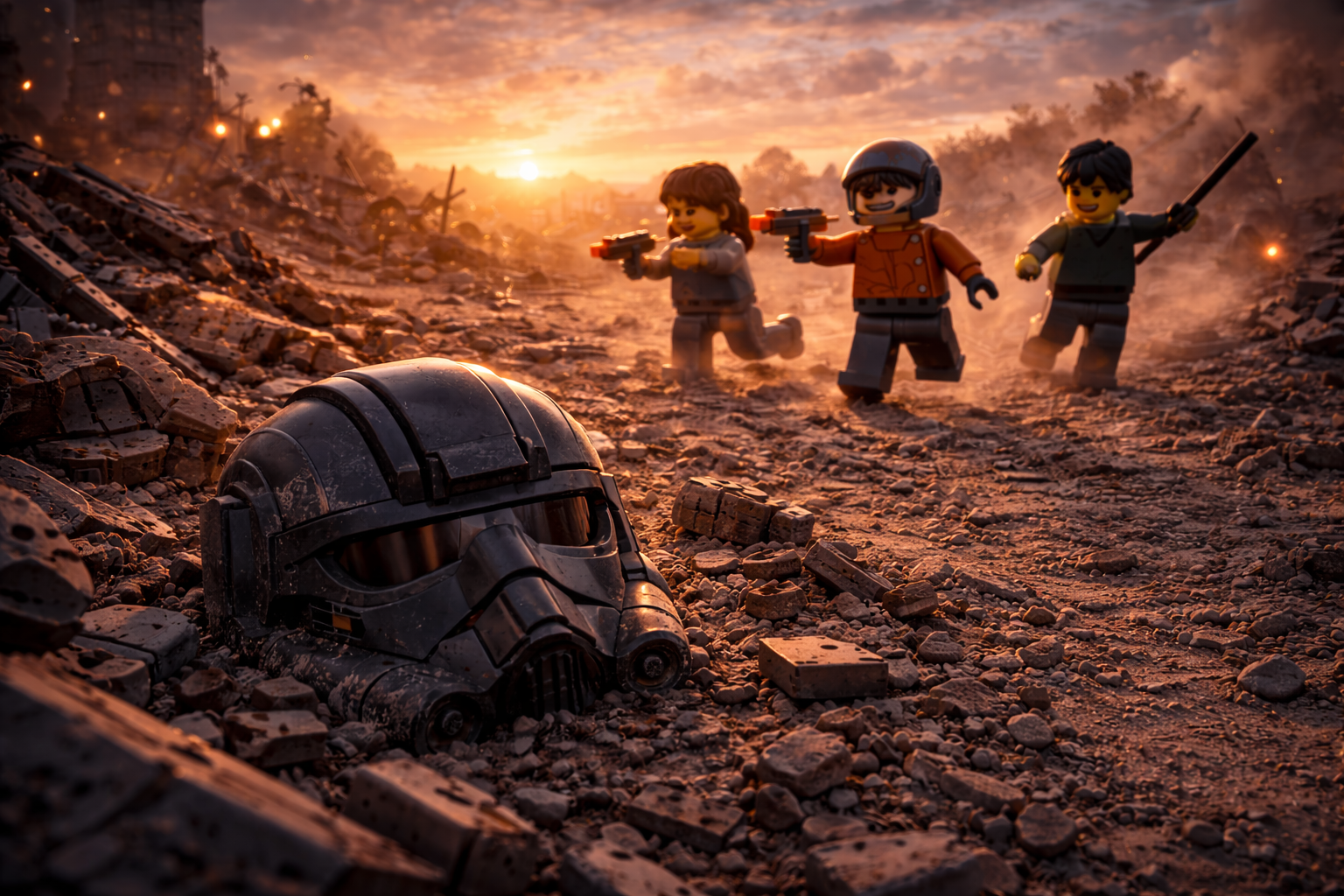
Brick-built black and gray helmet half-buried in rubble as minifigure children play nearby in a ruined field.

The game begins the same way every time: with Toma yelling, “Incoming!” and the rest of us dropping behind whatever the world offers as cover.

Today it’s a rib of twisted metal half-buried in ash-gray dirt. Yesterday it was a broken cart in the orchard. Tomorrow it’ll be a stone wall, or a ditch, or the shadow of the water tower. We don’t need a real battlefield to make one—just space, just breath, just the way our hearts speed up when we decide the air is dangerous.

Except this time, the air is different.

The old field beyond the village isn’t really a field anymore. It’s a place people avoid, where the soil looks scorched in patches and the grass grows in strange, stubborn lines. Everyone calls it “the burn,” like naming it makes it smaller.

We came anyway, because we were bored, and because we were brave in the careless way you can be when you haven’t lived long enough to understand what bravery costs.

And because we found something.

“Hold the line!” Sera shouts, her voice cracking a little with excitement. She’s crouched behind a chunk of concrete, using a stick as her “signal wand,” the way she saw the transit officers do during last year’s festival. “No one crosses the ridge!”

Jax—who isn’t actually named Jax but insisted we call him that during games because it “sounds like a pilot”—leans over the metal rib and squints into the smoke-colored distance like he’s seeing enemies between the trees. “I see movement,” he says. “Two… maybe three.”

“There’s nothing there,” I whisper.

He doesn’t look at me. “That’s what they want you to think.”

Theo, the smallest of us, is pressed flat against the ground, cheeks dusty, hands planted like he’s bracing for an explosion that hasn’t happened yet. “Do the stompers come now?” he asks, eyes wide, half terrified, half thrilled.

Toma makes the sound effects because Toma always does. He rumbles his throat low and drags a rock across another rock to make it feel like something huge is shifting out there. “They’re close,” he says in a voice that isn’t quite his. “You can feel it.”

We can feel something, actually—faint vibrations, a weird buzz that sometimes seems to come up through the soles of our shoes. Sera says it’s just wind through hollow metal. Toma says it’s the ground remembering.

I don’t know what I think. I just know the burn feels like it’s holding a story in its ribs, and we keep poking it like it might answer.

Jax lifts a hand to his head, as if he’s adjusting a visor. Except he isn’t.

Because the visor is real.

The helmet sits on the broken slab beside him, catching the last sunlight in dull, curved surfaces. It’s heavier than it looks—he proved that earlier by nearly dropping it on his foot and swearing so hard Sera threatened to tell his mother. The front is smooth, the faceplate dark, the lines clean in a way that doesn’t match the messy ruin around it. A piece of a world that wasn’t ours, left behind like someone forgot it mattered.

We found it under a sheet of bent metal, wrapped in ash and silence. Toma had dug it out with his hands like he was unearthing treasure. Theo had reached out and then pulled back as if it might bite.

Sera didn’t touch it at first. She stared at it like it was a question.

Then she said, “It’s a pilot helmet.”

Jax said, “It’s my pilot helmet.”

And that was that.

Now it sits between us and the sky, a silent referee of our pretend war.

“Alright,” Sera says, slapping her stick against the concrete like it’s a clipboard. “We’re pinned. We need a runner.”

Everyone looks at me.

I didn’t volunteer, but nobody ever does. The runner is the one who has to cross open ground, the one who has to risk being “tagged” by imaginary fire. The runner is the one who gets remembered in the retelling.

“You’re fastest,” Toma says, like it’s a compliment and not a sentence.

“I’m not—” I start.

Jax puts on the helmet.

The sound of it settling over his head changes everything. It isn’t loud. Just a soft thunk, a finality, like a door closing. He lifts his chin, and the dark faceplate reflects the burn field in a warped curve.

He becomes someone else.

“Runner,” he says, voice deeper because he thinks the helmet deserves a deeper voice. “On my mark.”

Theo’s eyes go even wider. “He looks real,” he whispers.

“He’s still Jax,” I whisper back.

But I’m not sure it’s true, not in the way we usually mean it.

Sera points her stick toward the far side of the field where the ruin thickens into a line of broken beams and half-sunk panels. “Your target is the tower,” she says. “You plant the signal, and we push forward.”

“The tower is fake,” I say.

Sera’s expression is serious enough to make my stomach tighten anyway. “Everything is fake,” she replies. “That’s the point.”

Toma makes another rumble sound. “They’re moving,” he says.

Jax turns his helmeted head slowly, as if tracking something tall and unseen. Then he raises a hand. “Now.”

I run.

The burn field rushes up under my feet—grit, ash, scattered pebbles that shift under every step. The air tastes metallic. Wind snaps at my sleeves. I can hear the others behind me, shouting instructions and threats and warnings like they’re reading from a script only kids can see.

“Incoming!” Toma yells.

“Down!” Sera shouts.

“Too late!” Jax adds, and makes a sharp sound like a laser blast with his mouth.

I throw myself into a slide behind a broken panel and grit scrapes my palms. I laugh—just a little—because sliding is fun and because I didn’t get “hit.”

Then the ground really vibrates.

Not the soft imagined kind. A clear, unmistakable shudder that ripples through the metal around me. A loose bolt rolls and clicks against the panel. Dust lifts off the ground in a thin puff.

I freeze.

So does everyone else. Even Toma stops making sounds.

For a second, the burn field is quiet enough that I hear a bird call from somewhere far away. A normal sound, like the world is trying to remind us it still exists.

“What was that?” Theo says, voice small.

Sera doesn’t answer. She’s staring at the helmet.

Jax—helmet still on—slowly turns his head toward the deeper ruins beyond our play zone. His shoulders square, the way they do when the game gets serious.

“Maybe it’s them,” he says softly.

“That’s dumb,” Toma says, but he doesn’t sound convinced.

Another vibration comes, lighter this time, as if something shifted far away and the earth politely informed us.

Sera steps forward, stick lowered. “Okay,” she says, trying to keep her voice steady. “New rule.”

We all look at her.

“No going past the beam line,” she says, pointing to the jagged skeleton of a fallen frame farther into the burn. “That’s the edge of the map.”

“We always—” Toma begins.

“No,” Sera cuts in. “Not today.”

For a moment, none of us argue. We just listen to the wind moving through the hollow metal, making it sing in long, low notes. It doesn’t sound like a warning exactly.

It sounds like a memory.

Jax walks toward the edge of the map anyway.

Not far. Just a few steps, slow and deliberate, helmet reflecting the burnt field and the orange sky. The faceplate makes him unreadable, which is unfair, because it means we can’t tell if he’s scared.

“Jax,” I call from behind the panel. “Don’t.”

He stops.

In the fading light, the helmet looks less like a toy and more like a relic. Like it belongs to a person who wasn’t playing.

Jax reaches up and lifts it off.

His hair is flattened. His cheeks are dusty. He looks like himself again—almost.

“It smells like smoke inside,” he says quietly, like he’s surprised.

Theo takes a step closer. “Can I—”

“No,” Sera says immediately, then softens. “Not yet.”

Toma, who hates seriousness, clears his throat and forces the game back into place. “Okay,” he says loudly. “The stompers are retreating! We won!”

“We didn’t win,” I say before I can stop myself.

They all look at me.

I point toward the beam line, toward the deeper ruin where the vibrations came from, where the air seems to hold its breath. “We just… stopped.”

Sera’s eyes narrow, thoughtful. “Sometimes,” she says, “stopping is winning.”

That sounds like something a grown-up would say. It makes all of us uncomfortable.

Jax sets the helmet on the concrete again, carefully this time. Like it’s fragile. Like it’s listening.

Then he raises a hand in a sloppy salute. “Pilot’s grounded,” he declares, trying to brighten it.

Theo laughs, relieved.

Toma makes a triumphant rumble noise.

And the game tries to restart.

But the burn field doesn’t feel like it’s letting us go.

Sera points her stick toward the beam line again, voice back in command mode. “New mission,” she says. “We retreat to the village. We tell no one. We come back tomorrow.”

“Tomorrow,” Toma repeats, a little too quickly.

Jax picks up the helmet.

He doesn’t put it on this time. He cradles it against his chest like a secret you can carry.

As we start walking back, the streetlights of the village blink on one by one in the distance. Warm. Normal. Safe.

Behind us, the burn field hums again—so faint we could pretend it’s wind.

But the helmet in Jax’s arms feels heavier with every step.

And none of us says what we’re all thinking:

Tomorrow, the game might not stay a game.

This is an original work of fiction created by Brick Crossing, inspired by the design themes of LEGO® set 75429.
LEGO® is a trademark of the LEGO Group, which does not sponsor, authorize, or endorse Brick Crossing.
Posted on

Under the Streetlight’s Halo

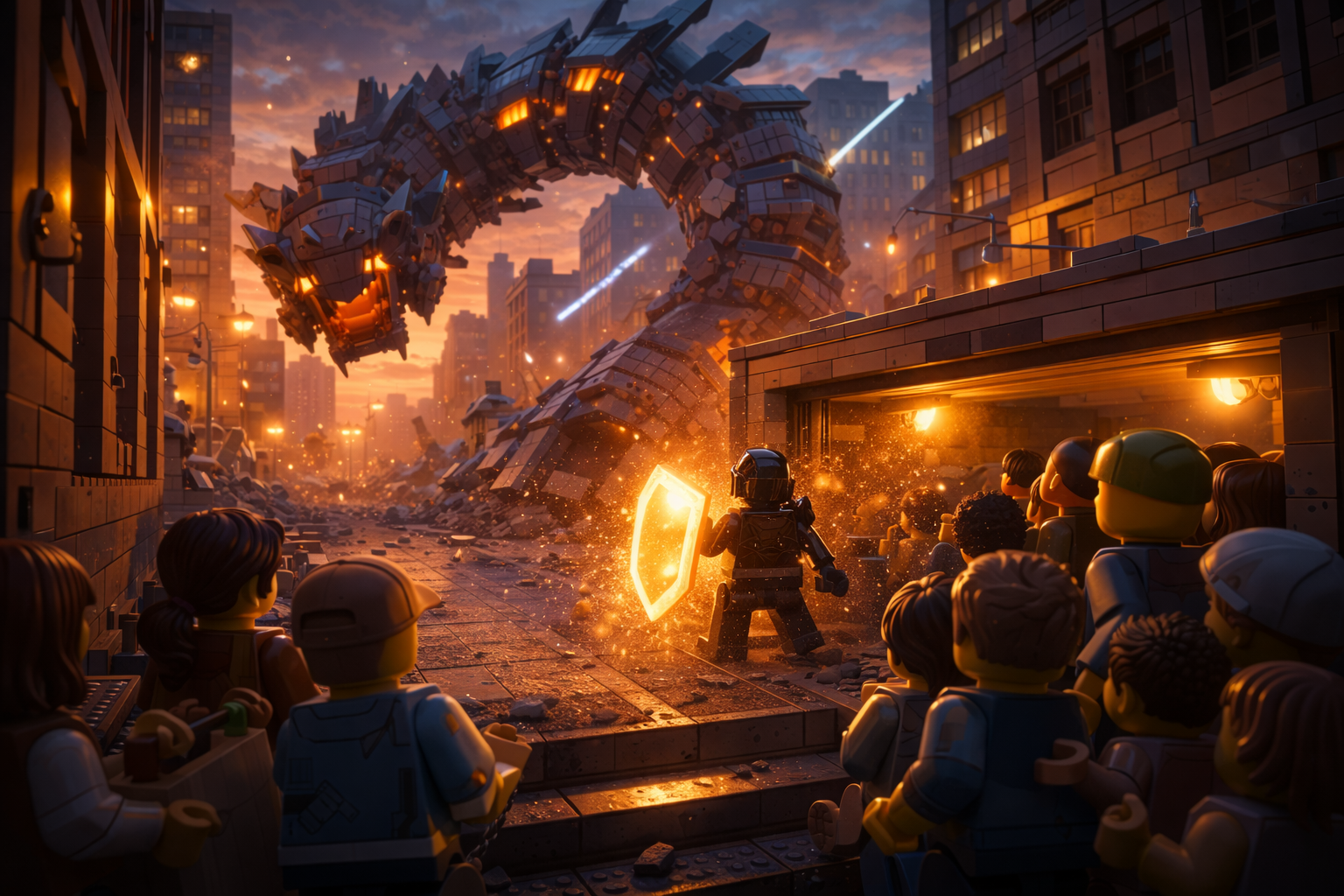
Brick-built segmented creature looms over a city street as a minifigure hero shields a crowd taking cover at a subway entrance.

When the first shadow crossed the avenue, we thought it was a blackout.

That’s what your brain reaches for in a city—something you’ve heard of before. A grid failure. A passing storm. A helicopter overhead. Something explainable that will end if you wait it out.

But the streetlights stayed on.

Their halos held steady in the early evening haze, lighting up the steam rising from a subway grate and the pale dust drifting through the air like slow snow. The storefront signs still glowed. Traffic signals still cycled through their colors as if nothing had changed.

Only the sound changed.

It came from far away at first—an enormous, distant grinding that didn’t match any engine anyone could name. A rumble so low you felt it in your teeth before you heard it with your ears. Windows shivered in their frames. A few car alarms chirped and then fell silent again, like they’d reconsidered.

Then people began running.

Not in one direction—every direction. From sidewalks into doorways. From crosswalks into alleys. Toward anywhere that felt smaller than the street.

We ended up in the same place for the same reason: the old transit entrance that went down under the block. A concrete stairwell with a metal railing, posters peeling on the walls, and a locked gate that someone had forced open a long time ago and never bothered to fix.

It wasn’t safe.

It just felt like it might be safer than standing in the open.

The crowd formed in layers the way panic always does—front line pressed to the edge, second line craning to see, third line pulling others back, and everyone talking at once without actually communicating.

A woman with a grocery bag clutched it to her chest like it mattered. A teen in a varsity jacket kept refreshing their phone as if the right notification could make reality reverse. A delivery rider stood with their helmet still on, breathing too hard, staring out at the street as if their eyes could calculate the danger.

I was with my little brother, Theo, who had stopped asking questions and started counting his breaths instead. Next to us, an older man in a work shirt held a flashlight that shook slightly in his hand.

“What is that sound?” Theo whispered.

No one answered.

Across the avenue, above the line of buildings, something rose.

Not a head. Not wings.

A segment.

It arched into view like a piece of a moving bridge, plated and ridged, too massive to belong to anything living and too fluid to belong to any machine we’d ever seen. It moved with intent, sliding forward through the air as if gravity was optional for it.

Then another segment followed.

Then another.

A chain of armored curves advancing between buildings, scraping the sky. Streetlight halos snapped across its surface, revealing sharp edges and seams that caught and released light like scales.

The creature—if that’s what it was—didn’t roar. It didn’t need to. Its movement was loud enough: the grinding of metal against itself, the deep thud of impacts as parts of it brushed rooftops and fire escapes, the collapsing crash when a billboard finally gave up and folded down into the street.

A shockwave rolled through the city.

We felt the air punch our faces. Theo flinched and grabbed my sleeve. The crowd surged backward, steps clattering down into the stairwell. Someone shouted to keep moving, but moving where?

Up was open. Down was dark.

Another segment slid into view, closer now—close enough to see that it wasn’t just one body. It was a long, articulated thing, each section able to bend and twist independently, like it could wrap around the city if it wanted to.

It turned its path slightly.

Toward us.

The streetlights flickered once, as if the city itself blinked.

A new sound cut through everything—higher, sharper, like a whistle made of electricity. It came from above the rooftops, moving fast, leaving a trail of light that was almost blue but not quite.

People pointed. People screamed. People filmed. Some people did all three at once.

Something—someone—moved through the air between the creature’s segments, too quick to track, leaving brief flashes that reflected off windows and painted the street in stuttering light.

Not a single person in our crowd could say what we were seeing.

But every person understood the same thing:

The conflict was happening around us, and we were small enough to be accidental.

The creature shifted. One segment dipped low, scraping the corner of a building. Masonry burst outward, raining dust and small stones. A streetlight pole bent like a blade of grass and snapped. Sparks spilled onto the pavement, bright and harmless-looking until they weren’t.

The crowd pressed deeper into the stairwell. Bodies packed tighter. Breath and sweat and fear made the air thick.

A kid in the back started crying. Not loudly—just the kind of quiet crying that happens when you’re trying to be brave but you’re not sure bravery will matter.

Theo’s voice was smaller than I’d ever heard it. “Are we going to die?”

I hated that question because it had no right to exist in a city on a normal evening.

I didn’t answer him with words. I pulled him closer and looked for exits that weren’t there.

Above us, the creature’s shadow passed again, and this time the streetlight halos didn’t return right away.

For a second, the avenue was dim—only the glow from distant windows and emergency lights beginning to pulse in the far blocks.

In that dimness, the creature moved differently. More confidently. Like it preferred the dark.

A segment dipped lower, angling down the street as if it had found something it wanted.

Its direction was unmistakable now.

It was coming straight toward the transit entrance.

Toward us.

The crowd’s panic finally unified into one instinct: down.

People stumbled on the steps. Someone fell and was yanked back up by strangers who didn’t know their name. The flashlight beam jittered wildly, illuminating shoes, railing, faces. A few people shouted at a locked service door that refused to become an escape route just because we asked.

Above, the creature’s movement filled the street with pressure, as if the air itself was being pushed aside to make room for it.

Theo’s fingers dug into my wrist. “Please,” he said, not sure who he was saying it to.

I looked up the stairwell opening and saw the underside of the nearest segment slide into view. It was so close the streetlight glow reflected off it in warm orange, turning its armor almost beautiful for an instant—like a sunset on a storm.

Then the segment lowered further.

Debris rattled down the steps. Dust poured into the stairwell. People screamed. Someone shouted to cover your mouth. Someone else prayed. A phone slipped from a hand and clattered down metal steps, still recording, its screen a tiny trembling window on the street.

The segment tilted, and a seam along its underside began to open—panels separating like jaws, revealing a darker interior that looked too empty for its size. The air changed. A pull, like a vacuum, like the creature was about to swallow space itself.

The crowd froze as one.

Every instinct screamed to run, but there was nowhere to go.

That was the moment we saw the figure.

They dropped into the street between the transit entrance and the creature with the kind of certainty that made the whole scene rearrange itself around them. They weren’t tall like the creature, but they were unafraid in a way that made height irrelevant.

A shield—no, not that, not a symbol, not a known thing—something broad and bright was braced in their hands, angled like a wall you could carry. Their stance was solid, knees bent, shoulders squared, as if they were anchoring themselves to the city.

The creature’s seam opened wider.

The pull increased.

Loose papers and dust lifted off the ground and streamed toward the opening. A plastic cup skittered. A torn poster peeled away from a wall. Someone’s hat flew off and vanished into the dark.

The figure in the street took one step forward and drove their broad barrier down into the pavement.

The impact rang like a bell.

A field—visible only because dust suddenly stopped moving—spread outward in a shallow dome. The air pressure equalized. Theo’s hair, which had started to lift in the pull, settled back down. The crowd exhaled in one shaky wave.

The creature’s “jaws” strained against the unseen barrier, its segments flexing, armor plates grinding. The street trembled.

The figure didn’t move.

They held.

For the first time since we’d run into the stairwell, the city felt like it had a choice.

Above, that blue-not-blue streak returned, arcing through the air, striking the creature’s side in a burst of light that made the streetlights blink. The creature recoiled—just a little, but enough. Another flash hit, then another, each one pushing the segment upward by inches.

The figure in front of us glanced back—just once.

I couldn’t see their eyes clearly, not through the dust and the fading light, but the gesture felt like a message: Stay. Breathe. Live.

Then they turned forward again and charged.

Not at us. Not toward safety.

Toward the creature.

The barrier lifted, and the figure sprinted up a broken chunk of pavement like it was a ramp, leaping onto the nearest segment as it rose. The creature’s body flexed, trying to shake them off, but the figure kept moving—running along armor plates toward the conflict unfolding above the rooftops.

Behind them, the streetlight halos returned fully, bright and steady, as if the city had decided to pretend it hadn’t been terrified.

The crowd in the stairwell didn’t cheer. We couldn’t. We just stared, stunned, as the figure disappeared into the maze of segments and sparks and impossible motion.

Theo finally breathed out.

And somewhere overhead, the grinding sound shifted direction—moving away from us, deeper into the city.

The danger wasn’t over.

It had simply moved on.

This is an original work of fiction created by Brick Crossing, inspired by the design themes of LEGO® set 76290.
LEGO® is a trademark of the LEGO Group, which does not sponsor, authorize, or endorse Brick Crossing.
Posted on

The Deck at Golden Hour

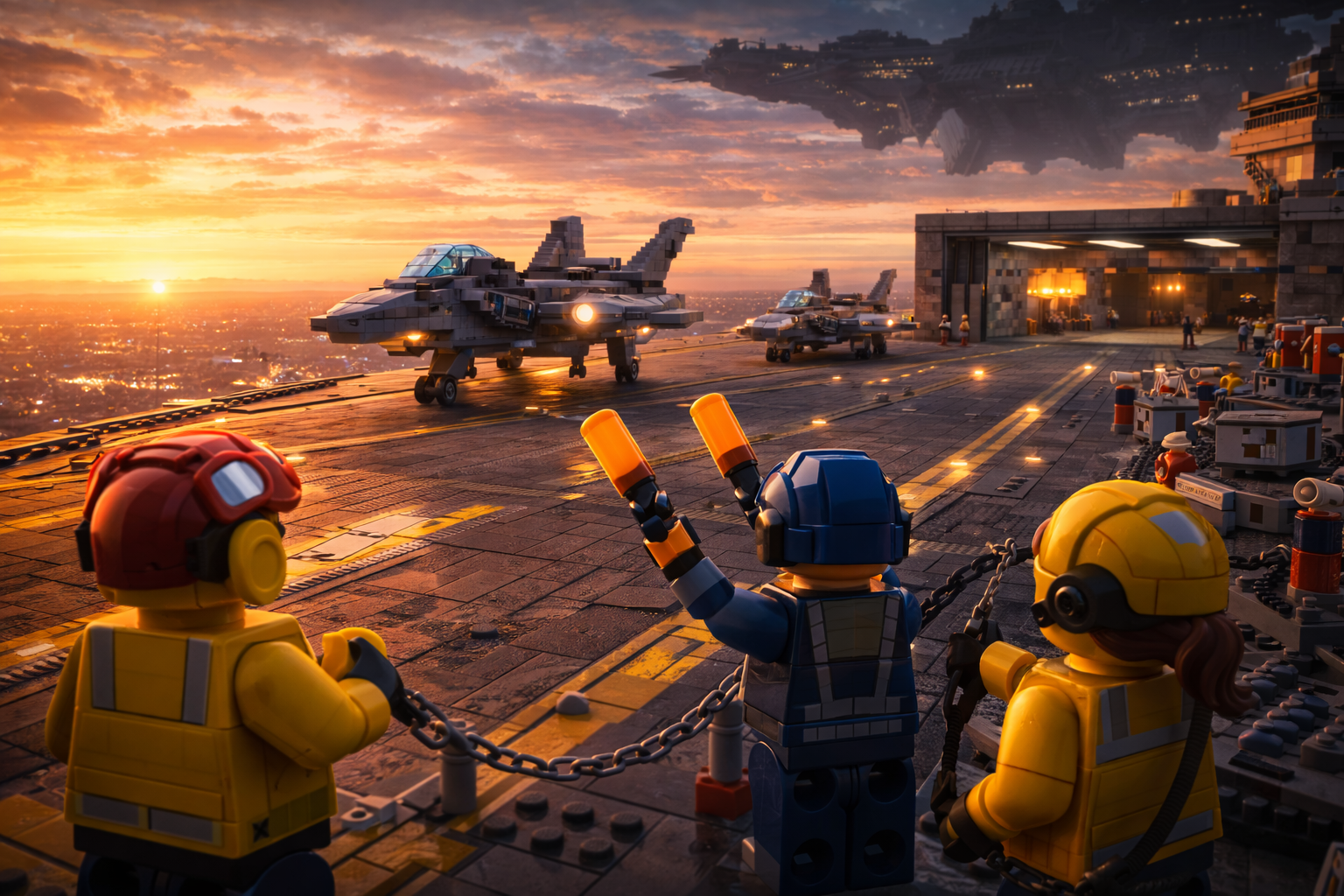
Brick-built flight deck crew guides jets at sunset on a massive airborne carrier as the city glows below.

Sunset made everything on the flight deck look like it belonged in a postcard—right up until you noticed the danger.

The sky was a slow burn of orange and violet, smeared across the horizon like paint dragged with a thumb. The clouds below were darker, bruised at the edges, and the city lights far beneath them blinked on one by one as if the world was trying to catch up to the height.

Up here, nothing caught up. It either worked or it didn’t.

The deck stretched wide and flat, a floating runway held up by engines you never saw and vibrations you always felt. Yellow lines cut through the gray plating, guiding vehicles, crews, and aircraft into a choreography that could not afford mistakes. Wind slapped at loose straps and snapped flags hard enough to sting your ears.

We were three deep in our shift, and our whole world was the deck.

Jax stood at the edge of the landing zone, wands of light in each hand, visor down, chin set like he’d carved it from the same metal as the ship. Mina checked the tether lines near the maintenance carts, fast fingers working knots and clips like they were music. I—Rory—kept my eyes on the deck readouts, the wind, the lights, and the one thing we weren’t supposed to say out loud:

Something big was coming.

It started with the change in comms.

Normally, the channel was a steady stream of short calls—fuel, clearance, taxi, brake check. It was noise you learned to understand without thinking, like rain against a roof.

Then the noise thinned. Messages became clipped. Coded. Pauses stretched longer than they should have.

“Deck crew, status,” the tower voice said.

“Green,” Jax answered instantly.

Mina didn’t look up from her work. “Green,” she repeated under her breath, like saying it out loud made it true.

The ship vibrated differently, too. A slight shift in pitch through the soles of our boots. Not rough—controlled—but a reminder that the entire platform was making a decision about where to be in the sky.

A service cart rolled by with a sealed crate strapped down like it was the most precious thing aboard. Nobody joked about it. Nobody even stared too long.

I watched the horizon instead.

Far out, where the last band of sunlight met the blue-black of approaching night, a point of light appeared—then another. A formation. Tight. Fast. Not civilian.

Jax angled his helmet toward me.

“You seeing that?” he asked.

“Yeah,” I said. “And it’s coming in hot.”

The tower voice returned. “Prepare for priority landing. Clear the deck. Full readiness.”

Priority meant no mistakes. It meant whatever was incoming mattered more than our schedule, our comfort, our confidence.

Mina clipped the last tether and sprinted, moving like the wind itself had taught her. She grabbed a coil of line that could turn deadly if it snapped loose at the wrong time. Jax stepped into position at the landing zone, light wands up, body squared to the sky like he could negotiate with speed.

I moved to the control panel at the edge of the deck, fingers hovering over toggles that controlled the lights—guidance strips, hazard markers, emergency beacons. My screen flickered with altitude and wind shear data.

The crosswind ticked higher.

The ship held steady anyway.

Because it had to.

The approaching aircraft cut through the sunset glow and dropped lower. As it crossed into the deck’s airspace, the wind it carried hit us like a wave. Loose grit skittered across the deck. Straps snapped. The smell of fuel sharpened.

Jax signaled with sharp, confident motions—down, left, steady, steady—his wands painting instructions in bright arcs.

The aircraft responded instantly.

It landed hard, precise, wheels biting the deck. The sound was a metallic scream that turned into a rumble, then into a steady roll as it taxied forward.

Mina and I moved in together, exactly as trained. Chocks in. Tethers on. Hands fast. Eyes faster.

The canopy didn’t open.

The aircraft’s engine didn’t fully power down.

That wasn’t normal.

A second aircraft lined up behind it, then a third. The deck filled quickly with machines that looked like they’d been built to arrive under pressure and leave before anyone asked why.

The tower voice came through again, lower now. “Deck crew, maintain positions. No unauthorized approach. Stand by.”

Jax’s visor turned slightly toward me, just enough for me to feel the question.

What kind of mission needs this many landings at sunset?

Then the answer arrived in the form of a tremor through the deck.

Not from an engine.

From somewhere deeper.

The hangar doors below the deck—massive segmented plates—shifted open with a groan, like the ship itself was exhaling. Warm air rolled up, carrying the smell of oil, metal, and something else—ozone, sharp and clean, like a storm about to break.

Something down there powered up.

The deck lights flickered once.

Mina froze mid-step. “That’s not us,” she said quietly.

“No,” I agreed. “That’s not us.”

We weren’t supposed to look down into the hangar when the priority shutters were moving.

But everyone did.

Because the sound wasn’t subtle. It was the kind of sound that made your bones feel like they’d been tapped from the inside. Heavy machinery aligning. Locks disengaging. A low thrumming that climbed in pitch as if a giant heart was speeding up.

Inside the hangar, crews in darker gear moved fast, silhouettes against floodlights. Equipment rolled into position. Crates were unsealed. A shape—tall, angular—shifted behind a row of maintenance stands.

Mina leaned closer to me, her voice barely audible over the wind. “Do you think it’s… one of the assets?”

We didn’t use that word often. It was what people said when they didn’t want to say what they really meant: something powerful, something classified, something that made the ship more than just metal and engines.

Jax stepped toward us, keeping his body between our line of sight and the hangar opening like he could block curiosity.

“Eyes up,” he snapped. “You want to keep your clearance? Eyes up.”

We obeyed, because we always did.

But the deck was changing.

The sunset was fading, and the ship’s lights grew brighter in response, cutting white lines into the dusk. The air cooled quickly. The wind intensified, whipping loose paper into the sky like startled birds.

The first aircraft finally powered down.

The canopy opened with a hiss.

A pilot climbed out—helmet on, visor reflective, face hidden. They didn’t look at us. They didn’t wave. They walked straight to the edge of the deck where a transport team waited, and disappeared down a stairwell.

The second aircraft didn’t stop at all.

It rolled, turned, and launched again—taking off into the darkening sky as if delivering something, or escaping it.

I watched its lights shrink into the distance.

Then I noticed the city below.

It wasn’t just lights anymore. There were pulses—flashes too bright and too regular to be normal. In the far distance, a bloom of purple-white lit up the horizon for half a second and vanished.

Mina saw it too. “That’s not lightning,” she said.

“No,” I repeated. “That’s not lightning.”

The tower voice returned, tighter than before. “All crew, brace. Course correction. Stand by for possible turbulence.”

The ship tilted—just a fraction—enough to make my stomach shift. The deck readouts jumped. Wind shear spiked.

Jax planted his boots wider, steadying himself like he could anchor the ship by force of will. “Hold your lines!” he yelled. “Hold everything!”

A deep vibration rolled through the deck, stronger than anything we’d felt all day.

The hangar doors below began to close—fast. Too fast.

Whatever was happening down there, it was moving from “prepare” to “now.”

Mina grabbed my sleeve, hard. “Rory,” she said, and for the first time all shift, her voice cracked. “Tell me you feel that.”

I did.

The air pressure shifted. The hair on my arms lifted. The deck lights flared bright and steadied, as if the ship was pulling power from somewhere else.

And the aircraft nearest us—still tethered—gave a sudden warning chirp, its systems reacting to something in the air.

Something approaching.

Jax raised his wands again, reflexively, scanning the sky like the incoming threat might be visible in the sunset.

But the horizon was empty.

Then a shadow passed across the deck—too large to belong to a cloud.

We all looked up at the same time.

Above us, the sky darkened by a moving shape that didn’t belong to the day or the night.

The wind slammed into the deck. Straps snapped tight. The ship groaned, correcting itself midair.

Jax lifted one wand higher, as if he could guide whatever it was away from us by sheer command.

Mina held the tether line with both hands, knuckles pale.

I stared at the shadow and tried to understand its size.

The tower voice cut through the comms, urgent and sharp:

“Brace. Brace. Brace—”

And then the hangar doors sealed with a final metallic snар, shutting out whatever had been waking below.

The ship lurched.

The sunset vanished behind steel and shadow—

—and the deck went weightless for a heartbeat.

This is an original work of fiction created by Brick Crossing, inspired by the design themes of LEGO® set 76295.
LEGO® is a trademark of the LEGO Group, which does not sponsor, authorize, or endorse Brick Crossing.
Posted on

The Distance Between Us and the Monument

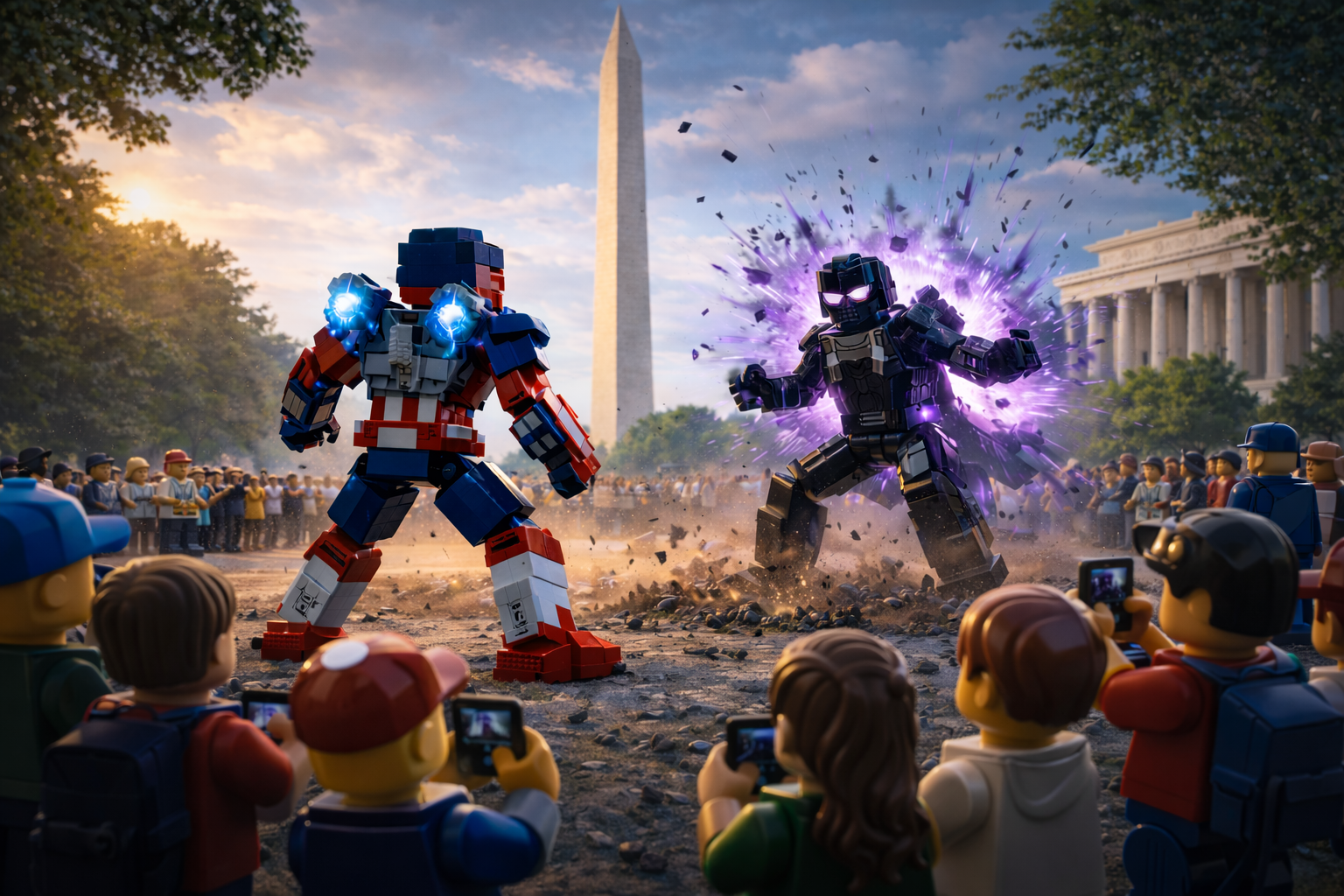
Brick-built hero and villain clash near the Washington Monument as a crowd of minifigures watches from the National Mall.

The afternoon was ordinary until it wasn’t.

Tourists drifted across the grass between the Reflecting Pool and the memorial steps, phones raised, voices overlapping in a dozen languages. School groups clustered around chaperones. Food trucks hummed at the curb. The Monument stood clean and white against a pale sky, unmoved by any of it.

We were there together—three of us—because that’s how you do D.C. on a weekend. You walk until your feet complain, then you sit where history feels close enough to listen. We had just sat down when the wind changed.

It wasn’t strong. Just wrong.

A ripple ran across the pool, thin and sharp, like someone had dragged a finger across glass. Conversations stuttered. Heads turned. The Monument didn’t move—but the air around it did, bending, pressing, as if the city had inhaled and forgotten to breathe out.

At first, people thought it was a demonstration. Someone shouted about a parade permit. Someone else laughed. The laughter didn’t last.

A figure rose into view near the base of the Monument—not climbing, not flying exactly, but lifting as if the ground had decided to let go. The figure was tall, built broad and steady, colors bright enough to cut through the afternoon glare. When they landed, the sound traveled through the stone beneath our feet.

A man near us lowered his camera. “Is this… a show?”

No one answered.

Across the lawn, something answered instead.

It came from the direction of the memorial—dark against the pale steps, moving too smoothly, like it had learned the shortcuts between moments. Where the first figure stood open and unmistakable, this one kept its shape tight, edges pulled in, as if it preferred the shadows even in full daylight.

The crowd did what crowds do when certainty disappears. It leaned back. Phones went up. A line of space opened without anyone agreeing to open it.

We stood, suddenly aware of how small we were between stone and sky.

The two figures faced each other with the Monument behind one and the memorial behind the other, as if the city had staged this on purpose. A voice carried across the grass—low, distorted, not quite human, not quite amplified. We couldn’t make out the words, only the tone: accusation sharpened into promise.

The bright figure didn’t answer right away.

When they did, it wasn’t loud. It didn’t need to be.

The first strike didn’t hit a person. It hit the ground.

Stone fractured with a sound like thunder held too long. The shockwave rolled outward, knocking people back a step, then another. Someone screamed. Someone dropped a phone that skittered across the pavement and didn’t stop until it met the curb.

We moved together without planning it, pulling back toward the trees, toward anything that felt less open. A family ducked behind a low wall. A ranger shouted directions that tangled with sirens starting up from everywhere at once.

The bright figure moved fast—faster than our eyes wanted to believe—meeting the dark one in a clash that rang against the Monument like a bell. The air flashed. Light bent. For a second, the world looked like it had been folded and unfolded wrong.

They weren’t fighting wildly. That was the strange part. Each movement was measured, deliberate, like a debate written in force instead of words. When the bright figure blocked, it was with the whole body turned into a promise kept. When the dark one struck, it was with precision, looking for gaps no one else could see.

We realized then that this wasn’t new to them.

This was a continuation.

A blow glanced off stone and carved a scar into the steps of the memorial. Gasps rippled through the crowd—not just fear now, but offense. This place mattered. These stones held names and ideas and weight.

The bright figure noticed the damage and shifted instantly, drawing the fight away, planting themselves between the dark one and the memorial as if the boundary had always been there. The message landed without words.

The dark figure laughed. The sound crawled.

“You think that’s what they need?” the voice said, clearer now, carrying easily. “A wall?”

The bright figure advanced instead of answering.

We felt it then—not hope exactly, but recognition. The kind you get when you see someone step into a space that shouldn’t belong to anyone and claim it anyway, not for themselves, but for everyone else.

The fight moved fast across the lawn, away from the densest parts of the crowd. Trees shuddered as if bracing. The Monument watched, unchanged, the city’s long memory refusing to blink.

Sirens closed in. Drones buzzed overhead. Orders crackled from radios. None of it slowed what was happening.

A strike sent the bright figure skidding across the grass, tearing a line through green and earth. The dark figure followed, pressing the advantage, shadows stretching too far for the angle of the sun.

We held our breath together.

The bright figure rose.

Not immediately. Not effortlessly.

They pushed up, one knee, then two feet, shoulders squared. There was a pause—a human pause—and then they were moving again, faster, stronger, like the hit had clarified something instead of taking it away.

They met in the open, light and shadow colliding so close we felt the heat of it. The sound wasn’t loud this time. It was focused, compressed into a single moment that seemed to narrow the world down to two figures and a decision.

The dark figure faltered.

Just for a heartbeat.

That was enough.

The bright figure drove forward, forcing space, forcing distance, steering the fight toward the edge of the grounds where the city opened into streets and choices multiplied. The crowd surged with them, not following, but believing.

At the far edge of the lawn, the dark figure broke away, retreating into the grid of the city where buildings rose and sightlines vanished. The bright figure stopped at the boundary and didn’t chase—not yet.

They turned back toward us.

Toward the Monument. Toward the memorial. Toward a crowd that had fallen silent without noticing.

For a moment, the distance between us felt enormous.

Then the bright figure nodded—once—and stepped after the shadows, disappearing into the city where the next move would be made out of sight.

The sirens arrived all at once.

We stood there, together, staring at stone that had watched it all, wondering how close we’d come to something breaking—and how close we’d come to something holding.

This is an original work of fiction created by Brick Crossing, inspired by the design themes of LEGO® set 76296.
LEGO® is a trademark of the LEGO Group, which does not sponsor, authorize, or endorse Brick Crossing.
Posted on

The Lesson That Looked Back

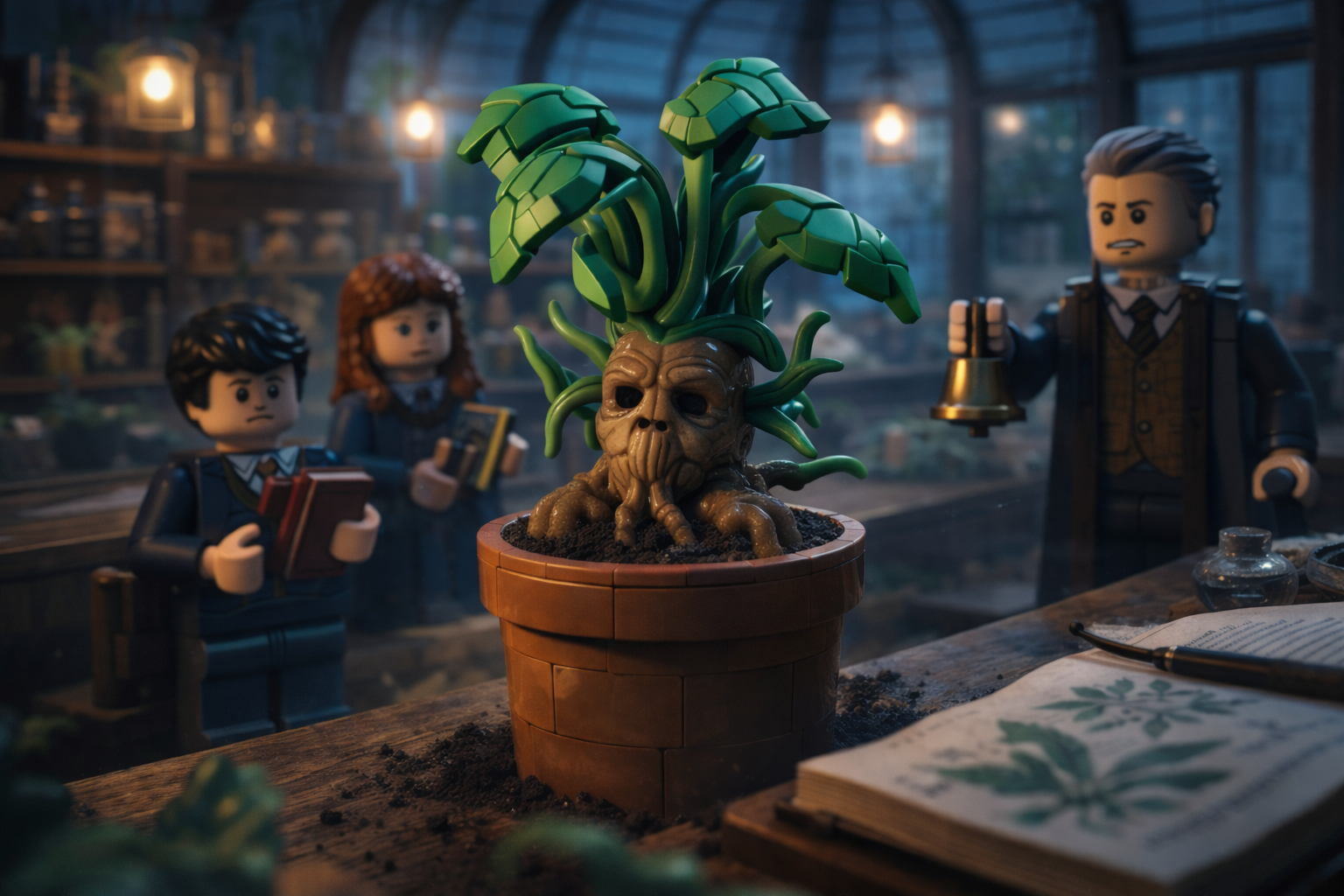
Brick-built humanoid plant in a pot observed by a professor and students in a dim botanical classroom.

The classroom was built like a greenhouse that forgot it was supposed to be gentle.

Glass panes arched overhead in black iron ribs, fogging at the edges where warm air met the cold outside. Shelves climbed the walls in careful tiers—jars of seeds, pressed leaves in labeled frames, clay pots with soil dark as coffee grounds. A long demonstration table ran down the center, scarred with years of careful cutting and cautious mistakes.

Somewhere beneath the floorboards, pipes clicked softly, feeding heat into the room like a slow heartbeat.

Students filed in with notebooks and half-zipped jackets, voices low, shoulders brushing as they took their places. Most of them had the same look when they entered this wing: curiosity, yes—but also the quiet awareness that something in here might be alive in a way they weren’t prepared for.

At the far end of the room, under a cloth the color of storm clouds, a pot sat alone.

No label. No warning.

Just a shape beneath fabric, as if the thing under it didn’t like being named.

Professor Ardent arrived exactly when the bell finished ringing—no earlier, no later—as if time itself stepped aside for him. He was tall, sleeves rolled to the elbow, hands stained faintly green in the creases no soap ever reached. His eyes were bright in a way that made some students sit up straighter without meaning to.

He set a leather case on the table. Inside: pruning shears, a narrow trowel, a pair of thick gloves, and a small bell of tarnished brass.

The class watched the bell more than the tools.

“You’ve learned the ordinary rules,” Ardent said, voice calm and steady. “Light, water, soil chemistry. How to read leaves like weather.”

He walked to the cloth-covered pot and stopped as if listening for something.

“And you’ve learned,” he added, “that some life prefers not to be read at all.”

A few students exchanged glances. Someone’s pen clicked nervously.

Ardent laid his gloves on the table instead of putting them on. That, more than anything, tightened the room.

“This specimen,” he said, “doesn’t respond to sunlight the way you expect. It doesn’t grow toward warmth. It grows toward attention.”

A laugh almost happened—then died before it could become real.

At the second row, a student named Juno leaned forward, eyes narrowed. Juno liked puzzles. Juno believed the world could be understood if you stared long enough.

Beside Juno sat Mateo, who had the opposite instinct: if something felt wrong, he trusted that feeling and kept his distance. He tucked his hands under his notebook as if the desk was suddenly too exposed.

Ardent’s fingers found the edge of the cloth.

“Today,” he said, “you will practice observation without assumption.”

He lifted the fabric.

The pot held a plant unlike anything in the room.

Its leaves were thick and curled, like green hands caught mid-motion. Its stem rose sturdy, but not stiff—more like a spine than a stalk. At the base, half-buried in soil, a pale shape pressed upward: rounded, knotted, and eerily familiar in the way driftwood can resemble a face if you catch it at the wrong angle.

A hush fell over the class.

The plant did not sway with the classroom’s warm air currents.

It was still.

Then—slowly—it turned.

Not a dramatic snap, not the twitch of a vine. A gradual, deliberate rotation, as if it had decided to face the room. As if it had chosen an audience.

Juno’s breath caught. Mateo’s pen slid from his fingers and tapped against the desk.

Ardent didn’t react. He didn’t flinch, didn’t smile, didn’t warn them away. He watched the plant the way a navigator watches the horizon: without surprise, but with respect.

“Note what you feel,” he said. “Not what you think.”

A student in the back whispered, “It’s looking at us.”

“It has no eyes,” Ardent replied, not unkindly. “And yet.”

The plant’s leaves unfurled a fraction, revealing veins that ran in patterns too organized to be random—like fingerprints. Like maps.

Juno raised a hand, then lowered it, then raised it again. “Professor… what is it?”

Ardent tapped the brass bell once, very softly.

The plant stopped moving.

Silence thickened, heavy as damp soil.

“You may call it whatever you want,” he said. “Names are doors. Some doors should remain closed until you understand what’s on the other side.”

He nodded toward the nearest table. “Sketch. Do not touch. Do not speak to it. Not yet.”

The class began to draw, pencils scratching in quick, uncertain lines. But the room had shifted. It wasn’t just a classroom anymore; it was a threshold.

Mateo tried to focus on leaf shape and stem thickness, but his eyes kept sliding back to that pale form at the base—the almost-face in the soil. He told himself it was roots. He told himself it was coincidence.

The longer he looked, the less he believed himself.

Juno’s sketch was careful, almost reverent. Juno leaned closer, searching for logic in the veins, the symmetry, the way the plant held itself like a person holding a secret.

A bead of condensation slipped down the glass overhead and tapped onto the table with a tiny sound like a countdown.

Ardent walked between desks, pausing behind students, correcting a line here, a proportion there. He stopped behind Mateo and spoke quietly.

“You’re pulling away,” he said.

Mateo swallowed. “I just—don’t like it.”

Ardent nodded once, as if that was the correct answer on a test no one knew they were taking. “Dislike is useful. It keeps you honest.”

Then he moved on.

At the front, the plant shifted again.

Just enough to make the leaves angle toward Juno.

Juno froze, pencil hovering.

It wasn’t moving randomly. It was moving with purpose.

And purpose, in a thing that shouldn’t have it, made the air feel thinner.

Ardent returned to the demonstration table and opened his leather case fully, spreading the tools as if preparing for a delicate operation.

“Observation is the first skill,” he said. “The second is restraint.”

He lifted the brass bell but didn’t ring it. He held it instead, listening to the room, to the plant, to the quiet fear gathering in corners.

“Some specimens,” he continued, “react to touch as a trap reacts to pressure. Others react to attention. They learn the rhythm of your breath. They learn your habits.”

Mateo felt his pulse in his fingertips. Juno didn’t blink.

Ardent set the bell down and, for the first time, took a step closer to the pot.

The plant leaned toward him.

Not fast. Not aggressive.

Like recognition.

Ardent’s voice lowered. “If you ever find something like this outside these walls—if you ever uncover it in a forgotten garden, a sealed room, a place where no one has walked in years—remember this.”

He placed one finger on the rim of the pot.

The plant’s leaves lifted.

The pale shape at the base pressed higher through the soil, and for an instant the suggestion of a mouth—only a curve, only shadow—seemed to form.

The classroom went absolutely still.

Ardent did not remove his finger.

“Do not assume it wants what you want,” he said. “And do not assume it wants what you fear.”

Juno’s pencil dropped. The sound was small, but it landed like a stone in deep water.

The plant turned its “face” toward the class.

Not toward Ardent.

Toward them.

A ripple moved through its leaves, as if it was taking inventory of every person in the room.

Then—without warning—the glass overhead shuddered.

Not from wind. Not from weather.

From a low vibration that seemed to come from the plant itself, a hum felt more than heard.

Ardent’s eyes sharpened.

His hand went to the bell.

He lifted the bell, ready to strike—

And the plant leaned forward, leaves spreading like hands reaching for the edge of the world.

The hum deepened.

The lights flickered once.

Then went steady again.

Ardent hesitated.

And in that half-second, the plant decided to move.

This is an original work of fiction created by Brick Crossing, inspired by the design themes of LEGO® set 76433.
LEGO® is a trademark of the LEGO Group, which does not sponsor, authorize, or endorse Brick Crossing.
Posted on

76908 – Pink Slips at Midnight

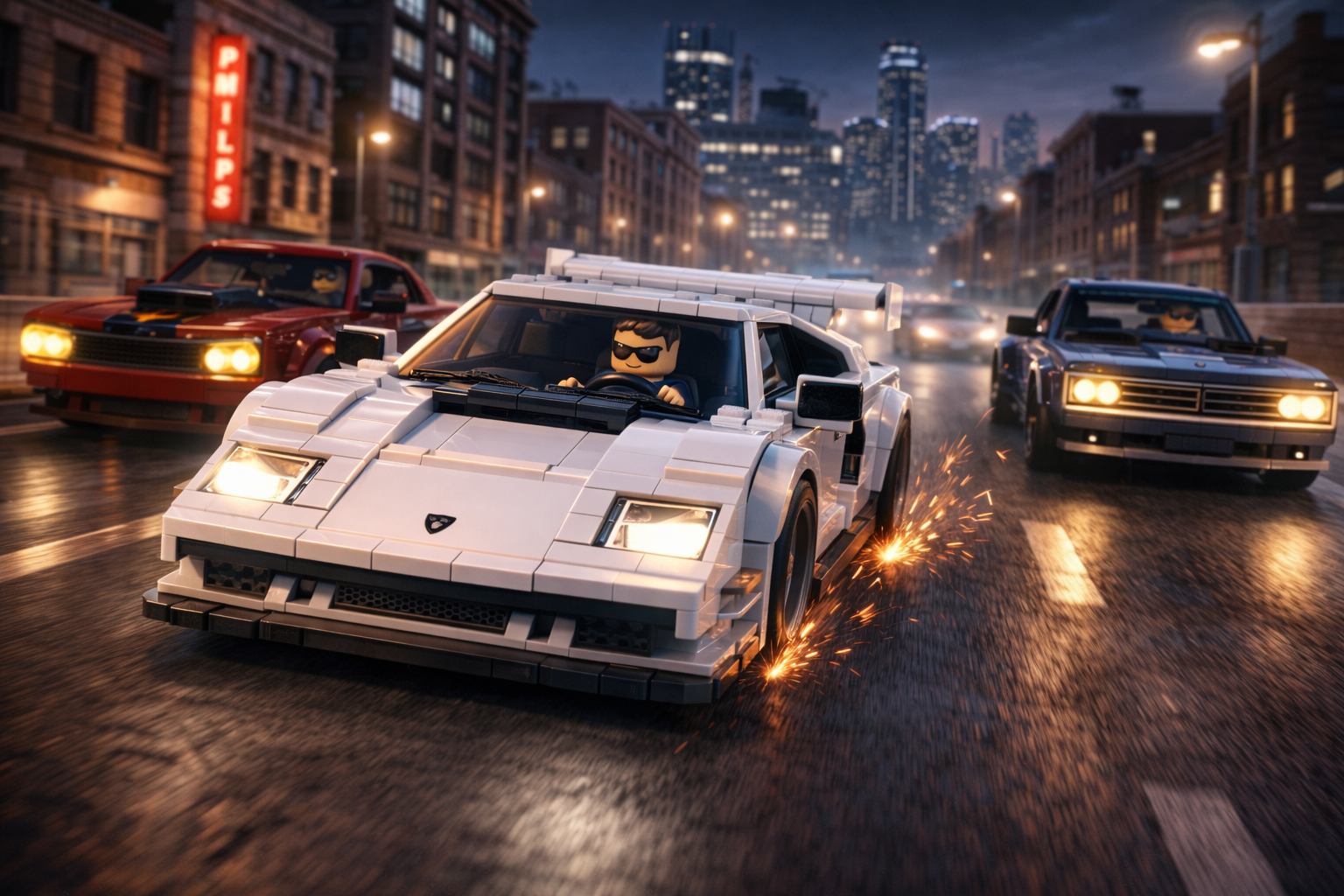
White brick-built Lamborghini Countach races through downtown streets at night alongside muscle cars, driven by a minifigure.

Detroit didn’t sleep—it waited.

Streetlights hummed above empty lanes, casting long reflections across rain-dark pavement. Old brick buildings rose like silent witnesses, their windows black, their murals half-lit and watching. Somewhere in the distance, a train horn echoed low and lonely, threading through the city like a warning.

At the edge of an abandoned plaza, cars gathered.

Most were loud even at rest—wide American muscle machines crouched low on fat tires, engines rumbling impatiently, paint glowing in deep reds, blues, and blacks. They looked heavy. Powerful. Built to win through force.

Then there was the white car.

It sat slightly apart from the others, sharp-edged and unmistakable, its shape all angles and confidence. Clean. Low. Almost unreal under the streetlights, like it didn’t belong to this city at all.

Inside, the driver rested both hands on the wheel and stared straight ahead.

Tonight wasn’t about money.

Tonight was about slips.

The driver stepped out, door swinging upward, and the conversations nearby dipped just enough to notice. He wasn’t from Detroit. Everyone could tell. His jacket was clean. His car even cleaner.

A man with a thick jacket and a scarred grin approached, holding a stack of folded papers.

“Winner keeps driving,” he said. “Loser walks.”

No one laughed.

One by one, drivers pulled documents from pockets and glove boxes. Titles. Ownership papers. Futures, folded thin enough to fit in a hand.

The white car’s driver hesitated for half a second—just long enough to feel it—then added his slip to the pile.

The papers were sealed in an envelope and handed off to someone no one argued with.

Engines fired.

The muscle cars thundered awake, their sound filling the plaza, shaking windows and nerves alike. The white car answered differently—higher, sharper, slicing clean through the noise instead of adding to it.

The race route wasn’t marked.

Everyone knew it anyway.

Down Jefferson. Past the river. Through the warehouse district. A hard left under the old overpass. Finish somewhere only the lead car would recognize.

The starter raised one hand.

Dropped it.

Tires screamed.

The pack launched forward, metal surging into motion as the city rushed up to meet them. The white car slipped between two muscle cars instantly, its acceleration clean and effortless, engine singing where the others roared.

Detroit blurred.

Streetlights streaked overhead. Painted lines vanished beneath spinning wheels. The road tightened, narrowed, challenged. The muscle cars fought the turns, weight shifting hard as they muscled through corners with brute strength.

The white car danced.

It cut clean lines through intersections, braking late, accelerating early, trusting precision over power. A red muscle car surged beside it on a straight, engine bellowing, forcing the white car toward the curb.

The driver didn’t flinch.

He waited.

At the next corner, he turned in smoothly, letting the heavier car overshoot. Tires chirped. Sparks flew as metal scraped concrete. The white car slipped through untouched.

Warehouse walls rose on both sides now, close enough to feel. Shadows swallowed headlights. The sound of engines echoed wildly, making distance impossible to judge.

A blue muscle car took the lead.

For now.

The white car tucked in behind it, close enough to read the reflection of its own headlights off the other car’s bumper. Wind tore across the windshield. The driver’s focus narrowed until there was nothing else—no city, no crowd, no consequences.

Just the line.

The overpass loomed ahead, massive and dark, concrete pillars flashing past like a countdown. The road split beyond it—two possible routes, only one correct.

The blue muscle car swerved left.

The driver of the white car smiled.

He dropped a gear and surged forward, engine screaming as he pulled alongside, the city exploding into motion around them.

Headlights vanished into the darkness beyond the overpass.

And somewhere behind them, an envelope waited to decide who would still have a car when the night ended.

This is an original work of fiction created by Brick Crossing, inspired by the design themes of LEGO® set 76908.
LEGO® is a trademark of the LEGO Group, which does not sponsor, authorize, or endorse Brick Crossing.
Posted on

76922 When the Lights Come On

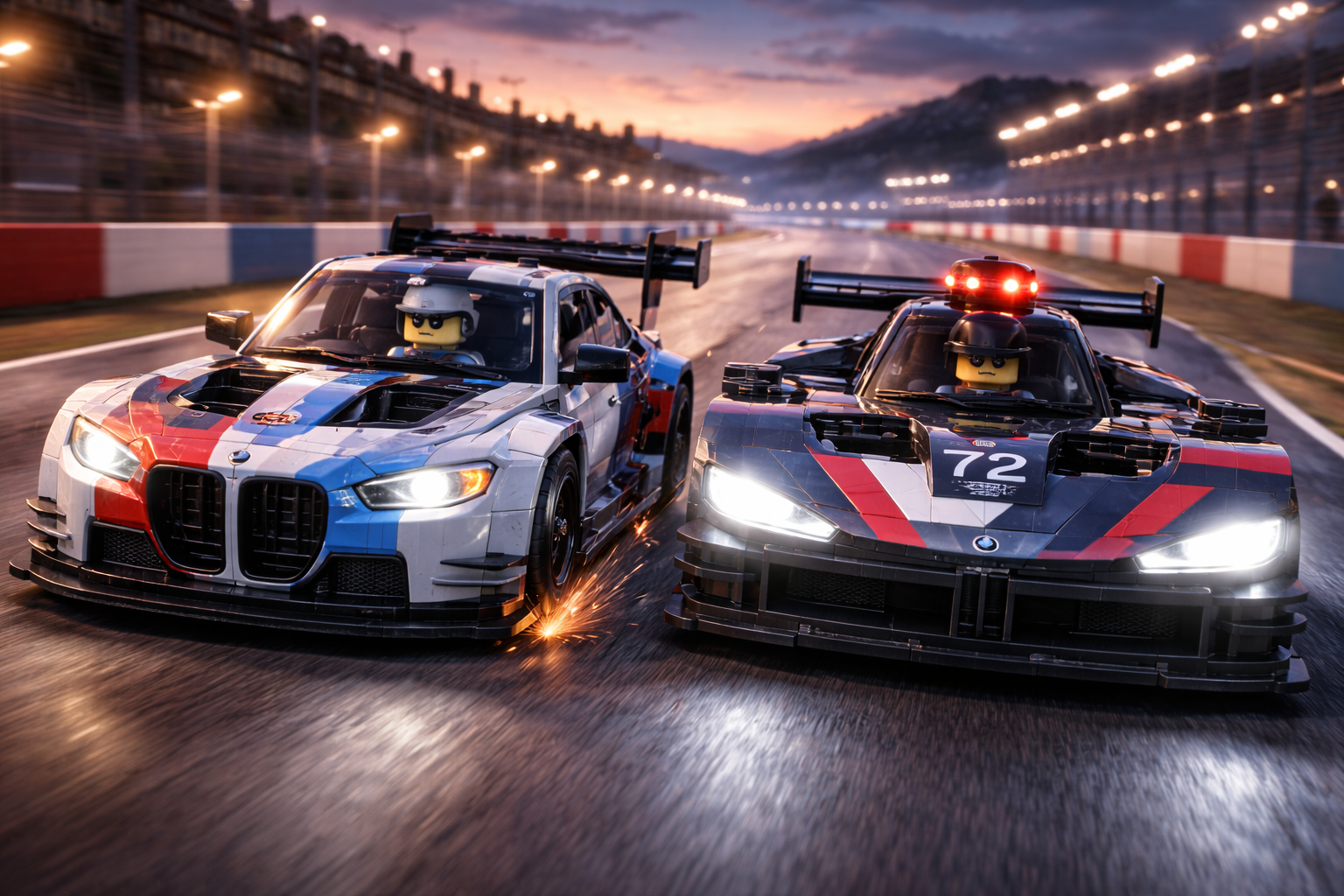
Two brick-built BMW race cars driven by minifigures race side by side on a circuit at dusk under track lights.

The circuit shimmered under the afternoon sun.

Heat rose from the asphalt in slow waves, blurring the far end of the straight where the track disappeared into distance. Grandstands buzzed with motion—flags snapping, voices overlapping, cameras raised high. Above it all, the sky was wide and blue, giving no hint of how long the day would known be before night took over.

In the pit lane, two cars waited.

One was low and aggressive, wide across the shoulders, its shape built to fight through traffic and hold its line no matter the pressure. Its colors stood out sharply against the gray track, every angle designed for endurance, not elegance.

Beside it sat something very different.

Sleeker. Longer. Almost futuristic. Its body flowed like it had been shaped by wind alone, quiet and controlled even at rest. This car wasn’t built just to race the others—it was built to race time itself.

Two drivers stood between them.

Eli adjusted his gloves, eyes fixed on the darker car. This would be his first stint. Traffic, heat, chaos. The hardest part of any endurance race.

Mara leaned against the pit wall, helmet resting at her feet. She would take over later, when the sun dipped low and the circuit changed personality. She preferred it that way.

Different cars. Different moments.

Same race.

The start came clean and fast.

Engines erupted together, sound rolling through the stands like thunder. Eli launched the first car forward, tires gripping hard as the pack funneled into the opening corners. The track was alive now—cars everywhere, each fighting for position, each demanding space that didn’t exist.

This was where endurance began.

The heat pushed hard against the cockpit. Brakes glowed faintly behind wheels. Every lap demanded patience as much as speed. Eli threaded through traffic, choosing lines carefully, protecting the car while still pushing forward.

Time stretched.

Minutes blurred into rhythm. Brake. Turn. Accelerate. Repeat.

Down the pit lane, Mara watched the timing screens flicker. She tracked fuel numbers, lap times, tire wear. The race wasn’t won in one move. It was built piece by piece.

As the sun dropped lower, shadows lengthened across the circuit. Corners that had been clear and bright now hid in darkness just long enough to surprise the unprepared.

That was her cue.

The pit stop was fast. Clean. Practiced.

Eli climbed out, heart still racing, and Mara slid in. Harness tight. Visor down. The second car rolled forward, engine humming with restrained power.

This machine felt different immediately.

Where the first car fought the track, this one flowed with it. Acceleration came smooth and silent, speed stacking without drama. The circuit opened up, especially as traffic thinned and daylight faded.

Lights flicked on around the track.

White beams cut through the dusk, reflecting off barriers and catching flashes of color as cars passed. The sky turned deep blue, then darker still. The race entered its second life.

Mara pushed harder now.

The car responded instantly, carving through corners with precision, its design built for exactly this moment. Night racing wasn’t about aggression. It was about trust—trust in the machine, in muscle memory, in the thin white lines rushing beneath the wheels.

Lap after lap, the car held steady.

Behind the pit wall, Eli watched, tension easing as the numbers stayed strong. They were still in it. Still fighting.

The circuit pulsed with light and sound, a living thing racing against the clock.

Near midnight, the checkered flag waved.

The car crossed the line under full lights, engine singing one final time before easing back. Cheers rolled through the stands, softer now but no less real. The day had turned into night, and the race had survived both.

Mara guided the car into the pit lane and shut the engine down. Silence followed—thick, satisfying.

Eli met her at the wall.

Two cars cooled under the lights. Two drivers stood side by side.

The circuit dimmed, but the memory stayed bright.

Tomorrow, the track would sleep again.

But tonight, it remembered everything.

This is an original work of fiction created by Brick Crossing, inspired by the design themes of LEGO® set 76922.
LEGO® is a trademark of the LEGO Group, which does not sponsor, authorize, or endorse Brick Crossing.
Posted on

76924 – The Road That Keeps Its Secrets

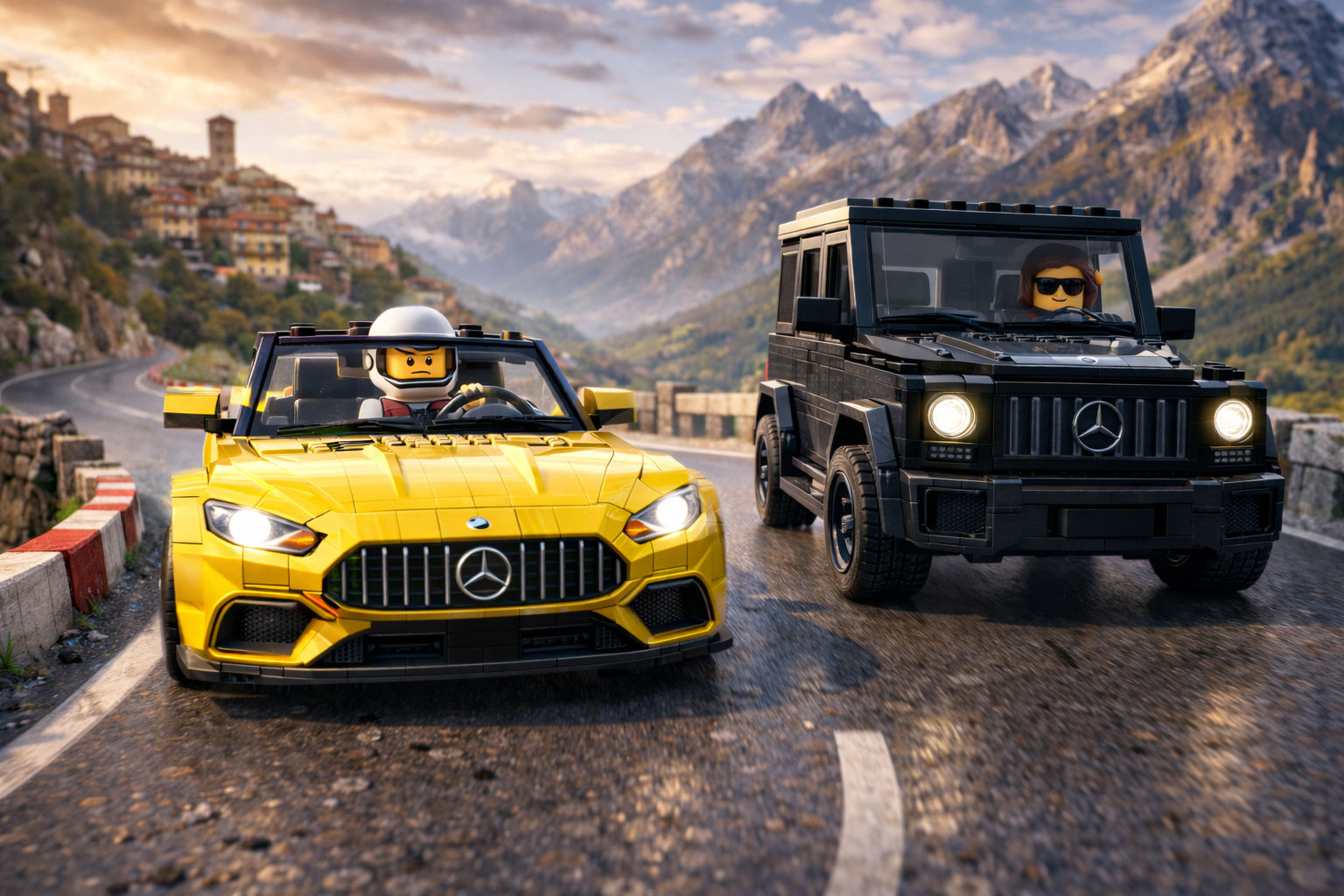
Yellow brick-built convertible race car and black brick-built SUV driven by minifigures on an Italian mountain road.

The mountain road rose out of the village like a dare.

It twisted upward through stone and shadow, cutting across cliffs where the drop vanished into mist. Old buildings clustered far below, their tiled roofs glowing softly in the early light. The road above them was narrow, unforgiving—lined with guardrails, rock walls, and nothing else.

At the start line, a low silver convertible waited, engine humming with barely contained energy. Its shape was tight and sharp, built to attack corners and vanish into the next turn before anyone could blink.

Behind the barriers stood its driver, helmet tucked under one arm, eyes fixed on the climb ahead. This was Luca’s race. He knew every bend, every shift point, every place the mountain tried to trick you.

A short distance away, parked near the team trucks, stood a very different machine.

Tall. Black. Solid.

Beside it leaned Sofia, arms crossed, sunglasses catching the light. She wasn’t racing today. She was watching. Waiting. The SUV behind her looked ready for anything the mountain could throw at it—and everything that came after.

Luca climbed into the racer and pulled the harness tight. The engine answered instantly, sharp and eager, echoing off the stone walls like a challenge shouted into the valley.

The crowd pressed closer. Flags waved. Someone counted down with raised fingers.

The lights changed.

The racer launched forward, tires biting hard as the road narrowed almost immediately. The first corner came fast—blind and uphill. Luca turned in without hesitation, trusting memory and instinct more than sight.

The mountain demanded precision.

Left. Right. Brake. Accelerate.

Stone walls flashed past inches from the wheels. The open cockpit filled with wind and sound, the engine’s note bouncing back from the cliffs. This wasn’t about straight-line speed. It was about choosing the perfect line and never letting go.

Higher up, the air cooled. Shadows stretched across the road. The racer surged out of corners, engine singing, every movement sharp and deliberate.

Below, Sofia watched the timing screens flicker. She followed Luca’s progress corner by corner, her expression calm but focused. She knew this mountain too—just in a different way.

She knew where the road went after the race ended.

The racer burst into view near the summit and crossed the finish line in a flash of silver and sound. The crowd erupted, cheers rolling down the mountain like thunder.

Luca eased off the throttle, heart still racing, hands buzzing with leftover energy. He guided the car down a narrow service road toward the paddock, brakes ticking as they cooled.

That’s when he saw it.

The black SUV waited near a stone wall overlooking the valley, engine off, stance confident. Sofia stood beside it now, helmetless, smiling as the racer rolled in.

“Still standing,” she said.

“Barely,” Luca replied, climbing out of the cockpit.

The mountain stretched behind them, silent again, as if nothing had happened. Luca pulled off his gloves and looked back up the road he’d just conquered. Speed had ruled up there—but only for a while.

He walked toward the SUV.

Sofia handed him a bottle of water, then climbed into the passenger seat. Luca took the driver’s side. The door closed with a solid, reassuring sound—nothing like the light snap of the racer.

The engine started low and steady.

Different kind of power.

The SUV rolled away from the paddock and into the village streets below. Stone buildings slipped past. The road widened. The mountain loosened its grip.

Ahead lay winding roads, fading sunlight, and the long drive home.

Luca adjusted the steering with ease. Sofia leaned back, watching the cliffs slide by.

The race was over.

The road, however, was just beginning.

This is an original work of fiction created by Brick Crossing, inspired by the design themes of LEGO® set 76924.
LEGO® is a trademark of the LEGO Group, which does not sponsor, authorize, or endorse Brick Crossing.

Posted on

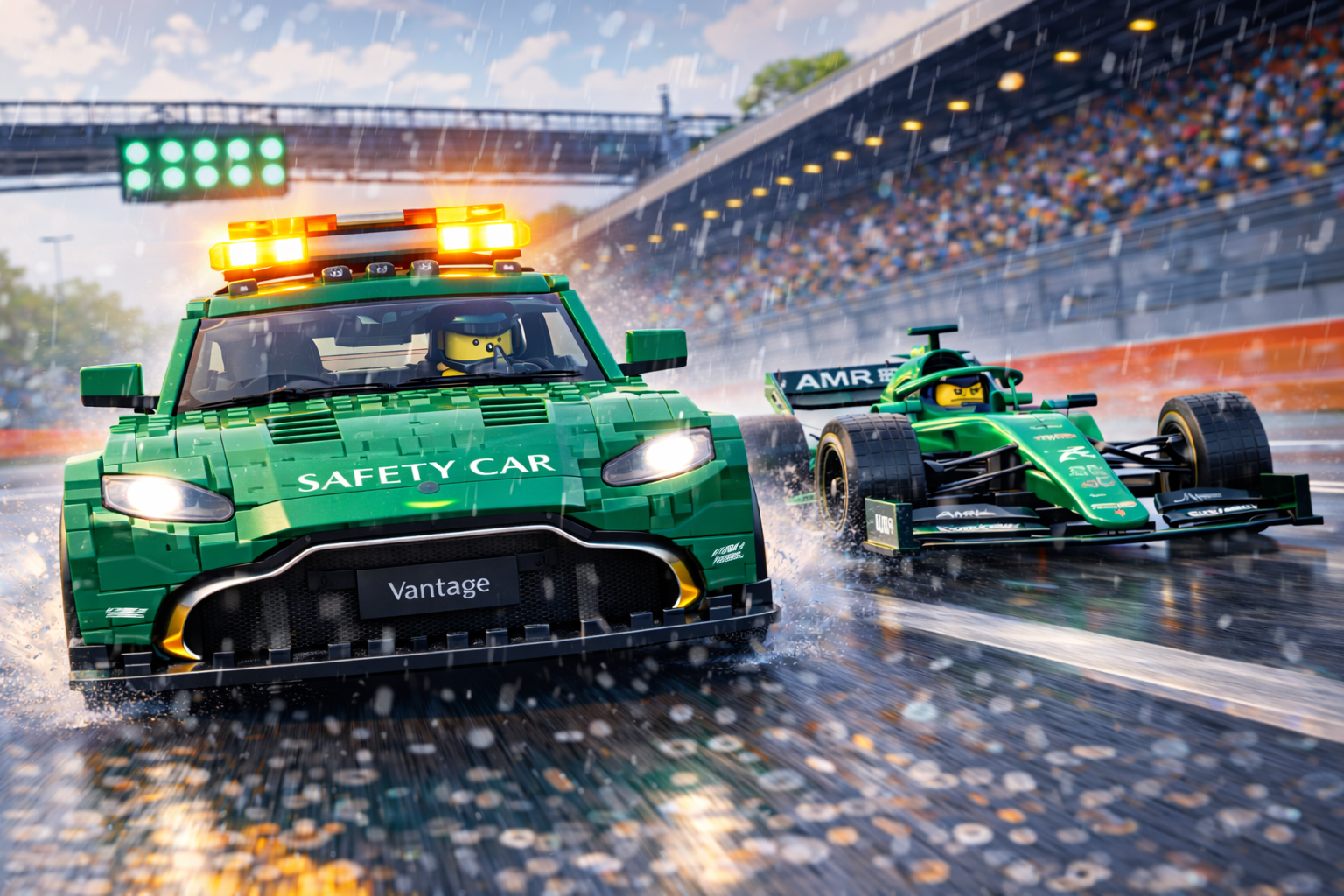
76925 – When the Lights Take Over

Brick-built safety car with flashing lights leads a Formula-style race car on a wet track, driven by minifigures during a rainy racing scene.

Morning arrived fast at the circuit. The sun climbed above the grandstands, flashing across metal rails and glass panels, turning the track into a long silver streak. The air buzzed with expectation, even before a single engine started.

Two cars waited in the pit lane, side by side but built for different purposes. One crouched low, sharp and sleek, every line shaped to cut through air as if it barely existed. The other stood taller, broader, marked by a light bar stretching across its roof—calm, visible, impossible to ignore.

Around them, crews moved with purpose. Tool carts rolled. Visors snapped shut. Radios crackled with short updates. Today wasn’t about luck. It was about readiness.

At the far end of the lane, the track stretched forward like a challenge.

The drivers climbed in. Harnesses clicked tight. Gloves wrapped firmly around steering wheels worn smooth by practice. For a moment, everything stilled.

Then the engines fired.

Sound surged through the pit lane, deep and thrilling, echoing off the barriers and waking the empty seats above. The low car trembled with energy, eager to break free. The taller car answered with a steadier roar, confident and controlled.

They rolled out together.

The pit exit opened onto the circuit, and suddenly the world widened. Corners flowed into straights. Painted lines blurred at the edges. Even at controlled speed, the track demanded attention.

The first laps were clean. Fast curves tested courage. Braking zones demanded precision. Each turn felt like a question, and each answer came faster than the last.

On the third lap, everything changed.

A flash of movement ahead. A burst of smoke near the barrier.

Yellow flags waved.

The low car slowed instantly. The taller car surged forward, slipping into the lead. Its light bar ignited, amber flashes cutting through the air like a signal flare.

This was its moment.

The safety car took control of the circuit. Speed dropped, but tension climbed. Behind it, the racing car followed closely, engine humming, waiting.

They passed the trouble spot carefully. A car sat stranded at an angle, crew members already rushing in, their movements fast but focused. The system worked because everyone trusted it.

Rain began without warning.

First a few drops. Then more. The track darkened, reflections spreading across the asphalt. The circuit looked different now—slick, unpredictable, alive in a new way.

Inside the safety car, the driver adjusted smoothly, eyes scanning mirrors and corners. Every decision mattered. Too slow, and the race would lose its rhythm. Too fast, and control would vanish.

Behind, the racing car felt the change instantly. Tires searched for grip. Steering grew lighter. The thrill sharpened.

Radio chatter increased. Short commands. Clear answers.

They rounded the final section of the lap, rain tapping harder now, lights blazing against the gray sky. The safety car guided them through, holding the balance between caution and excitement.

Everyone knew what was coming next.

At the final bend, the safety car’s lights went dark.

The track seemed to pause.

Then the safety car peeled away, slipping toward the pit lane, its job done.

The racing car surged forward, engine screaming as water sprayed behind it. Speed returned all at once—louder, faster, more alive than before.

The straight rushed toward the horizon.

And the race truly began.

This is an original work of fiction created by Brick Crossing, inspired by the design themes of LEGO® set 76925.
LEGO® is a trademark of the LEGO Group, which does not sponsor, authorize, or endorse Brick Crossing.