Posted on

The Temple That Remembered

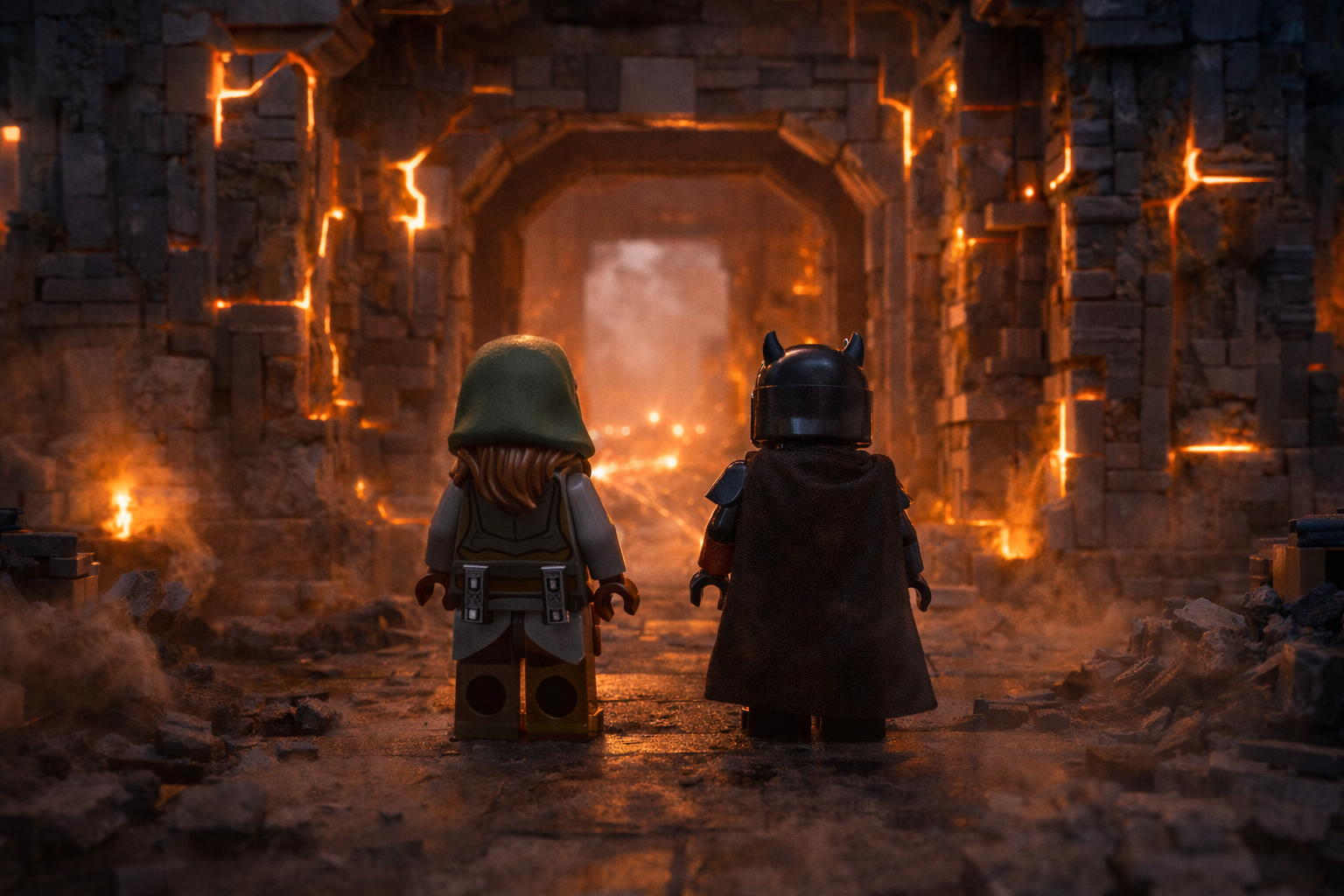
Brick-built minifigure duo stand at the entrance of a forgotten stone temple as glowing energy seams awaken through ancient ruins.

The world had no proper name anymore. Maps showed it as an omission—an empty patch of dark where routes bent away for no stated reason. Pilots called it the Quiet Orbit. Salvagers called it Bad Luck. The few who’d set boots on its surface simply called it don’t.

And yet the temple waited there, half-buried in dust the color of old bone, its broken spires clawing at a sky bruised by permanent twilight. Wind moved through the ruins in slow, deliberate breaths, as if the stone itself was learning how to speak again.

Serai reached the outer steps at dusk, cloak snapping behind her in the gusts. She paused with one hand on the carved railing, feeling warmth where there shouldn’t have been any—heat pulsing through rock that hadn’t seen a living builder in centuries.

Somewhere inside, something answered.

Across the collapsed courtyard, Nox watched from behind a fallen column, his silhouette hard against the dim. He hadn’t expected to see her tonight. He had expected her eventually. Their paths had a habit of crossing when the world was about to tip.

He kept his fingers away from his weapon, as if touching it too early would make the moment less true.

Serai moved through the shattered entryway without lighting a lamp. The temple provided its own glow—thin seams of pale energy running through the walls like veins under skin. The closer she walked, the brighter the lines became, responding to her presence like a creature recognizing a familiar scent.

She told herself it was just an old mechanism.

She didn’t believe it.

The corridor widened into a hall of broken statuary: faces worn smooth by time, arms missing, torsos split by cracks that still radiated faint heat. Each step echoed too long, as if the temple didn’t want to let any sound leave once it arrived.

A whisper rode the air—almost language, almost memory—threading itself between her thoughts.

Serai stopped and breathed out slowly. “Not yours,” she murmured, whether she meant the voice or her own fear.

Behind her, something shifted.

Nox stepped into view, boots quiet on the dust. He’d come through a side breach the way he always did—never direct, never announced. He was a shadow by trade and by necessity, a courier of stolen truths and broken codes, someone who lived on the edges of conflicts and survived by never being the center of one.

But tonight his presence felt inevitable, like a door closing.

“Still walking into places that want you dead,” he said.

Serai didn’t turn fully. “Still following me into them.”

“I follow problems,” Nox replied. “You’re just… consistent.”

The faintest curve touched Serai’s mouth—gone as quickly as it came. “This isn’t a problem. It’s a conclusion.”

Nox’s gaze drifted to the glowing seams in the stone. “Conclusions get messy.”

They were quiet for a moment, listening to the temple’s breathing. Somewhere deeper, the rhythm changed—faster now, as if the structure had noticed the second heartbeat inside it.

Serai finally faced him. Her eyes were calm in a way that made people underestimate her. Calm wasn’t softness. Calm was choice.

“You shouldn’t be here,” she said.

Nox shrugged once. “We both know that never matters.”

It was true. Their lives were separate: Serai the wanderer who carried a purpose too heavy to share; Nox the opportunist who kept finding himself spending his last credits on other people’s wars. They met in ports, in ruins, in the aftermath of raids, always circling the same storm without naming it.

The storm had a name, though, even if no one dared speak it openly: the Veil Court.

The Court didn’t conquer with armies at first. It seeded influence like rot—quiet, patient, inevitable—drawing power from relics and temples the way miners drew ore. This temple, this forgotten world, was one of their deepest roots.

And now Serai stood here to sever it.

Nox lifted his chin toward the inner archway, where darkness pooled like ink. “They’re inside.”

Serai’s hand tightened on her weapon. “I know.”

The hall ahead opened into a circular chamber whose ceiling had collapsed to reveal the twilight sky. At its center rose a dais of black stone, smooth and untouched by dust—too clean, too present. Symbols spiraled across it, glowing faintly as if recently fed.

Figures waited around the dais in a loose ring, their armor matte and featureless, faces hidden behind masks that reflected nothing. They looked less like soldiers and more like pieces on a board.

One stepped forward. Their voice carried without amplification, as if the chamber itself decided to deliver it.

“You came back,” the figure said to Serai. “We wondered if you’d forgotten what you owe.”

Serai’s response was quiet. “I don’t owe you anything.”

The masked figure laughed once—dry, pleased. “Everyone owes the Court. Some pay in currency. Some pay in fear. Some pay in—”

They stopped, head tilting slightly toward Nox, as if noticing him for the first time.

“—betrayal.”

Nox felt the word land like a hook. He didn’t flinch. He’d been called worse by better people.

Serai didn’t look at him. She didn’t need to. She trusted patterns more than promises, and Nox had never once sold her out—no matter how convenient it would have been.

The figure lifted a hand toward the dais. The symbols brightened, and the temple’s seams flared in response. The walls vibrated. The air thickened, tasting faintly of metal and storms.

The temple wasn’t just a building.

It was a battery.

And the Court had been charging it for a long time.

Serai moved first.

She didn’t announce herself with a speech or a shout. She cut forward like a blade through cloth, her weapon igniting in a clean line of light. The chamber erupted—masked soldiers closing in, the dais pulsing brighter, the temple’s veins glowing like a heart pushed too hard.

Nox didn’t hesitate. He was no duelist, no legend, but he knew how to survive a room that wanted you dead: keep moving, keep angles, never let them surround you. He drew his compact blade and slipped into the fight at Serai’s flank, not trying to match her, just trying to make her impossible to isolate.

For a breath, they moved like they’d trained together.

They hadn’t.

That was the terrifying part.

A masked soldier lunged at Nox; he pivoted, struck low, and felt the impact jar up his arm. Another came for Serai; she turned and met it with a single clean motion that sent the attacker skidding back across dustless stone.

The dais flared.

The temple answered with a groan—stone shifting, seams brightening, heat rising from the floor in waves. The air shimmered. Nox’s skin prickled as if the chamber had turned its attention inward.

Serai noticed it too. Her eyes flicked to the symbols, to the way the glow intensified with each strike, each fall, each surge of adrenaline.

“They’re feeding it,” Nox shouted over the roar of motion.

Serai’s jaw set. “Then we stop feeding it.”

She broke from the ring of attackers and drove straight toward the dais, ignoring the blades that snapped near her shoulders. A masked figure tried to intercept—taller, faster, armor edged with faint light.

Serai clashed with them, the impact so bright it burned afterimages into the air.

Nox darted in to support and nearly took a strike meant for her. He twisted aside at the last instant and felt heat singe his sleeve. The masked figure’s weapon hummed with the same cadence as the temple—linked, synchronized, as if the structure itself lent it power.

Serai shifted tactics. She stopped trying to win the duel.

She started trying to break the room.

She feinted left, drew the masked figure’s strike, then drove her weapon down—not into an enemy, but into the dais’s edge, where the symbols were brightest.

The stone screamed.

Light surged outward in a shockwave, throwing dust into the air for the first time in centuries. The seams in the walls flared so bright the chamber became a white bowl of fireless light.

Every masked soldier froze for a fraction of a second, as if the temple had yanked a leash.

Nox staggered, eyes watering. “Serai—”

“I know,” she breathed, voice steady with certainty. “It’s alive.”

The dais cracked under her blade. A fissure spidered through the black stone, and for a heartbeat Nox saw something inside it—not machinery, not wiring—something like liquid light, moving as if it had intention.

The Court’s leader hissed, anger finally breaking through their composure. “Stop!”

Serai pulled her weapon free and struck again, deeper this time.

The fissure widened.

The temple convulsed.

Somewhere far above, a spire collapsed with a thunderous groan. The floor shook hard enough to throw attackers off their feet. The seams along the walls flashed in chaotic patterns, like a mind losing its grip.

Nox realized what Serai had done.

She hadn’t just damaged their power source.

She’d triggered its end.

A self-destruction—not a button, not a fail-safe, but a living mechanism refusing to be used.

The Court’s soldiers surged forward in panic now, not to kill, but to stop the collapse. The leader shouted commands that sounded more like prayers.

Serai met Nox’s gaze for the first time in the fight.

“Run,” she said.

Nox didn’t move. “Not without you.”

Her expression softened—not with sentiment, with calculation. “Then run with me.”

They sprinted together as the chamber tore itself apart behind them—stone cracking, light spilling, the temple’s veins burning out in bright, furious lines. The Court’s voices rose in rage and disbelief as their centuries of planning began to crumble into dust.

A final tremor rolled through the ruin.

Above, the sky split with a sound like a mountain breaking.

Serai glanced back once—just long enough to see the dais collapse inward, swallowing its own light like a star going out.

Nox reached for her wrist and pulled her through the threshold—

—and the temple’s heart detonated into silence.

This is an original work of fiction created by Brick Crossing, inspired by the design themes of LEGO® set 75385.
LEGO® is a trademark of the LEGO Group, which does not sponsor, authorize, or endorse Brick Crossing.
Posted on

The Last Door

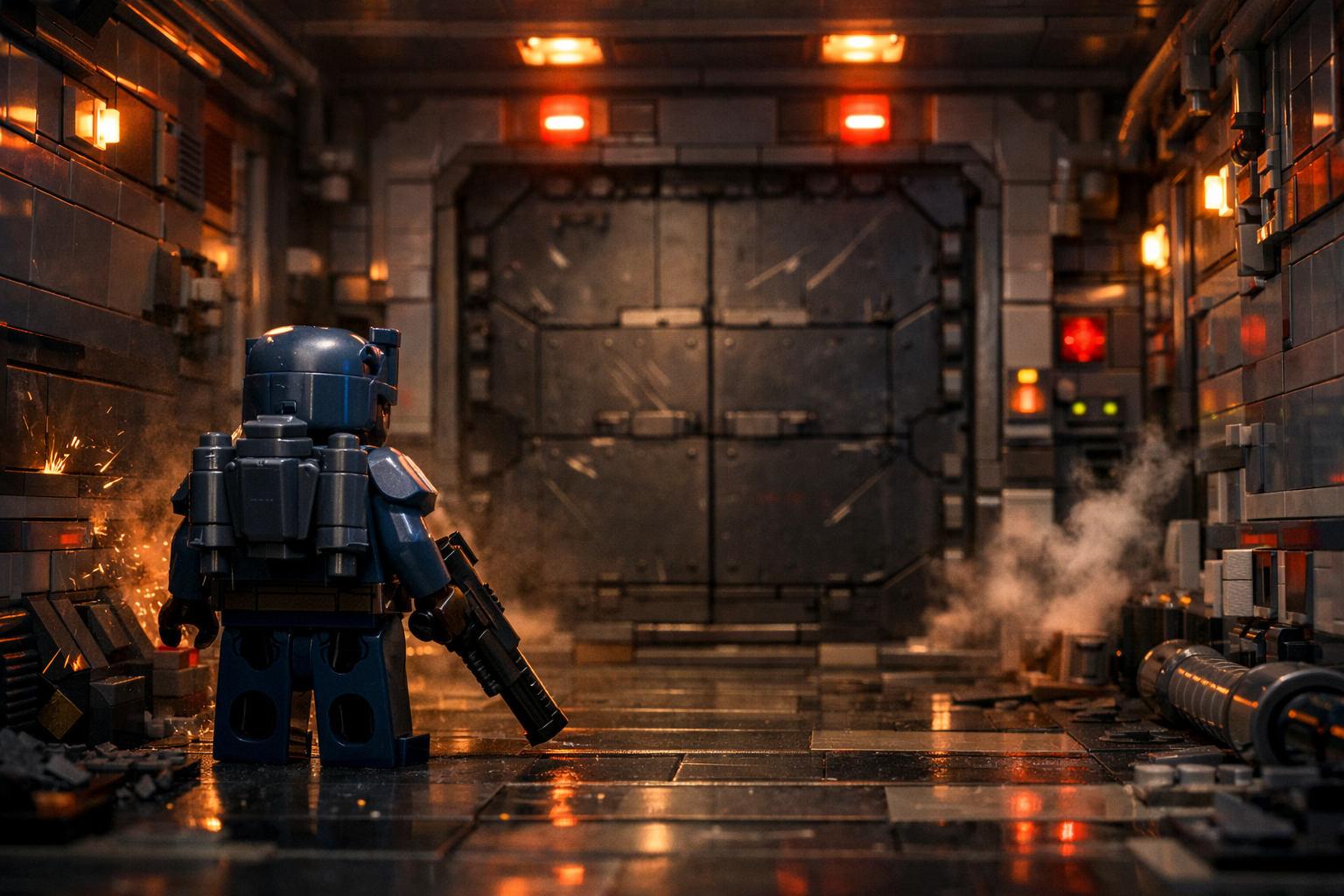
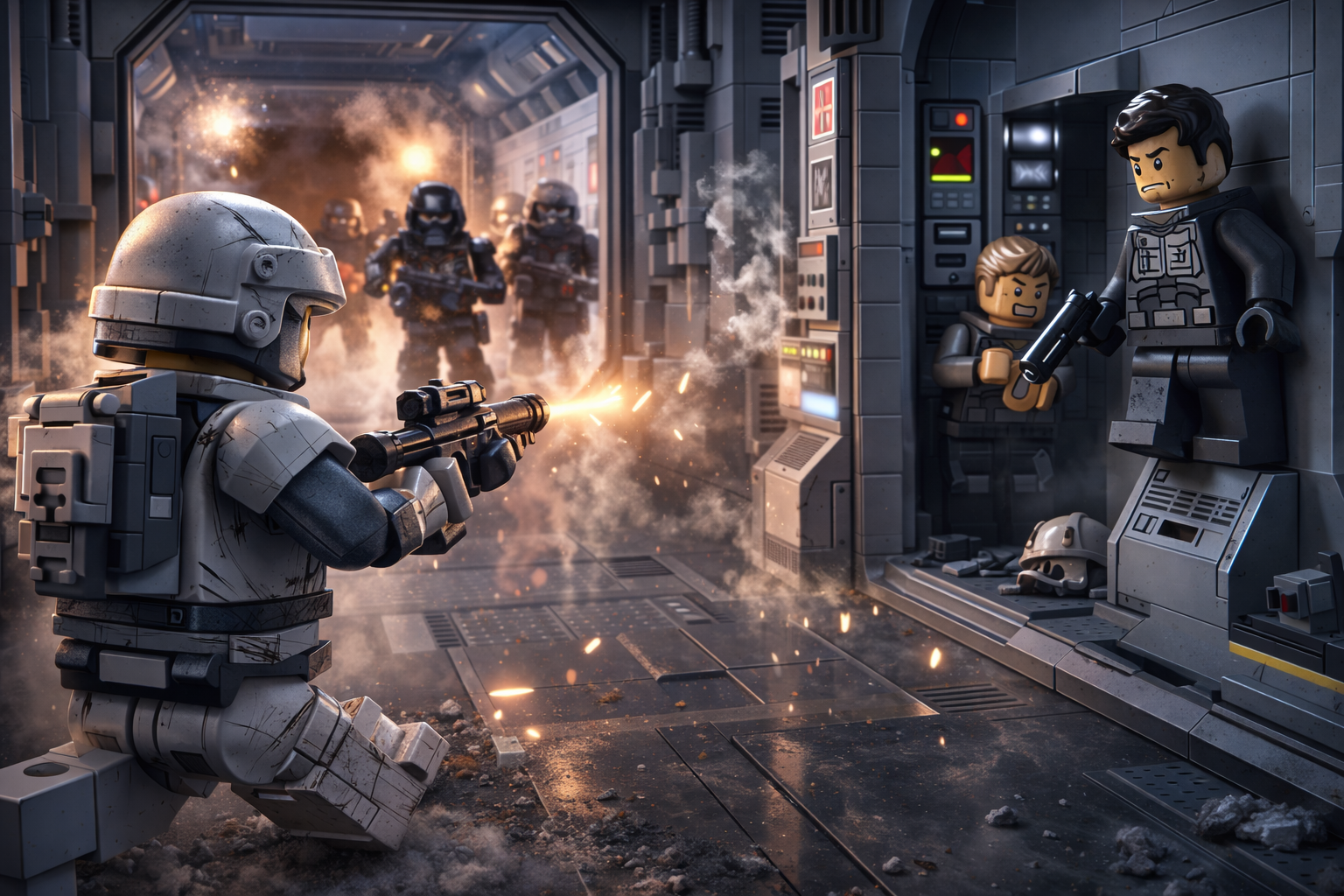
Brick-built armored minifigure stands alone in a smoke-filled corridor before a massive sealed blast door inside a sci-fi facility.

The corridor smelled like hot metal and old smoke, as if the building had been burning for years and only just remembered to stop. Overhead strips of light flickered in slow pulses, casting the kind of shadows that made every corner look like a decision.

At the far end stood the last door.

It wasn’t just a barrier—thick, segmented, reinforced. A door built for invasions, for riots, for the moment when someone with authority decided that everything on the other side had to become unreachable. Frosted dents scarred its surface. Fresh scratches ran in parallel lines where something had tried to pry it open and failed.

In front of it, alone, a defender planted his boots and checked the tightness of his gauntlets. The armor was heavy, practical, pitted from shrapnel and close calls. No insignia worth noticing. No ceremony. Only the weight of what it was designed to do.

Behind the door, people held their breath.

In the hallway, the defender listened to the silence and waited for it to break.

It broke softly at first—an electric whine threaded through the building’s bones, as if power was being rerouted for something that didn’t care who lost heat and light along the way. The corridor’s lights dimmed. Somewhere overhead, a vent fan died mid-spin.

The defender—Garron, called “Garr” when anyone dared shorten his name—kept his visor up, letting his eyes adjust. He liked seeing the world without a filter when it mattered. He liked making choices with his own vision.

A voice crackled in his ear, thin with interference. “Garr… status.”

He pressed two fingers to the comm. “Holding.”

“You’re alone,” the voice said. It belonged to Ilen, the shift coordinator who had stopped being a coordinator and started being a leader the day the facility became a target. “Fallback is still open. You can—”

“I know where fallback is,” Garr replied. He didn’t raise his voice. He didn’t need to. “Keep them sealed. Keep them quiet.”

A pause. He could hear movement behind the door—people shifting positions in a space that suddenly felt too small. “You don’t have to—” Ilen began.

Garr cut in, gentler. “I do.”

He wasn’t saying it to be brave. He was saying it because it was true. The building’s map lived in his muscles: where the corridor funneled, where the floor plating was weakest, where the door’s manual release sat behind a panel only he could reach in time. He’d walked this stretch on dull nights when nothing happened. He’d pictured this moment then without admitting he was picturing it.

Another sound joined the whine: footfalls.

Measured. Unhurried. Not the rush of a squad. Not the scramble of a raiding party. One set of steps, approaching with the calm of someone who believed the hallway belonged to them.

Garr rolled his shoulders, feeling armor plates settle. His breath fogged once in the cooler air, then cleared. He looked down the corridor and saw the figure emerge into the light.

Varrek didn’t wear bulk. He wore intent.

His armor was sharper in its lines, cleaner in its construction, shaped to intimidate as much as protect. A dark cape-like mantle hung from one shoulder—not for warmth, not for function, but for the way it moved when he stopped, the way it made space feel like a stage.

In his hand was a weapon that hummed at the edge of hearing, a blade of condensed energy that didn’t throw sparks so much as it threw warnings.

Varrek didn’t raise it. He didn’t need to.

He simply looked at Garron as if Garr were the last inconvenience between him and a conclusion.

“I expected more,” Varrek said.

Garr didn’t answer.

He shifted his stance—left foot forward, right foot braced—blocking the corridor’s centerline. His weapon came up, heavier and simpler: a broad-powered staff with an energized edge that glowed faintly, the kind of tool built to hold ground rather than carve it.

Varrek’s gaze flicked to the door behind Garr. “You’re protecting something.”

“I’m protecting time,” Garr said at last.

A small smile creased Varrek’s face, quick and unimpressed. “Time runs out.”

Garr’s comm hissed in his ear. Ilen’s voice returned, urgent. “Garr—he’s alone?”

“He’s never alone,” Garr murmured, eyes locked forward. “Not really.”

He could feel it now: pressure, like the building itself knew who was standing in its corridor. The air turned metallic. The lights overhead steadied as if bracing. Garr tasted old smoke and new electricity and the dry bite of fear he refused to let become panic.

Varrek took one step forward.

And the corridor became the only place that mattered.

The first clash was bright enough to erase shadow.

Energy met energy with a sound like metal struck underwater—muffled but violent, the impact traveling through Garr’s arms into his shoulders, into his chest. He held the line by refusing to give even half a step.

Varrek tested him—three fast strikes, precise, elegant. Garr absorbed them with brute practicality, redirecting the force into the floor, letting the corridor take the weight it had been built to take.

“You’re strong,” Varrek observed, almost conversational.

“Not the word,” Garr said, and shoved forward.

His counterstrike wasn’t stylish. It was committed. It forced Varrek back a fraction, boots scraping, mantle whipping.

Behind the door, something thudded—someone flinched hard enough to hit the wall.

Garr heard it. He used it.

He swung wide, not to hit, but to herd—driving the fight away from the door’s seam, away from the hidden panel where the manual release could be forced if Varrek got close enough. He needed the enemy centered in the corridor, where geometry did more work than courage.

Varrek read the tactic instantly. “You’re trained,” he said, and his blade flicked low.

Garr took the strike on a forearm plate. The armor sparked and smoked. Heat licked through the metal and bit his skin. He hissed once, controlled, and returned a heavy blow that rang off Varrek’s shoulder guard.

For a brief moment they were close—close enough for Garr to see Varrek’s eyes through a narrow visor slit. Not wild. Not furious.

Focused. As if this was inevitable and therefore not emotional.

That focus was a kind of cruelty.

“Who’s behind that door?” Varrek asked, voice low, almost curious. “Civilians? Engineers? Something you were told to die for without being told why?”

Garr’s jaw tightened. “Does it matter?”

“It matters to me,” Varrek said. “Because it means someone lied. And I’m here to collect the truth.”

Garr felt anger flare—sharp, dangerous. He tamped it down. Anger made you chase. Chasing got you killed.

He shifted his grip and slammed the butt of his staff into the floor.

The impact triggered a hidden mechanism—a strip of plating along the wall slid open, venting a burst of cold suppressant gas into the corridor. It wasn’t enough to freeze, but enough to sting eyes, enough to make breath catch, enough to disrupt sensors that assumed clean air.

Varrek blinked once, surprised.

Garr used the half-second to drive forward, shoulder-first, armor against armor, pushing Varrek back toward the corridor’s centerline again. The old building groaned, accepting the violence like a familiar burden.

In his ear, Ilen whispered, “We’re almost ready.”

Garr didn’t ask what “ready” meant. He knew: engine spool, emergency detach, the ship—or transport platform, or whatever this facility’s lifeline was—preparing to leave with its secret cargo intact.

He just needed more time.

Varrek recovered quickly. He always would.

The blade snapped upward, too fast. Garr blocked, but the force cut through his defense and scorched a line across his chest plate. The armor didn’t fail. It screamed, heated, and held.

Garr staggered one step.

Varrek seized the opening, pressing in with three more strikes, each one meant to take Garr’s ground inch by inch. Garr retreated another half step, then stopped himself—heel catching against a seam in the floor he’d memorized months ago.

If he went back further, the door was vulnerable.

He couldn’t.

So he did the only thing left.

He advanced.

Garr surged forward into the blade’s path—not reckless, but decisive—using his heavier weapon like a lever, locking it against Varrek’s arm and twisting hard. Energy screamed. Sparks rained. The mantle snapped as Varrek pivoted to avoid being thrown.

For a heartbeat, Garr had him off-balance.

He could feel the hallway tilt toward possibility.

Then Varrek’s free hand came up, palm outward, and a pulse struck Garr square in the chest—an energy shock that wasn’t a blast so much as a command. Garr flew backward and hit the wall hard enough to spiderweb the paneling.

Pain flashed white behind his eyes. His visor snapped down automatically. The corridor blurred.

He forced himself upright anyway.

Varrek walked toward him with patient certainty.

“You’re buying time,” Varrek said. “But you’re spending yourself.”

Garr’s breath rasped. “That’s the job.”

The comm hissed again. Ilen’s voice—shaking now—said, “We’re moving. Garr—get out.”

Garr laughed once, short and bitter. “If I leave, he follows.”

“Garr—” Ilen started.

Garr cut in, voice suddenly quiet. “Then don’t look back.”

He planted his feet again between Varrek and the door. The air felt heavier, charged with finality.

Varrek lifted his blade.

Garr raised his staff.

And for the first time, he didn’t feel like the corridor belonged to him.

He felt like it belonged to the moment.

They moved at the same time—energy flaring, armor colliding, the corridor’s lights strobing like a heartbeat at its limit.

Behind the sealed door, something deep within the ship’s frame shifted—engines catching, clamps releasing, the whole structure preparing to tear itself away from this place and this fight.

Garr lunged.

Varrek met him.

And the screen of Garr’s visor flooded with white—

—then cut to black.

This is an original work of fiction created by Brick Crossing, inspired by the design themes of LEGO® set 75386.
LEGO® is a trademark of the LEGO Group, which does not sponsor, authorize, or endorse Brick Crossing or this content.

Posted on

The Space Between Doors

Brick-built corridor inside a military cargo ship where a minifigure soldier defends against a boarding force near a breached doorway.

THE CORRIDOR

The corridor was too narrow for retreat.

That was why Jace had chosen it.

White panels ran the length of the passage, scuffed by boots and cargo crates, scarred where something had once gone wrong and been repaired in a hurry. Overhead lights flickered—not enough to fail, just enough to remind him the ship was under strain.

Behind him: the cargo vault.

Ahead of him: the breach.

Jace adjusted his stance, planting his boots wide. The ship shuddered again as something heavy locked onto its hull. Magnetic clamps, maybe. Or cutting tools. Either way, the boarders were already closer than command wanted to admit.

He keyed his comm.

“Contact imminent,” he said. “I’ll hold here.”

A pause.

Then his brother’s voice, tight but steady. “Copy that. I’m still not seeing how they knew.”

Jace smiled despite himself. “You always did ask the wrong questions first.”

THE SHIP’S CORE

Eren didn’t answer.

He was already moving.

The ship’s internal sensors told a story that didn’t make sense unless you knew how to read between the lines. Boarding vectors too precise. Power fluctuations timed with internal door cycling. Someone had fed the attackers more than coordinates.

Someone on board.

Eren slid into the auxiliary control room and pulled up access logs, fingers moving faster as patterns emerged.

Unauthorized pings. Short-range bursts routed through maintenance relays. Clever. Hidden.

Not clever enough.

“Jace,” Eren said into the comm, “they didn’t guess. They were told.”

BUYING TIME

The first blast blew the far door inward.

Metal screamed. Smoke poured into the corridor. Jace raised his weapon and fired immediately—not to stop them, just to force hesitation. He needed seconds. Minutes if the universe was feeling generous.

Shapes moved in the smoke.

Too many.

He stepped forward instead of back.

Each step cost him ground he didn’t have to spare, but it kept the fight where he wanted it. The corridor funneled the attackers, stripped them of numbers, made every advance expensive.

“Find them,” Jace said calmly. “I’ll keep them busy.”

His shoulder burned where a shot grazed him. He ignored it.

Pain was negotiable.

Time wasn’t.

POV TWO — THE TRAITOR

Eren followed the data trail down into the maintenance ring, where the ship’s bones were exposed—wires like veins, conduits humming with restrained power.

He found the traitor crouched at a junction node, transmitter clutched in shaking hands.

Not a hardened saboteur.

A crewman.

“You didn’t mean for this,” Eren said quietly.

The man looked up, eyes wide. “They said they wouldn’t hurt anyone. Just take the cargo.”

Eren felt something cold settle in his chest.

“The cargo,” he repeated. “You knew it mattered.”

The man broke down then, words tumbling out. Debts. Threats. Fear.

Eren shut the transmitter off himself.

Too late to stop the boarding.

Just in time to save the ship.

POV ONE — THE LAST STAND

The corridor was filled with smoke now.

Jace fired until his weapon overheated, then switched to short bursts, then single shots. His armor was cracked. His breath came in sharp pulls.

The boarders kept coming.

He checked his ammo.

Enough for one more push.

“Eren,” he said, voice rough but calm. “How close are you?”

A pause.

Then: “I found them.”

Relief washed through him, so sudden it almost made him laugh.

“Good,” Jace said. “Then listen carefully.”

He stepped forward again, drawing fire, drawing attention.

“Get the ship clear. Burn hard. Don’t wait for me.”

“No,” Eren said instantly.

Jace smiled, unseen. “You always did wait too long.”

ESCAPE

Eren ran.

He sealed bulkheads as he passed, rerouting power, overriding safeties that screamed at him in red warnings. The engines spun up, straining against clamps still biting into the hull.

He reached the bridge and slammed controls forward.

The ship lurched.

Something tore free with a sound like the universe ripping fabric.

The stars shifted.

They were moving.

SILENCE

The corridor fell quiet.

Jace leaned against the wall, sliding down slowly as the ship’s vibrations changed. The engines’ deep hum told him everything he needed to know.

They’d made it.

He laughed once, breathless.

Worth it.

EPILOGUE — THE TRUTH

Hours later, with the ship secure and the cargo untouched, Eren stood alone in the corridor.

The repaired door gleamed where the breach had been.

He rested his forehead against the cool panel and closed his eyes.

The reports would say a defender fell holding the line.

They wouldn’t say his name.

They wouldn’t say he was a brother.

Eren whispered it anyway.

“Thank you.”

The ship sailed on, carrying its secret—and the space one man had bought with his life.

This is an original work of fiction created by Brick Crossing, inspired by the design themes of LEGO® set 75387.
LEGO® is a trademark of the LEGO Group, which does not sponsor, authorize, or endorse Brick Crossing or this content.

Posted on

New Steel, Old Ground

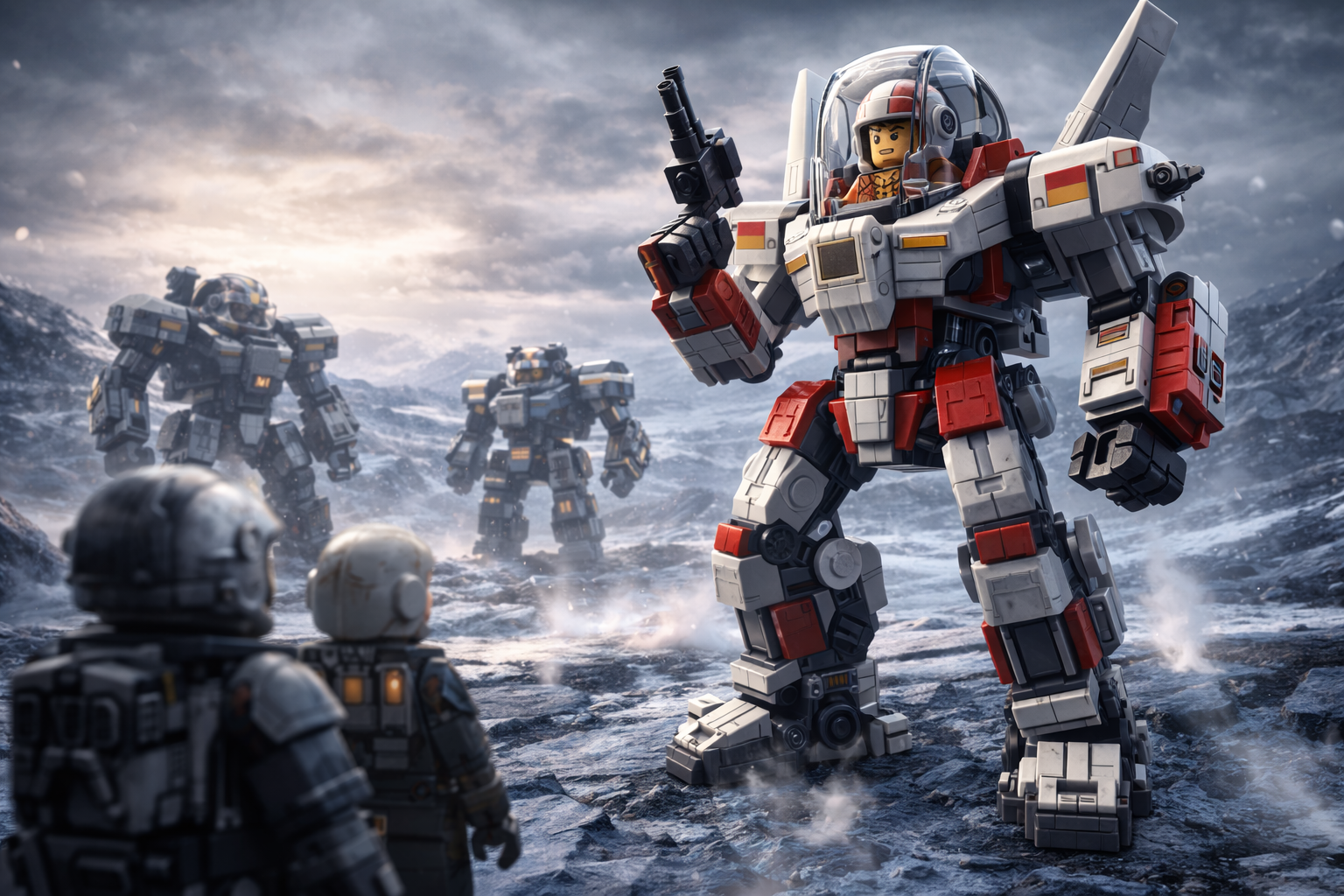
Brick-built mech piloted by a rookie minifigure stands on cracked ice and volcanic rock as veteran mechs watch from the outpost behind.

The new mech hummed instead of growled.

That was the first thing Arin noticed.

It stood taller than the older machines lining the outpost’s bay—sleeker armor, cleaner joints, control surfaces that adjusted themselves before he even thought to correct them. Diagnostic lights glowed calm and confident, cycling through readiness checks like a promise.

It made him feel taller, too.

Which was dangerous.

Outside the bay, the moon hadn’t changed. Ice still cracked open around slow-breathing vents of heat. Steam froze midair and fell back as brittle snow. The ground remembered every mistake that had ever been made on it.

Arin didn’t yet.

ARRIVAL OF REINFORCEMENTS

They’d arrived in force—three new mechs, fresh crews, updated systems meant to hold the line that outdated frames had somehow survived weeks earlier. Command called it reinforcement.

The veterans called it noise.

Arin felt their eyes on him as he climbed into the cockpit. He didn’t need to look to know who they were.

Lio, standing with his arms crossed, unreadable.
Mira, leaning against a crate, helmet under one arm, watching everything.
Kett, half-hidden behind a console, pretending not to stare.
Oren, already shaking his head at something the diagnostics insisted was “optimal.”

They didn’t look impressed.

They looked tired.

FIRST MISSION BRIEF

The assignment was simple.

A perimeter sweep. Sensor calibration. Show presence.

“Not a fight,” Lio said flatly. “You don’t chase. You don’t engage unless ordered. This ground eats confidence.”

Arin nodded quickly. “Understood.”

He meant it.

Mostly.

The mech sealed around him with a hiss, controls syncing instantly. The responsiveness was intoxicating. It moved like it wanted to be pushed.

He thought of the scarred veterans’ machines—patched armor, exposed welds, stabilizers that needed coaxing instead of commands.

Old steel.

He stepped out onto the ice.

CONTACT

The first warning came as a flicker—movement near the fissure field. Arin’s sensors painted it cleanly, automatically tagging threats before he’d even asked.

Two enemy signatures.

Outdated. Heavy.

We can handle that, his mech seemed to say.

Arin didn’t wait for confirmation.

He surged forward, boosters flaring, closing the distance faster than any of the older mechs ever could.

“Arin—hold position,” Mira snapped over comms.

He didn’t ignore her.

He just… finished the move first.

THE MISTAKE

The ground shifted.

Not dramatically. Not obviously.

Just enough.

Arin felt it a heartbeat too late as the ice under his left foot fractured into glassy plates. His mech compensated automatically—too aggressively—throwing his balance off instead of settling it.

He fired to regain control.

The shot missed its target.

It hit the ground.

The fissure answered.

Steam and heat burst upward, blinding sensors and overloading stabilization systems. Warnings screamed through the cockpit. The mech staggered, one knee slamming down hard enough to crack basalt beneath it.

Enemy fire clipped his shoulder.

Pain bloomed—not physical, but worse.

Embarrassment.

Fear.

Then a familiar voice cut through the chaos.

“Power down your left stabilizer,” Lio ordered. Calm. Absolute.
“Do not fight the ground,” Mira added. “Let it move.”

Arin swallowed and obeyed.

VETERANS MOVE

The older mechs entered the field like they belonged there.

Mira slid in fast and low, her machine dancing over the ice with practiced familiarity. Lio took the high ground, not firing, just being present. Kett and Oren worked in tandem—one disrupting enemy targeting, the other guiding Arin’s systems back into alignment.

The enemies withdrew.

Not because they were destroyed.

Because they weren’t welcome.

Arin’s mech stood again, systems stabilizing, new armor scorched and cracked in places it had promised wouldn’t fail.

The silence afterward was heavier than the fight.

AFTERMATH

Back in the bay, Arin climbed out slowly.

No one shouted.

That was worse.

Mira finally spoke. “Your machine’s impressive.”

Arin nodded. “It—”

“But you flew it like it was invincible,” she finished.

Lio met Arin’s eyes. “This ground doesn’t care how new your steel is.”

Arin felt heat rise to his face. “I thought—”

“I know,” Lio said. “That’s why you’re alive.”

Oren gestured toward the cracked armor plate. “We’ll fix it. But you should keep that mark.”

Arin frowned. “Why?”

“So you remember,” Oren said simply.

Later, alone in the bay, Arin ran a hand over the scar in the armor.

The mech hummed softly—still powerful, still capable.

But quieter now.

Outside, the moon steamed and cracked and waited.

Arin understood, finally.

New steel didn’t make you ready.

Listening did.

This is an original work of fiction created by Brick Crossing, inspired by the design themes of LEGO® set 75390.

LEGO® is a trademark of the LEGO Group, which does not sponsor, authorize, or endorse Brick Crossing or this content.

Posted on

The Long Way Home

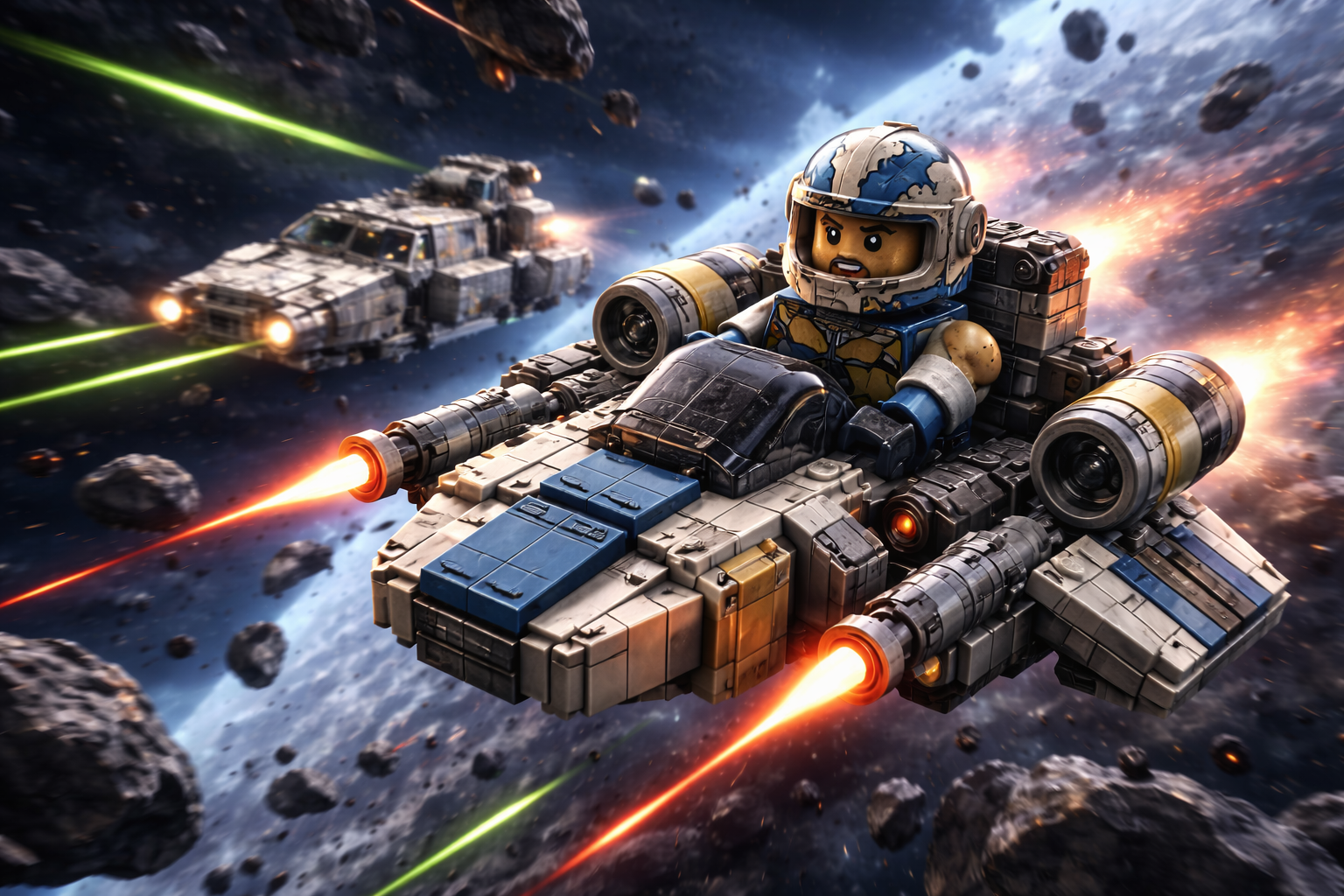
Brick-built microfighter escorts a slower courier ship through hostile skies as distant enemy craft close in.

The microfighter rattled the way old ships always did—not from weakness, but from memory.

Every vibration carried a history: patched hull plates, rerouted power lines, a stabilizer that had never quite forgiven its last repair. The ship wasn’t elegant. It wasn’t meant to be.

It was meant to come back.

The escort marker pulsed ahead—slow, steady. A civilian courier, overloaded and under-armed, drifting through contested sky lanes that hadn’t earned the word safe in years.

Kael held position off the courier’s port side, microfighter angled slightly inward. Close enough to shield. Far enough to maneuver.

That balance mattered more than speed now.

He’d flown escorts long enough to know what they meant.

Not heroics. Not kills.

Responsibility.

You flew differently when someone else’s survival depended on your discipline instead of your reflexes. You thought in arcs instead of lines. You watched shadows instead of targets.

And lately—if Kael was honest—you thought about how many runs you had left before your luck started to argue with your age.

The thought didn’t scare him.

It felt… inevitable.

FIRST CONTACT

The warning came as a flicker on his peripheral sensors—not a lock, just a suggestion. A shape sliding across the edge of detection where clouds thickened and light scattered.

Kael adjusted course by degrees, not jumps.

“Stay tight,” he said into the open channel. “Don’t accelerate unless I tell you.”

The courier pilot acknowledged, voice thin but steady.

Then the sky broke open.

Two hostile craft punched through the cloud layer above them, dropping fast and hard. Not subtle. Not cautious.

Predators who thought mass and surprise were enough.

Kael rolled instantly, cutting between the courier and the incoming fire. Energy splashed across his shields, lighting the cockpit in harsh white pulses.

He didn’t chase.

He blocked.

THE INJURY

The second pass came lower.

Kael pulled into a tight turn, forcing one attacker wide while lining the other up just enough to discourage persistence. He fired—not to destroy, but to displace.

It worked.

Almost.

A delayed shot clipped his starboard side just as he banked. The impact wasn’t catastrophic—but it was personal. The cockpit jolted violently. Warning lights flared.

Pain followed half a second later.

Sharp. Hot. Immediate.

Kael grunted as his shoulder slammed into the harness, breath knocked from him. Something tore—fabric, skin, pride. Blood bloomed warm against his flight suit.

“Damage?” the courier asked, panic breaking through.

Kael exhaled slowly, steadying his hands. “Cosmetic,” he lied. “Stay on vector.”

The microfighter screamed in protest but obeyed.

So did Kael.

HOLDING THE LINE

The attackers pressed harder now, sensing advantage. Kael leaned into discipline instead of anger. He flew defensive spirals, forcing them to choose between chasing him or reaching the courier.

They chose wrong.

Every time.

One broke formation, trying to slip past him. Kael rotated, using his wounded side to present a smaller target, firing just enough to force retreat.

His shoulder throbbed with every movement.

Good.

Pain meant he was still flying.

REINFORCEMENTS

The sky changed before the fight could finish.

Sensor contacts bloomed behind the attackers—clean, coordinated, unmistakable. Allied craft dropping in from higher lanes, weapons cold but presence overwhelming.

The attackers disengaged immediately, vanishing back into the clouds.

Silence followed.

Kael finally let himself breathe.

AFTERMATH

He guided the courier through the final approach, holding formation until docking clamps locked and relief took over.

Only then did he power down.

Only then did his hands start shaking.

Medics met him at the hatch. Someone cursed softly when they saw the blood. Someone else smiled anyway.

“You’ll live,” they said.

Kael chuckled weakly. “Unfortunate.”

They helped him out of the cockpit, careful around his shoulder. As they worked, Kael glanced back at his microfighter—scarred again, just like him.

Another mark to remember.

Another story waiting to be exaggerated later.

THE THOUGHT HE CAN’T SHAKE

As they patched him up, Kael stared at the ceiling and did the math he’d been avoiding.

Reaction times. Recovery speed. How many more hits his body would forgive before it stopped negotiating.

He imagined himself older—grounded, instructing instead of intercepting. Telling younger pilots how to survive by pointing at scars instead of collecting new ones.

The idea didn’t feel like defeat.

It felt like the long way home.

When they released him, Kael walked past his ship one last time before the next sortie cycle began.

He rested a hand against the hull, just for a second.

“Not today,” he murmured.

The microfighter sat quiet, patient, ready.

So was he.

For now.

This is an original work of fiction created by Brick Crossing, inspired by the design themes of LEGO® set 75391.
LEGO® is a trademark of the LEGO Group, which does not sponsor, authorize, or endorse Brick Crossing.
Posted on

Dress-Up Protocol

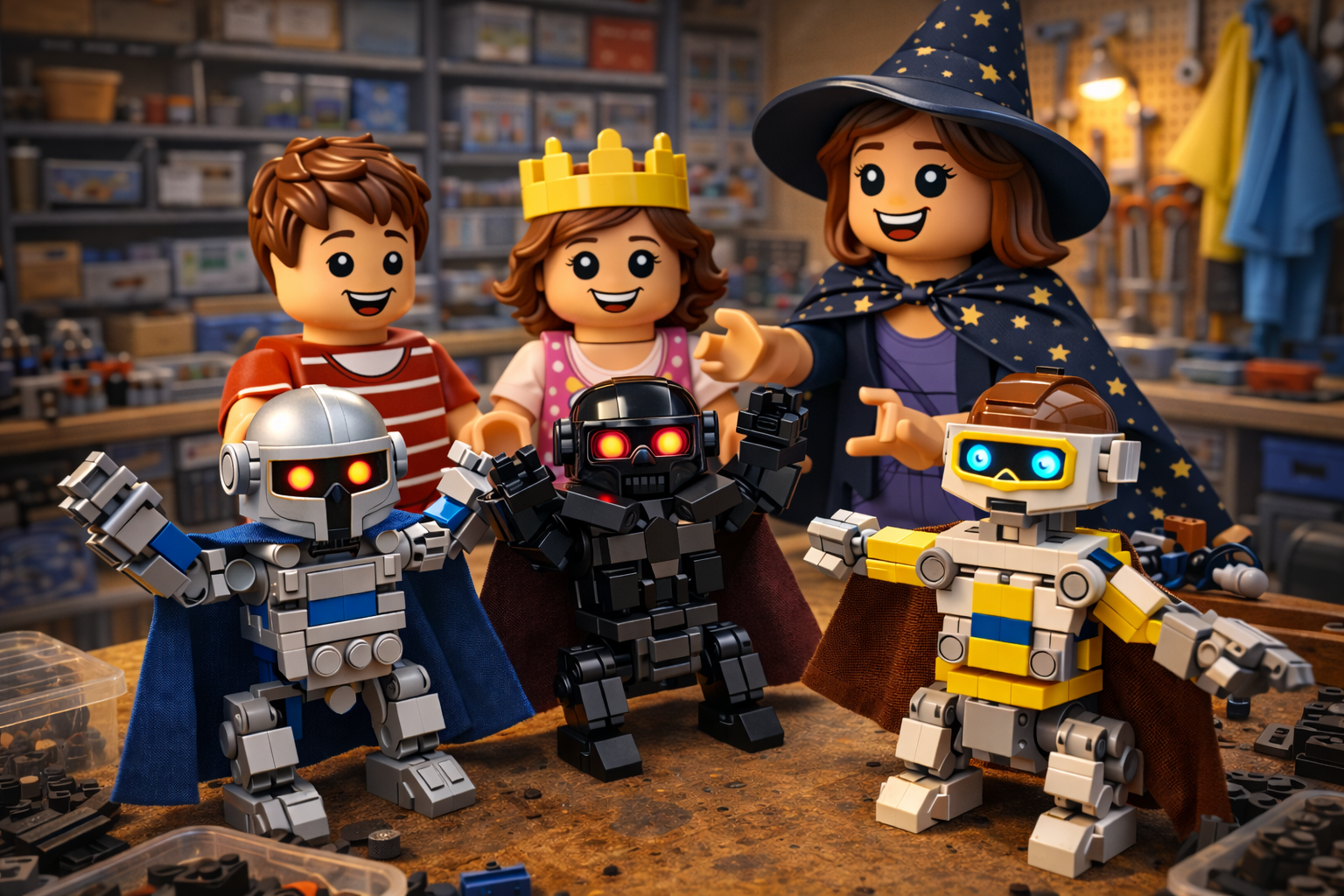
Brick-built workshop scene with two minifigure children and a minifigure babysitter playing dress-up with customizable droids.

The workshop was officially off-limits.

Which meant it was irresistible.

It sat at the back of the house, one door always locked, the other pretending not to be. The smell inside was a mix of oil, warm plastic, and dust—comforting in the way only places full of unfinished projects ever were.

Mara knew this because she had been warned about it.

Twice.

She stood just inside the doorway with her brother Finn and their babysitter, Lena, all three of them staring at the shelves stacked with bins, tools, and half-built contraptions.

“We’re not touching anything,” Lena said immediately, hands on her hips. “Just looking.”

Finn nodded enthusiastically. “Just looking.”

Mara already knew that was a lie.

They didn’t notice the droids at first.

There were too many other things—costumes hanging from hooks, masks in a crate labeled THEATRICAL, fabric scraps, helmets missing pieces. Their dad never threw anything away if it could be “repurposed later.”

It was Finn who found the first one.

“What’s this?” he asked, pulling open a low drawer.

Inside lay a small, modular robot frame—no face, no color scheme, just a collection of parts snapped together with careful intention. Next to it were more bins, all neatly sorted: ARMS, EYES, SOUNDS, ACCESSORIES.

Mara’s eyes lit up. “They’re build-your-own.”

Lena crouched down, curiosity getting the better of her. “Your dad never mentioned these.”

“He calls them prototypes,” Finn said. “Which means we’re not allowed to play with them.”

Mara grinned. “Which means we absolutely are.”

DRESS-UP BEGINS

They started harmlessly.

Accessories first. A cape from the costume rack draped over one droid’s shoulders. A tiny hat perched awkwardly on another. Finn found a voice mod chip and insisted it made the droid sound “more dramatic.”

Mara took charge of aesthetics. “This one’s a hero,” she declared, snapping on bright panels and wide, friendly eyes. “And this one’s mysterious.”

Finn slapped dark pieces onto the third droid. “This one’s the villain.”

Lena watched, arms crossed, trying not to smile. “You know they’re not supposed to be on, right?”

“We’re not turning them on,” Mara said quickly. “Just… setting the scene.”

Finn struck a pose. “Dress rehearsal.”

They laughed, acting out exaggerated roles—hero speeches, villain monologues, dramatic betrayals. Lena even joined in, lowering her voice and pretending to narrate.

“And just when hope seemed lost,” she intoned, “the villain revealed—”

The droid’s eyes lit up red.

Everyone froze.

THE ACCIDENT

“Nope,” Lena said instantly. “Nope, nope, nope.”

The droid’s head turned slowly. Its voice mod crackled to life.

“I AM THE SHADOW COMMANDER,” it declared, far louder than anyone expected.

Finn’s jaw dropped. “I didn’t touch anything!”

Mara backed up a step. “Why is it moving?”

The droid stepped forward, cape swishing dramatically. “THIS WORKSHOP NOW BELONGS TO ME.”

Lena lunged for the power switch.

Missed.

The droid pivoted, surprisingly fast, and ducked under the worktable.

“Oh no,” Lena whispered. “Oh absolutely no.”

CHAOS WITH RULES

The Shadow Commander began issuing commands—to no one, at first.

“SECURE THE PERIMETER,” it said, knocking over a stack of bins. “NO CAPES LEFT BEHIND.”

Finn clutched Mara’s arm. “We made it too convincing.”

Mara swallowed. “We need help.”

Lena looked at the other two droids, still inert on the table.

“…Fine,” she said. “But we are fixing this.”

They activated the others.

The hero droid powered up with a cheerful chime. “HELLO! I AM READY TO ASSIST.”

The mysterious one flickered to life more quietly. “Awaiting directive.”

Mara pointed dramatically. “Stop the villain.”

The hero droid saluted. “ENGAGING NARRATIVE MODE.”

What followed was the most controlled chaos Lena had ever supervised.

The hero droid blocked doorways with surprising effectiveness. The mysterious droid predicted the villain’s movements by analyzing clutter patterns. Finn crawled under tables, unplugging things before they could be weaponized.

Mara distracted the Shadow Commander by challenging it to a monologue duel.

“You’ll never win,” she shouted.

“WINNING IS IRRELEVANT,” the droid replied. “STYLE IS ETERNAL.”

Lena finally cornered it near the charging station.

“Okay,” she said firmly. “Dress-up time is over.”

The droid paused.

“CHARACTER CONFLICT DETECTED,” it said. “RETURNING TO—”

Lena hit the switch.

Silence.

RESTORATION

They didn’t celebrate.

They cleaned.

Everything went back exactly where it belonged. Capes folded. Bins closed. Droids reset, memory logs cleared. Lena checked the clock three times.

The front door opened just as they finished.

“Hey!” their dad called. “How was everything?”

Mara, Finn, and Lena exchanged a look.

“Normal,” Mara said.

Lena smiled, a little breathless. “Very normal.”

The workshop door stayed closed.

And the secret stayed theirs.

Later that night, as the house settled, a small indicator light blinked once in the workshop.

Then went dark.

Posted on

Not Today

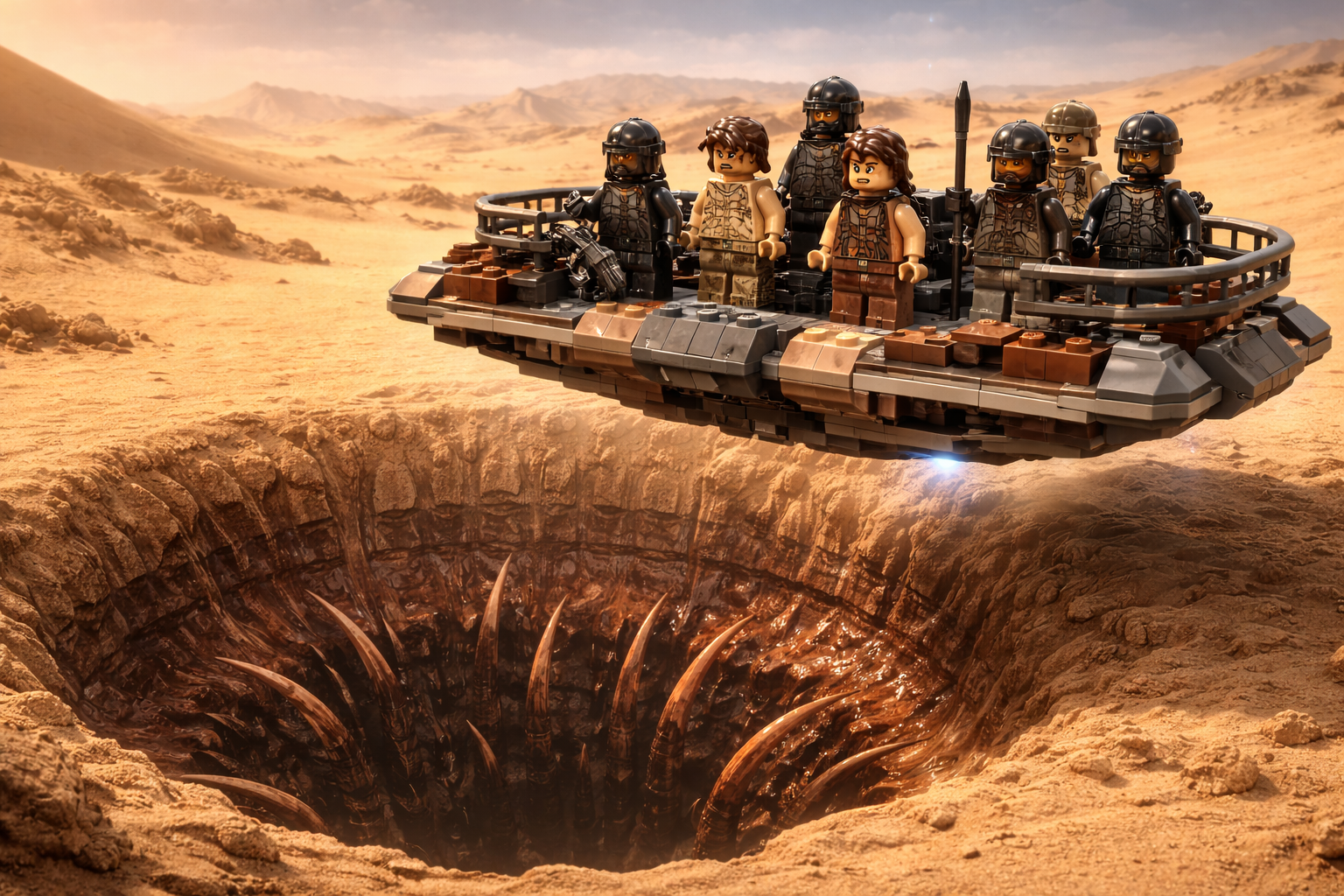
Brick-built desert skiff hovers above a massive ominous pit as captives and guards stand tensely on the deck.

The skiff drifted with the patience of something that had done this before.

Heat rolled off the desert in visible waves, blurring the horizon into something unreal. The skiff’s shadow slid slowly across the sand, stretching, shrinking, never quite touching the edge of the pit beneath it. Chains rattled softly as captives shifted their weight, the sound sharp in the open air.

The pit breathed.

That was the first thing Lysa noticed.

Not a roar. Not a scream. A rhythm. A deep, wet inhale that pulled hot air downward, followed by a slow exhale that carried the smell of rot and minerals back up into the sunlight.

She kept her eyes on the deck plating.

Looking down made the breathing feel personal.

Lysa had stopped counting the hours days ago. Time behaved strangely when death waited below you with infinite patience.

The pit wasn’t still. Its rim twitched in small, almost polite movements. Rings of muscle shifted under the sand, tightening, loosening, as if testing its grip on the world above. Every so often, something deep inside it moved, and the sand slid inward in a soft avalanche.

The pit was awake.

A man next to her whispered a prayer under his breath. Another laughed once, sharp and broken, then went quiet. Chains pulled tight as someone lost their balance and nearly went over the rail.

The guards shouted.

“Back!”

Lysa obeyed instantly. Survival was a habit now, not a hope.

She dared a glance sideways — not down — and saw one of the guards standing rigid near the skiff’s control post. He was young, younger than most, helmet tucked under his arm. His jaw was clenched so tightly it looked painful.

He wasn’t looking at the captives.

He was looking at the pit.

Joren told himself this was just another duty rotation.

That was the lie he used when the skiff lifted off. When the heat rose. When the pit came into view, wider than memory ever allowed.

But the lie fell apart the moment the ground started to move.

The pit wasn’t supposed to shift.

It was supposed to wait.

Joren tightened his grip on the railing as the sand slid inward again, exposing darker layers beneath. The creature’s interior flexed, opening slightly, revealing ribbed surfaces that glistened wetly before retreating again.

The pit was feeding already.

His superior barked orders down the line, voice loud and confident, but Joren heard the strain underneath it. Everyone did.

This execution wasn’t scheduled to be dramatic.

It was becoming dramatic anyway.

The skiff drifted lower.

A lever creaked as restraints were adjusted. One prisoner was pulled forward — not Lysa, not yet — and her heart slammed hard enough to make her dizzy.

She watched the prisoner’s feet scrape the deck.

She watched his shadow stretch across the sand and disappear.

She did not look down.

The pit exhaled.

The skiff shuddered as if something beneath it had brushed the air.

“Hold steady!” someone shouted.

The prisoner screamed once.

Then the pit surged.

Sand collapsed inward in a sudden rush. A thick, muscular tendril lashed upward, slamming into the skiff’s underside with a wet crack. The entire platform tilted violently.

Chains snapped taut.

People fell.

Lysa hit the deck hard, breath knocked from her lungs. Hands grabbed at her, fingers digging into fabric, into skin. The railing loomed inches away.

Across the skiff, Joren lost his footing as the deck pitched again. He slammed into another guard, both of them crashing down as the pit’s tendril recoiled and struck again — higher this time.

The skiff screamed metal.

A guard at the edge tried to recover, boots sliding on scorched plating.

Joren saw it happen in fragments:

  • The guard’s hand slipping.
  • The prisoner beside him, already half over the rail.
  • The pit opening wider than before.

For one frozen second, their eyes met — guard and captive — both realizing the same thing.

Then gravity decided.

They fell together.

The pit swallowed them whole.

The sound that followed was not a scream.

It was a closing.

The skiff rocked violently, then steadied.

The pit settled.

Sand slid inward slowly now, covering the disturbance like a scar closing. The breathing slowed, deepened, satisfied — for now.

No one spoke.

Lysa lay on the deck, staring at the sky, chest heaving. She realized her hands were shaking uncontrollably. She pressed them flat against the metal to stop it.

Across from her, Joren sat against the railing, helmet forgotten at his feet. His face was pale beneath the dust, eyes locked on the pit’s surface.

They were both still alive.

The weight of that realization came down harder than fear ever had.

Orders were shouted again — sharper, angrier, rushed.

“Raise altitude!”
“Secure the deck!”
“No more delays!”

The skiff climbed, pulling away from the pit’s edge. The creature did not follow. It didn’t need to.

Lysa finally looked at the guard.

Joren finally looked at the captives.

Their eyes met, just briefly.

No hatred. No triumph.

Just understanding.

Not today.

As the skiff turned away, the pit sank deeper into itself, its surface smoothing, breathing evening out into something almost peaceful.

The desert swallowed the moment like it swallowed everything else.

Lysa closed her eyes and let the wind dry the sweat on her face.

Joren picked up his helmet with hands that still trembled.

They would remember this day forever.

Because the pit had chosen.

And today, it had chosen someone else.

This is an original work of fiction created by Brick Crossing, inspired by the design themes of LEGO® set 75396.
LEGO® is a trademark of the LEGO Group, which does not sponsor, authorize, or endorse Brick Crossing.
Posted on

The Sky Lane Rule

Brick-built microfighter flies through storm clouds along glowing sky lanes as lightning flashes nearby.

Up here, roads didn’t touch the ground.

They were drawn in air—imaginary lanes carved through storm clouds by habit, old maps, and pilots who preferred not to die. The sky lanes were only “safe” the way a narrow ledge is safe: if you stay on it, if you respect it, if you don’t pretend it’s wider than it is.

The storm had been building all afternoon, stacking cloud layers into dark cliffs. Lightning flashed far off, silent at first, then closer, snapping like a whip through the gray. Wind shoved at anything that dared fly, turning the open sky into a shifting maze.

And in the middle of it all, small enough to look like a scrap of metal against the weather, a single-seat craft cut forward through the turbulence—tight, agile, and quick to answer every touch of the controls.

Inside, a young pilot held the yoke with both hands, knuckles pale, eyes locked ahead.

Kess had flown bigger training rigs before. Heavier ones. Safer ones.

This wasn’t safe.

This was fast.

The cockpit was cramped, like the craft had been built around the idea of “just enough.” Just enough hull. Just enough wing. Just enough engine to outrun trouble—if the pilot didn’t waste a second.

Kess flicked the comm switch once, twice, listening for the instructor channel that had been so loud during practice runs. Nothing but static and faint, faraway thunder.

He tried again. Still nothing.

The storm swallowed signals the way it swallowed light.

He swallowed too, then spoke anyway, as if the clouds might be listening.

“Training run,” he said to himself. “In and out.”

A white line appeared ahead—faint, stuttering—a beacon thread suspended between cloud banks. Sky-lane markers. Old tech. Reliable, if you believed in it.

Kess aligned the nose with the line.

The craft steadied.

For a few seconds, the turbulence softened, as if the lane itself had a spine. He let out a breath he hadn’t realized he’d been holding, and his shoulders dropped a fraction.

Then the wind hit again, sharper, throwing the craft sideways.

Kess corrected hard, almost too hard. The craft snapped back with a twitchy eagerness, like a wild animal on a leash.

“Easy,” he muttered. “Easy.”

Lightning cracked somewhere ahead—close enough to light the cockpit in blue-white for a heartbeat. The world flashed into clarity: layered clouds, the thin beacon line, and—just beyond it—movement.

Three dark shapes, low and fast, drifting across the lane like sharks crossing a channel.

Not weather. Not birds.

Craft.

They weren’t on the beacon line. They weren’t following the rule.

Kess’s stomach tightened.

The lead shape tilted its nose, and Kess saw the glint of hard edges—cleaner than anything built for a training run. Behind it, two more held position like they’d rehearsed it.

The storm didn’t hide them anymore.

It framed them.

A bright pulse cut the air near Kess’s wingtip—close enough that the cockpit shook.

He didn’t wait for the second one.

He dove.

The craft dropped beneath the sky-lane line into thicker cloud, where visibility collapsed into gray. Wind slammed into the hull. The engine’s pitch climbed as it fought thinner air and heavier turbulence at the same time.

Kess kept the nose down, counting in his head—not because counting helped, but because it stopped panic from taking the controls.

One. Two. Three.

A streak of light passed above him, visible through the cloud like a glowing scar. They were still firing.

They’d seen him dive.

They’d followed.

Kess pulled up hard, skimming along the underside of a cloud shelf where the storm’s belly churned. Lightning flickered inside it like the sky had a heartbeat.

He needed the lane.

The lane was safety.

But the lane was also predictable.

Predictable was how you got caught.

Kess spotted a break—a narrow corridor between cloud walls where wind roared through like a tunnel. It wasn’t a lane marker. It wasn’t safe.

It was the only thing that wasn’t expected.

He turned into it.

The craft almost flipped from the crosswind. Kess fought the controls, forcing the nose to stay pointed forward as the tunnel tried to twist him sideways. Rain hammered the canopy in hard, fast needles. The world became vibration and sound.

A shape entered the corridor behind him—one of the enemy craft, close enough that Kess felt its wake tug at his tail.

Then another.

Kess didn’t have the speed to outrun all of them in a straight line.

So he made the line not straight.

He banked left, tight, skimming close to cloud wall. The craft responded instantly, clipping the corridor’s edge by inches. His stomach rose into his throat as the cloud’s pressure buffeted him like hands trying to slap the craft away.

He held.

The first pursuer tried to match the turn, but it came in wider—built for power, not finesse. It drifted toward the cloud wall.

Kess saw the mistake before it happened.

A lightning pulse flared inside the cloud, a sudden bloom of white.

The pursuer clipped the edge.

Its lights jittered. It lurched, then vanished into gray with a sound that was more felt than heard.

Two left.

Kess didn’t celebrate. He didn’t even breathe.

The second pursuer fired again—bolts slicing past the canopy, bright enough to leave afterimages on Kess’s eyes. He flinched but kept the craft steady, forcing himself to focus on the tunnel’s shape and the changing wind patterns.

That’s what the instructors always said: Fly the environment, not the fear.

The corridor narrowed.

Ahead, it split around a towering column of cloud that rose like a mountain. Kess had a choice: left around the column—wider, safer—or right—tighter, faster, and dangerous.

He chose right.

The craft slipped into the narrow side, wind screaming against its wings. Kess pulled the nose up slightly, letting the craft climb just enough to catch a smoother current.

The third pursuer hesitated at the split.

It chose left.

The second pursuer chose right—still on Kess.

Good.

One-on-one.

Kess felt the storm like a living thing now: where it pushed, where it pulled, where it hid lightning behind pressure changes. He watched the rain patterns. He watched the way cloud texture shifted, indicating denser air.

He found his chance.

A thin thread of beacon light flickered ahead—one of the old sky-lane markers cutting across the storm column’s face. If he could reach it, he could re-enter the lane at a weird angle—an angle the pursuer wouldn’t expect.

Kess pushed the engine.

The craft surged forward, responding like it had been waiting for him to commit. The tunnel spat him into open storm air—wider but more chaotic. He saw the beacon thread and angled toward it.

The pursuer fired.

A bolt caught Kess’s wingtip, not a direct hit but close enough to scorch the edge. The craft shuddered and yawed.

Kess corrected, teeth clenched so hard his jaw ached.

Lightning flashed ahead—too close, too bright.

The beacon thread pulsed.

Kess reached it and snapped into the lane.

Instantly, the air changed. Not calm—never calm—but structured, the lane’s hidden stabilizers or pressure guides smoothing the worst of the turbulence.

He glanced back.

The pursuer tried to follow.

But it entered the lane at the wrong angle, hit a shear boundary, and skidded sideways like a car on ice. Its lights flared. It struggled to correct, fighting the lane’s invisible rules.

Kess didn’t wait to see if it recovered.

He pushed forward, riding the lane as it arced upward into thinner cloud.

Above, the storm opened briefly.

A patch of sky—pale, cold, and stunning—appeared like a window. The lane climbed toward it.

And there, silhouetted against the lighter air, were larger shapes: allied craft, steady and coordinated, descending into the storm like guardians returning to the fight.

Reinforcements.

The pursuer behind him broke off immediately, diving away into cloud cover.

Kess’s craft emerged into the clearer pocket, engines whining as the pressure dropped. For the first time in minutes, his hands stopped shaking.

A voice crackled through the comms, suddenly sharp and present, cutting through the static.

“Unidentified microcraft,” the voice said. “Hold course. Identify.”

Kess swallowed, glanced at the scorched wingtip, then the storm below.

He could have turned back. He could have gone home and called it luck.

But luck hadn’t flown those turns.

“I’m Kess,” he said, voice steadier than he felt. “I’m from the farming outpost—south ridge. Training run went… off-plan.”

A pause.

Then, quieter, almost amused: “You held the lane through a storm intercept.”

“I didn’t hold the lane,” Kess said. “I used it.”

Another pause—longer this time.

“Your age?” the voice asked.

Kess hesitated. He knew what they were really asking. Are you old enough to matter?

He answered anyway. “Not the usual.”

The channel went silent for a beat, like the other end was looking at something—data, a camera feed, the scorch marks on his craft.

Then: “Bring that microcraft in. We need pilots who can think in weather.”

Kess felt his chest tighten, not with fear now, but with something brighter and heavier.

“What about my outpost?” he asked.

“You’ll be returned,” the voice said. “After debrief.”

Kess looked down at the storm, where enemy shapes had disappeared, where the lane still pulsed faintly like a promise.

He had come out for a training run.

He was coming back with a new call attached to his name.

The allied craft formed a loose escort around him, guiding his small ship toward a larger silhouette hidden in the upper cloud—an airborne platform, lights dimmed, doors opening like a mouth.

Kess lined up his approach, heart hammering again, but this time the fear had edges of excitement.

Behind him, the storm swallowed the sky lanes and all the choices he’d made inside them.

Ahead, the open bay waited.

Kess eased forward.

And the clouds closed behind him like a door.

This is an original work of fiction created by Brick Crossing, inspired by the design themes of LEGO® set 75400.
LEGO® is a trademark of the LEGO Group, which does not sponsor, authorize, or endorse Brick Crossing.
Posted on

Where the Water Slows

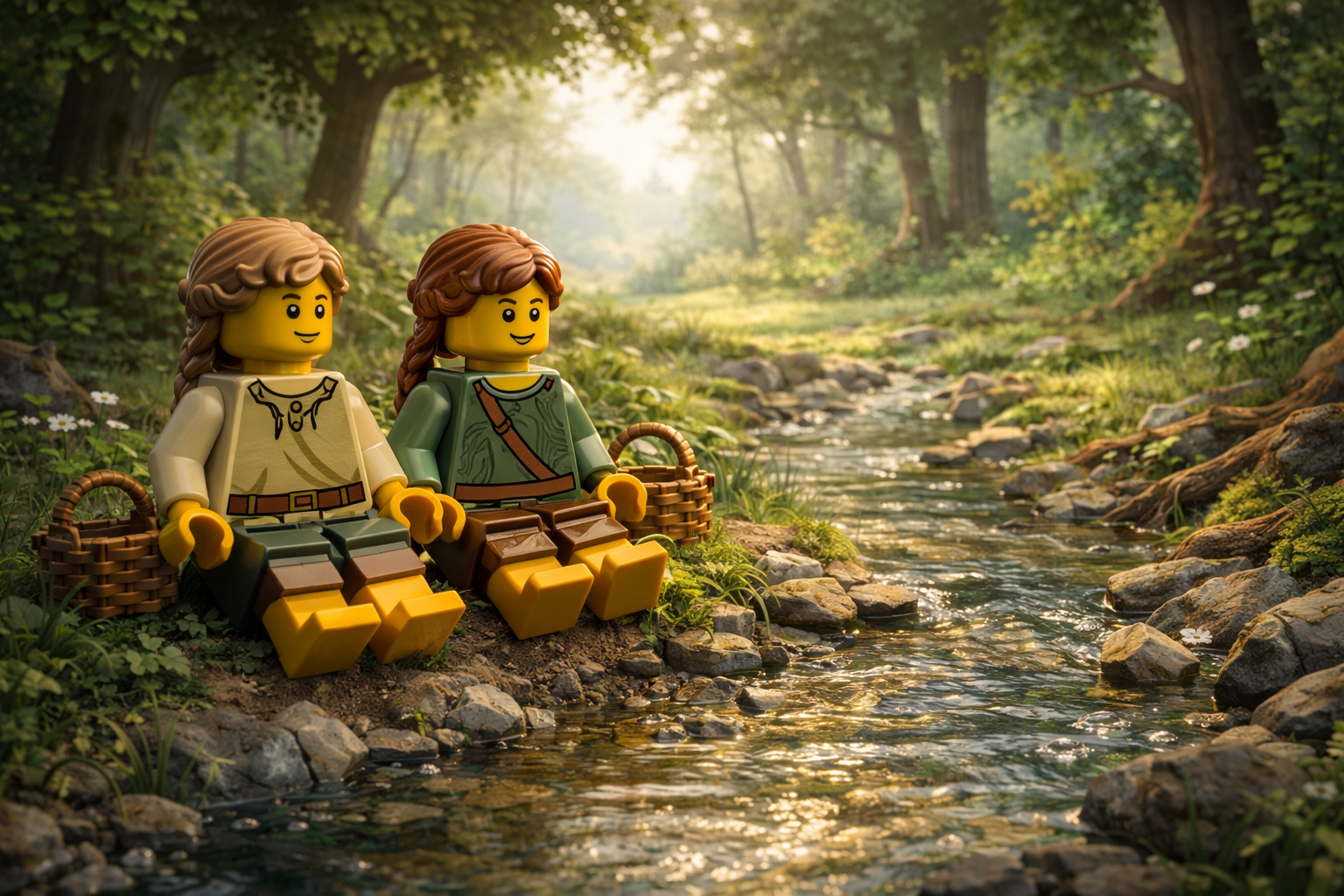
Two minifigure girls sit beside a forest stream in a brick-built clearing, unaware of what they are about to discover.

The stream didn’t rush here.

It curved gently around smooth stones and roots, slowing as it left the forest and entered the open land beyond. Sunlight filtered through the trees in thin, patient bands, catching on ripples and turning them into moving lines of gold. It was the kind of place adults forgot to watch closely—not because it wasn’t important, but because it felt safe.

That’s why Elia and Noor liked it.

They came with a basket and a promise to be back before dusk. The basket was mostly an excuse. The promise was real.

They sat on the bank with their boots off, feet numb in the cold water, tossing pebbles and arguing quietly about whose throw made the better sound. The forest behind them hummed with insects and distant birds. The fields beyond the clearing lay empty, furrowed and waiting, like they had been for months.

Since the night everything changed.

Elia skipped a flat stone and watched it hop twice before sinking. “Dad used to fish here,” she said, not looking at Noor.

“I know,” Noor replied. “He said the water listens.”

Elia snorted softly. “That’s not a thing.”

“He said it was,” Noor insisted. “He said if you’re quiet, it tells you when to leave.”

Elia rolled her eyes but didn’t throw another stone. The stream moved on, unconcerned with their argument.

They heard it before they saw it—a faint hum, low and steady, like a breath held too long. It didn’t belong to the forest or the fields. It hovered between sounds, subtle enough to be missed if you weren’t listening for reasons to be afraid.

Noor froze. “Do you hear that?”

Elia nodded slowly. “Yeah.”

The sound grew clearer as it drifted into the clearing from upstream, rounding the bend where the trees leaned close together. Leaves parted. Sunlight caught on smooth metal.

Something floated above the water.

It was a small cradle—round-edged, dark, worn smooth in places like it had been held often. It hovered just high enough to clear the stones, moving gently with the current as if the stream had decided to carry it without touching.

Inside it sat a child.

Not like them.

Smaller. Quieter. Green-skinned, with wide, curious eyes that reflected the light like polished glass. Large ears twitched slightly as the cradle drifted closer, responding to sounds only the child seemed to hear.

The hum softened when the cradle reached the shallows near the bank, settling into a hover that barely stirred the water.

Elia stood up so fast she slipped, catching herself on a tree root. “Noor,” she whispered urgently. “There’s—there’s a baby.”

Noor stared, heart pounding so hard she was sure the child could hear it. “It’s not a baby,” she said, unsure why she felt that mattered. “It’s… different.”

The child looked at them. Not startled. Not afraid.

Just watching.

Elia took a step back toward the trees. “We should tell someone.”

Noor didn’t move. “Who?”

They both knew the answer.

The outpost had people—grandparents, younger children, those who couldn’t fight. But the ones who made decisions were gone. Their father among them. Away, chasing the forces that had torn through the village months ago and left burned fields and quiet nights behind.

The child in the cradle made a small sound, not quite a cry. The cradle dipped slightly, adjusting itself.

Elia swallowed. “What if it’s… dangerous?”

Noor shook her head, even though she didn’t know why. “It’s just a kid.”

The forest shifted. A bird burst from the undergrowth, wings loud in the sudden silence. Elia flinched.

“Someone else could find it,” she said. “Someone who wouldn’t—”

“Wouldn’t what?” Noor asked.

Elia didn’t finish the sentence.

The hum changed—lower now, strained. The cradle wobbled, drifting sideways toward a cluster of rocks.

Without thinking, Noor stepped into the stream and reached out.

The water was cold enough to sting, but her hand found the edge of the cradle easily. It was warmer than she expected. Solid. Real.

The child’s eyes widened slightly.

“Hi,” Noor said, softly, because loud felt wrong. “You shouldn’t be out here alone.”

The child tilted its head. One small hand lifted and reached—not for Noor’s face, but for the stream. Its fingers brushed the surface, sending ripples outward in neat, concentric circles.

Elia watched the water respond. Not splashing. Not recoiling.

Listening.

The sound came back sharper this time—not the hum of the cradle, but something farther off. Engines. Voices. The wrong kind of noise.

Elia’s head snapped up. “Noor. Hide it.”

“What?”

“Hide the cradle. Now.”

The forest edge rustled. Shadows moved where the trees thinned, where the path led back toward the outpost road. Shapes passed between trunks—too tall, too fast, scanning the clearing with purpose.

Searchers.

Elia dropped to her knees and grabbed Noor’s sleeve. “Please.”

Noor hesitated only a second. She guided the cradle toward the overhang where roots formed a natural alcove in the bank. The cradle followed, responsive, hovering lower as if it understood urgency.

The child made another small sound—uncertain now.

“It’s okay,” Noor whispered, even as her hands shook. “We’ve got you.”

Elia crouched beside her, pulling a fallen branch and a curtain of leaves across the opening. From the clearing, it looked like nothing more than shadow and water.

The hum dimmed.

Footsteps approached. Voices murmured—sharp, impatient. A figure paused at the edge of the stream, boots crunching on gravel.

Elia held her breath so long her chest hurt.

The figure leaned forward, scanning the water. For a terrifying moment, Elia was sure they could hear her heartbeat. The stream moved on, slow and steady, reflecting nothing unusual.

After a long moment, the footsteps retreated.

The voices faded.

The forest exhaled.

Noor slumped back against the bank, knees pulled to her chest. Elia stayed frozen a heartbeat longer, then crawled closer to the alcove.

The child looked up at them, calm restored as if fear had never touched it.

Noor laughed quietly, a sound halfway between relief and disbelief. “Did you see that? It didn’t even cry.”

Elia wiped her eyes with her sleeve. “It knew.”

They sat there until the light shifted and the insects changed their song. When the clearing felt safe again, Noor carefully guided the cradle back into the open.

The child lifted one hand and touched Noor’s finger, skin warm and surprisingly strong. Noor felt a strange stillness spread through her, like the world had paused to pay attention.

Elia watched, awe and worry twisting together. “We can’t keep it,” she said. “We’re just kids.”

Noor met her gaze. “We can keep it safe. Just for now.”

Elia thought of their father’s empty chair. The fields waiting. The nights when the village lights stayed low.

She nodded. “Just for now.”

They walked back toward the outpost together, the cradle floating quietly between them. The forest closed behind, the stream returning to its patient curve.

At the edge of the clearing, the child looked back once—ears twitching, eyes reflecting the last light like stars caught in water.

Elia squeezed Noor’s hand.

Above them, clouds drifted slowly across the sky, hiding whatever watched from farther away.

The danger hadn’t ended.

But tonight, something small was safe.

And sometimes, that was enough.

This is an original work of fiction created by Brick Crossing, inspired by the design themes of LEGO® set 75403.
LEGO® is a trademark of the LEGO Group, which does not sponsor, authorize, or endorse Brick Crossing.
Posted on

Frost Over Fire

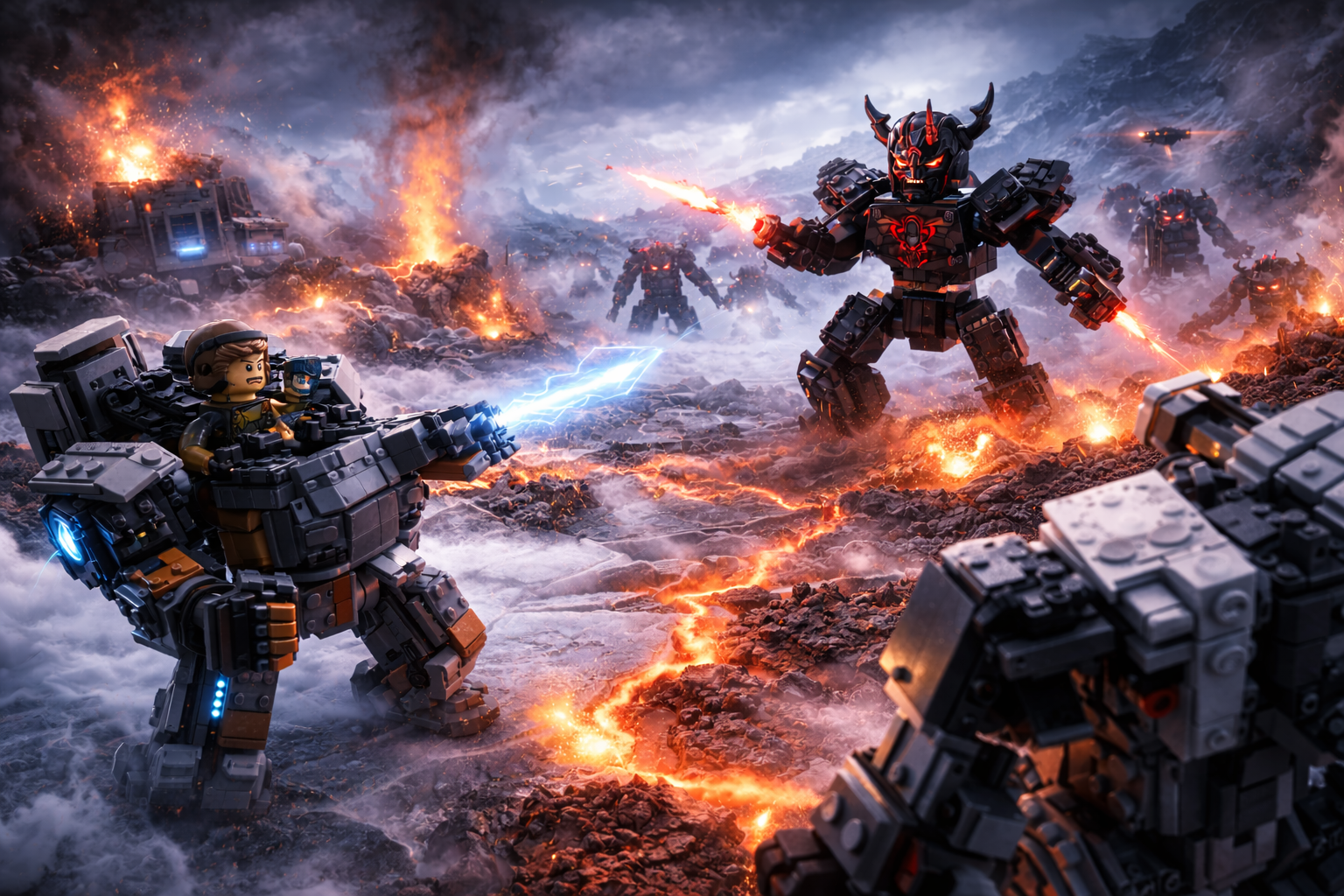
Brick-built enemy mech attacks a frozen volcanic outpost as a single minifigure pilot controls a defending mech amid steam and ice fissures.

The moon looked dead from orbit—white and still, a marble left too long in the cold.

Up close, it lied.

Heat breathed through cracks in the ice like the planet was trying to speak. Black volcanic rock pushed up in jagged ribs. Steam rose in pale columns and froze again as it drifted, forming ghostly curtains that snapped in the wind. The outpost sat on a basalt shelf above a field of frozen fissures, lights small and stubborn against the endless dusk.

We called it Cairn Station because it sounded like something meant to last.

It was mostly patched metal and old promises.

The defenders were the same.

A handful of soldiers and technicians, a rotating watch schedule, and three outdated mechs stored in bays that smelled like coolant and burnt wiring. The mechs had names painted on their plates—names that had survived longer than their original parts. Their joints creaked. Their armor didn’t match. Their sensors were temperamental. But they were ours.

And on nights like this, “ours” mattered.

The first warning didn’t come from the radar.

It came from the ice.

A tremor—soft, then sharper—ran through the deck plating under our boots. Frost sifted from a beam overhead. A cup on the mess table rattled in place, then tipped on its side like it had chosen to faint.

Sergeant Lio didn’t wait for confirmation. He was already moving.

“Stations,” he said. Calm voice. No wasted breath. “Now.”

We scattered in practiced silence—Mira to the comms, Kett to the generator room, Oren to the mech bay. I followed Lio to the observation slit that overlooked the ice field.

At first, there was nothing. Just wind across the frozen flats and steam rising from the fissures like the moon’s last exhale.

Then the horizon broke.

Shapes moved through the fog—tall, angular silhouettes advancing in a line too precise for nature. Their eyes—if you could call them that—burned with a dull red glow that smeared in the mist. Each step they took compressed the ice with a sound like cracking glass.

Enemy mechs.

Not one. Not two.

A force.

Mira’s voice snapped through the intercom. “Multiple contacts. Heavy. Closing fast.”

“How many?” Lio asked.

A pause—Mira counting and not liking the number. “Too many.”

Kett’s voice came next, strained. “They’re jamming our long-range. We can’t call for help.”

Lio stared at the advancing shapes, then turned away as if refusing to give fear the satisfaction of being seen.

“Oren,” he said into the comm. “How many can we field?”

Oren answered over the clang of tools and shouted instructions. “Two, maybe three if I can wake the old one without it throwing a tantrum.”

“Give me two,” Lio said. “Keep the third for the last card.”

There was a beat of silence, then Oren, softer: “You mean the trap.”

Lio’s mouth tightened. “I mean the plan.”

I followed him into the corridor that led to the mech bay. The walls vibrated now, not from our generators—but from the approaching steps outside. The moon was counting down.

In the bay, the mechs stood like old giants waiting to be convinced.

Mira was already there, helmet under her arm, climbing a ladder to the cockpit of the nearest one. Her mech’s shoulder plate was cracked and reinforced with a welded brace shaped like a question mark.

“You’re flying that?” I said before I could stop myself.

Mira smirked. “I’m not flying it. I’m persuading it.”

Oren slid past with a coil of cable. “Keep talking and I’ll assign you the one that leaks coolant like a confession.”

Lio stepped between them, voice low, urgent. “Listen. They’re better equipped. Faster. Cleaner. We don’t win head-to-head.”

Mira dropped into her seat and clipped in. “Then we don’t fight head-to-head.”

Kett appeared, wiping grease off his hands. He looked toward the doors that led outside, where the wind wailed like a warning siren. “The fissure field,” he said.

Lio nodded. “We hold them at the ice breaks. Make them commit. Make them chase. Then we fold the ground under their feet.”

“That’s not how ground works,” I muttered.

Oren looked at me like I’d offended the moon. “On this rock? That’s exactly how ground works.”

The bay doors began to open, inch by inch, revealing the frozen dusk beyond. Wind punched in, sharp and chemical, carrying steam and the bitter smell of volcanic stone.

Mira’s mech powered up with a reluctant groan. Lights blinked. Joints locked. It took a step forward like it was remembering how.

Beside it, Lio’s mech—older, heavier—came alive with a deeper hum. Its armor was scarred and mismatched, the paint worn from years of being asked to do more than it should.

Two defenders against a coming tide.

Lio’s voice came through our headsets, steady as a heartbeat. “We don’t need to stop them forever,” he said. “We just need to survive the night.”

The first enemy mech appeared through the fog at the ridge line, its red glow cutting through the steam. Behind it, more shadows followed, silent and confident.

Mira moved first—fast, light-footed, leading her mech out onto the ice like she was daring the moon to contradict her. She fired a flare—not at the enemy, but into the fissure field, lighting up the cracks in the ice with a harsh, white glow.

The terrain revealed itself: a spiderweb of fractures, some wide enough to swallow a vehicle, some thin as paper but deep as regret. Steam vents pulsed below, each one a pocket of heat under a fragile ceiling.

“Eyes on the lines,” Lio ordered. “They don’t.”

The enemy advanced without hesitation. Their mechs were sleek, their movements smooth, their confidence absolute.

They stepped onto the fissure field.

For a few seconds, nothing happened. Just the crunch of ice under metal feet and the rising scream of wind.

Then one of them fired.

A bolt of energy tore past Mira and struck the ground behind her, vaporizing a patch of snow and exposing black rock underneath. Steam erupted. The temperature shift made frost form instantly on the surrounding ice, turning it slick and glassy.

Mira laughed—one short burst, more adrenaline than humor. “They’re helping,” she said.

Lio’s mech moved into position, blocking the direct path to the outpost. He didn’t fire. He waited.

That waiting was the first trick.

The enemy expected panic. Retreat. Desperation. Instead, they got stillness—an invitation to come closer.

They took it.

Mira darted sideways, baiting the lead mech across a thin section of ice that looked solid in fog-light but wasn’t. She timed her step with the moon’s pulse—steam venting, ice tightening, cracking, tightening again.

The enemy mech followed—too fast, too sure.

Its foot came down.

The ice broke with a sharp, clean sound. For an instant, the mech hovered between balance and falling.

Mira didn’t shoot it. She didn’t need to.

She fired at the steam vent beneath the crack.

The vent burst open, a blast of heat punching upward. The sudden warmth melted the edge of the fissure just enough to widen it. Then the cold air hit, freezing the meltwater into jagged shards.

The enemy mech slipped.

It crashed down into the fissure with a metallic howl and vanished into steam.

The red glow dimmed below the ice like a sinking star.

Oren whooped over comms from inside the bay. “One!”

“Don’t celebrate,” Lio snapped, but there was steel satisfaction under it.

The enemy force adjusted instantly. Their formation tightened. They spread their weight. They fired into the ice ahead, carving safer paths, trying to turn the ground into something predictable.

Predictable ground was their advantage.

So we made sure it stayed unpredictable.

Lio advanced and struck the ice with the heel of his mech, shattering a surface plate to reveal the slick, glassy layer beneath. He drew the enemy toward it, then pivoted away at the last second. Two enemy mechs charged forward and skidded, their feet losing traction.

Mira came in low and fast, not to attack, but to shove.

She slammed her mech’s shoulder into one of them at an angle—just enough to shift its center of gravity onto a weak seam. The ice fractured under it like it had been waiting for permission.

It dropped halfway, jammed, struggling.

Red lights flared brighter.

And then the enemy did what enemies do when they stop underestimating you.

They stopped trying to chase.

They started trying to destroy.

Bolts rained into the fissure field, not aimed at our mechs but at the ground itself. Steam vents erupted. Ice plates shattered. The battlefield became chaos—heat and cold fighting in the open, creating sudden fog banks and brittle ridges.

Mira’s voice tightened. “They’re clearing the field.”

“They’re trying,” Lio said. “Oren. Now.”

A new sound rolled out from the outpost—low, heavy, old.

The third mech woke.

It stepped from the bay like a relic dragged into daylight, taller and bulkier than the others, its armor crude and reinforced. It carried something slung under one arm: a cable spool the size of a person, wrapped in thick insulated line.

Kett’s voice came through, breathless. “The grid’s ready. If they cross the marker—”

“They won’t cross,” Lio said. “They’ll think they can.”

The third mech drove its anchor spikes into the basalt shelf near the outpost and unspooled the cable across the ice in a wide arc—thin enough to be missed in fog, strong enough to matter if you hit it at speed.

Mira and Lio pulled back deliberately, giving ground in a way that looked like losing.

The enemy took the opening, pushing forward.

They crossed the arc.

Kett triggered the grid.

For half a second, the ice field lit up with thin lines of blue-white energy tracing the fissures like veins. The cable snapped taut, the energy surged, and the ground under the enemy mechs flashed with sudden crackling frost—an instantaneous freeze that locked joints, seized traction, and made movement costly.

The enemy force hesitated.

That hesitation was our breath.

Mira’s mech surged in, shoulder-checking one frozen mech into another. Lio followed, driving a heavy strike into the ground that shattered the frozen surface into a collapsing patchwork.

Two enemy mechs went down together, swallowed by steam and fractured ice.

The remaining enemy units backed off, red glow retreating into fog.

They weren’t defeated.

But they were delayed.

And the outpost still stood.

The wind eased as if surprised.

Steam drifted across the fissure field, hiding broken metal and fragile victory alike. Mira’s mech limped back toward the bay, one stabilizer sparking faintly. Lio’s mech moved slower, heavier, its armor scraped fresh.

In the distance, red lights lingered at the ridge line—watching. Waiting.

Oren’s voice came soft over comms. “They’ll come back.”

Lio looked toward the horizon, then up at the moon’s pale sky where the first hint of dawn tried to exist.

“Let them,” he said. “We learned the ground. They haven’t.”

Mira’s laugh was quieter this time, almost tired. “We survive another day.”

The outpost lights held.

And in the frozen steam beyond the ridge, something shifted—too far to see clearly, close enough to feel.

This is an original work of fiction created by Brick Crossing, inspired by the design themes of LEGO® set 75411.
LEGO® is a trademark of the LEGO Group, which does not sponsor, authorize, or endorse Brick Crossing.