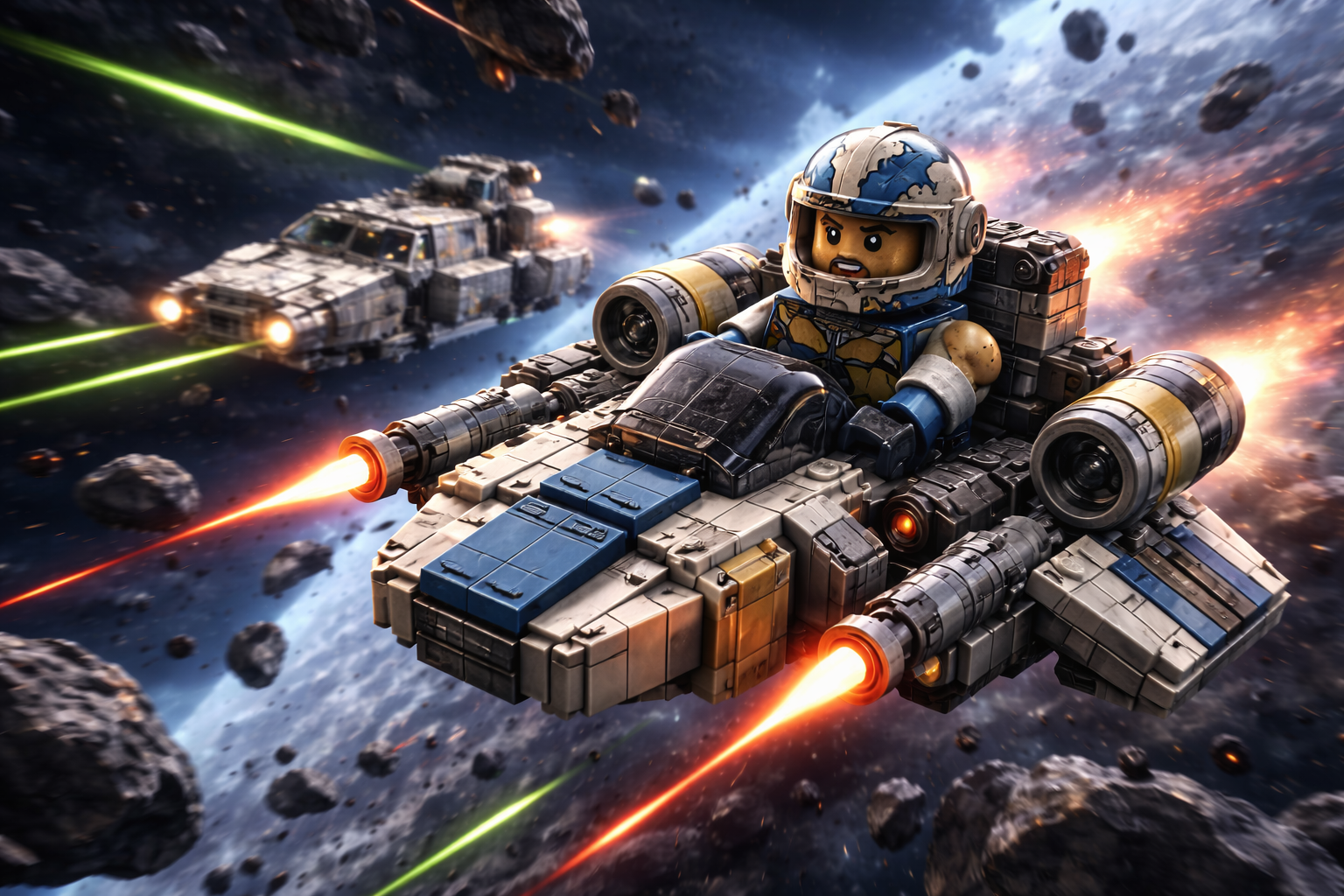
The microfighter rattled the way old ships always did—not from weakness, but from memory.
Every vibration carried a history: patched hull plates, rerouted power lines, a stabilizer that had never quite forgiven its last repair. The ship wasn’t elegant. It wasn’t meant to be.
It was meant to come back.
The escort marker pulsed ahead—slow, steady. A civilian courier, overloaded and under-armed, drifting through contested sky lanes that hadn’t earned the word safe in years.
Kael held position off the courier’s port side, microfighter angled slightly inward. Close enough to shield. Far enough to maneuver.
That balance mattered more than speed now.
He’d flown escorts long enough to know what they meant.
Not heroics. Not kills.
Responsibility.
You flew differently when someone else’s survival depended on your discipline instead of your reflexes. You thought in arcs instead of lines. You watched shadows instead of targets.
And lately—if Kael was honest—you thought about how many runs you had left before your luck started to argue with your age.
The thought didn’t scare him.
It felt… inevitable.
FIRST CONTACT
The warning came as a flicker on his peripheral sensors—not a lock, just a suggestion. A shape sliding across the edge of detection where clouds thickened and light scattered.
Kael adjusted course by degrees, not jumps.
“Stay tight,” he said into the open channel. “Don’t accelerate unless I tell you.”
The courier pilot acknowledged, voice thin but steady.
Then the sky broke open.
Two hostile craft punched through the cloud layer above them, dropping fast and hard. Not subtle. Not cautious.
Predators who thought mass and surprise were enough.
Kael rolled instantly, cutting between the courier and the incoming fire. Energy splashed across his shields, lighting the cockpit in harsh white pulses.
He didn’t chase.
He blocked.
THE INJURY
The second pass came lower.
Kael pulled into a tight turn, forcing one attacker wide while lining the other up just enough to discourage persistence. He fired—not to destroy, but to displace.
It worked.
Almost.
A delayed shot clipped his starboard side just as he banked. The impact wasn’t catastrophic—but it was personal. The cockpit jolted violently. Warning lights flared.
Pain followed half a second later.
Sharp. Hot. Immediate.
Kael grunted as his shoulder slammed into the harness, breath knocked from him. Something tore—fabric, skin, pride. Blood bloomed warm against his flight suit.
“Damage?” the courier asked, panic breaking through.
Kael exhaled slowly, steadying his hands. “Cosmetic,” he lied. “Stay on vector.”
The microfighter screamed in protest but obeyed.
So did Kael.
HOLDING THE LINE
The attackers pressed harder now, sensing advantage. Kael leaned into discipline instead of anger. He flew defensive spirals, forcing them to choose between chasing him or reaching the courier.
They chose wrong.
Every time.
One broke formation, trying to slip past him. Kael rotated, using his wounded side to present a smaller target, firing just enough to force retreat.
His shoulder throbbed with every movement.
Good.
Pain meant he was still flying.
REINFORCEMENTS
The sky changed before the fight could finish.
Sensor contacts bloomed behind the attackers—clean, coordinated, unmistakable. Allied craft dropping in from higher lanes, weapons cold but presence overwhelming.
The attackers disengaged immediately, vanishing back into the clouds.
Silence followed.
Kael finally let himself breathe.
AFTERMATH
He guided the courier through the final approach, holding formation until docking clamps locked and relief took over.
Only then did he power down.
Only then did his hands start shaking.
Medics met him at the hatch. Someone cursed softly when they saw the blood. Someone else smiled anyway.
“You’ll live,” they said.
Kael chuckled weakly. “Unfortunate.”
They helped him out of the cockpit, careful around his shoulder. As they worked, Kael glanced back at his microfighter—scarred again, just like him.
Another mark to remember.
Another story waiting to be exaggerated later.
THE THOUGHT HE CAN’T SHAKE
As they patched him up, Kael stared at the ceiling and did the math he’d been avoiding.
Reaction times. Recovery speed. How many more hits his body would forgive before it stopped negotiating.
He imagined himself older—grounded, instructing instead of intercepting. Telling younger pilots how to survive by pointing at scars instead of collecting new ones.
The idea didn’t feel like defeat.
It felt like the long way home.
When they released him, Kael walked past his ship one last time before the next sortie cycle began.
He rested a hand against the hull, just for a second.
“Not today,” he murmured.
The microfighter sat quiet, patient, ready.
So was he.
For now.
This is an original work of fiction created by Brick Crossing, inspired by the design themes of LEGO® set 75391.
LEGO® is a trademark of the LEGO Group, which does not sponsor, authorize, or endorse Brick Crossing.