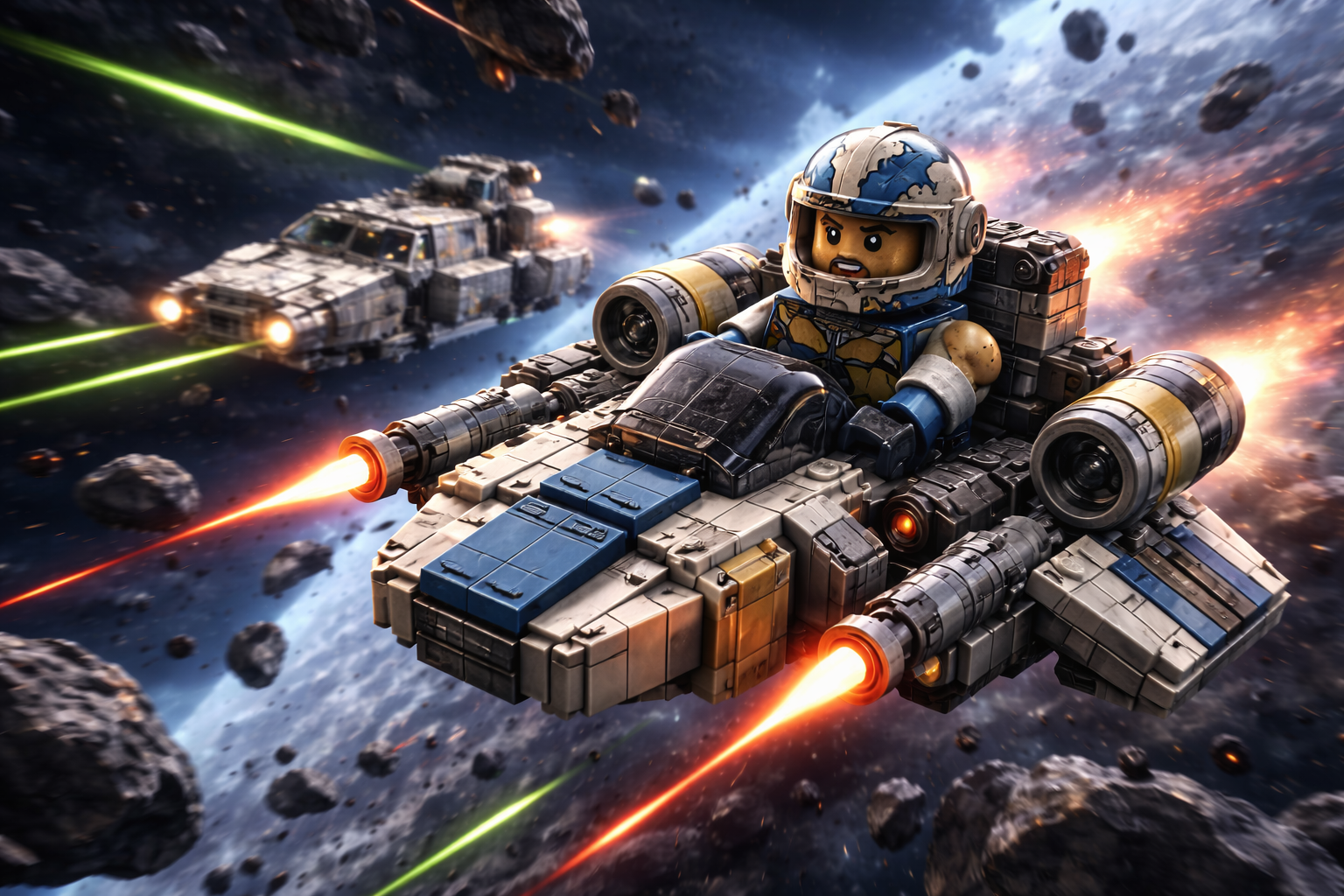
Up here, roads didn’t touch the ground.
They were drawn in air—imaginary lanes carved through storm clouds by habit, old maps, and pilots who preferred not to die. The sky lanes were only “safe” the way a narrow ledge is safe: if you stay on it, if you respect it, if you don’t pretend it’s wider than it is.
The storm had been building all afternoon, stacking cloud layers into dark cliffs. Lightning flashed far off, silent at first, then closer, snapping like a whip through the gray. Wind shoved at anything that dared fly, turning the open sky into a shifting maze.
And in the middle of it all, small enough to look like a scrap of metal against the weather, a single-seat craft cut forward through the turbulence—tight, agile, and quick to answer every touch of the controls.
Inside, a young pilot held the yoke with both hands, knuckles pale, eyes locked ahead.
Kess had flown bigger training rigs before. Heavier ones. Safer ones.
This wasn’t safe.
This was fast.
The cockpit was cramped, like the craft had been built around the idea of “just enough.” Just enough hull. Just enough wing. Just enough engine to outrun trouble—if the pilot didn’t waste a second.
Kess flicked the comm switch once, twice, listening for the instructor channel that had been so loud during practice runs. Nothing but static and faint, faraway thunder.
He tried again. Still nothing.
The storm swallowed signals the way it swallowed light.
He swallowed too, then spoke anyway, as if the clouds might be listening.
“Training run,” he said to himself. “In and out.”
A white line appeared ahead—faint, stuttering—a beacon thread suspended between cloud banks. Sky-lane markers. Old tech. Reliable, if you believed in it.
Kess aligned the nose with the line.
The craft steadied.
For a few seconds, the turbulence softened, as if the lane itself had a spine. He let out a breath he hadn’t realized he’d been holding, and his shoulders dropped a fraction.
Then the wind hit again, sharper, throwing the craft sideways.
Kess corrected hard, almost too hard. The craft snapped back with a twitchy eagerness, like a wild animal on a leash.
“Easy,” he muttered. “Easy.”
Lightning cracked somewhere ahead—close enough to light the cockpit in blue-white for a heartbeat. The world flashed into clarity: layered clouds, the thin beacon line, and—just beyond it—movement.
Three dark shapes, low and fast, drifting across the lane like sharks crossing a channel.
Not weather. Not birds.
Craft.
They weren’t on the beacon line. They weren’t following the rule.
Kess’s stomach tightened.
The lead shape tilted its nose, and Kess saw the glint of hard edges—cleaner than anything built for a training run. Behind it, two more held position like they’d rehearsed it.
The storm didn’t hide them anymore.
It framed them.
A bright pulse cut the air near Kess’s wingtip—close enough that the cockpit shook.
He didn’t wait for the second one.
He dove.
The craft dropped beneath the sky-lane line into thicker cloud, where visibility collapsed into gray. Wind slammed into the hull. The engine’s pitch climbed as it fought thinner air and heavier turbulence at the same time.
Kess kept the nose down, counting in his head—not because counting helped, but because it stopped panic from taking the controls.
One. Two. Three.
A streak of light passed above him, visible through the cloud like a glowing scar. They were still firing.
They’d seen him dive.
They’d followed.
Kess pulled up hard, skimming along the underside of a cloud shelf where the storm’s belly churned. Lightning flickered inside it like the sky had a heartbeat.
He needed the lane.
The lane was safety.
But the lane was also predictable.
Predictable was how you got caught.
Kess spotted a break—a narrow corridor between cloud walls where wind roared through like a tunnel. It wasn’t a lane marker. It wasn’t safe.
It was the only thing that wasn’t expected.
He turned into it.
The craft almost flipped from the crosswind. Kess fought the controls, forcing the nose to stay pointed forward as the tunnel tried to twist him sideways. Rain hammered the canopy in hard, fast needles. The world became vibration and sound.
A shape entered the corridor behind him—one of the enemy craft, close enough that Kess felt its wake tug at his tail.
Then another.
Kess didn’t have the speed to outrun all of them in a straight line.
So he made the line not straight.
He banked left, tight, skimming close to cloud wall. The craft responded instantly, clipping the corridor’s edge by inches. His stomach rose into his throat as the cloud’s pressure buffeted him like hands trying to slap the craft away.
He held.
The first pursuer tried to match the turn, but it came in wider—built for power, not finesse. It drifted toward the cloud wall.
Kess saw the mistake before it happened.
A lightning pulse flared inside the cloud, a sudden bloom of white.
The pursuer clipped the edge.
Its lights jittered. It lurched, then vanished into gray with a sound that was more felt than heard.
Two left.
Kess didn’t celebrate. He didn’t even breathe.
The second pursuer fired again—bolts slicing past the canopy, bright enough to leave afterimages on Kess’s eyes. He flinched but kept the craft steady, forcing himself to focus on the tunnel’s shape and the changing wind patterns.
That’s what the instructors always said: Fly the environment, not the fear.
The corridor narrowed.
Ahead, it split around a towering column of cloud that rose like a mountain. Kess had a choice: left around the column—wider, safer—or right—tighter, faster, and dangerous.
He chose right.
The craft slipped into the narrow side, wind screaming against its wings. Kess pulled the nose up slightly, letting the craft climb just enough to catch a smoother current.
The third pursuer hesitated at the split.
It chose left.
The second pursuer chose right—still on Kess.
Good.
One-on-one.
Kess felt the storm like a living thing now: where it pushed, where it pulled, where it hid lightning behind pressure changes. He watched the rain patterns. He watched the way cloud texture shifted, indicating denser air.
He found his chance.
A thin thread of beacon light flickered ahead—one of the old sky-lane markers cutting across the storm column’s face. If he could reach it, he could re-enter the lane at a weird angle—an angle the pursuer wouldn’t expect.
Kess pushed the engine.
The craft surged forward, responding like it had been waiting for him to commit. The tunnel spat him into open storm air—wider but more chaotic. He saw the beacon thread and angled toward it.
The pursuer fired.
A bolt caught Kess’s wingtip, not a direct hit but close enough to scorch the edge. The craft shuddered and yawed.
Kess corrected, teeth clenched so hard his jaw ached.
Lightning flashed ahead—too close, too bright.
The beacon thread pulsed.
Kess reached it and snapped into the lane.
Instantly, the air changed. Not calm—never calm—but structured, the lane’s hidden stabilizers or pressure guides smoothing the worst of the turbulence.
He glanced back.
The pursuer tried to follow.
But it entered the lane at the wrong angle, hit a shear boundary, and skidded sideways like a car on ice. Its lights flared. It struggled to correct, fighting the lane’s invisible rules.
Kess didn’t wait to see if it recovered.
He pushed forward, riding the lane as it arced upward into thinner cloud.
Above, the storm opened briefly.
A patch of sky—pale, cold, and stunning—appeared like a window. The lane climbed toward it.
And there, silhouetted against the lighter air, were larger shapes: allied craft, steady and coordinated, descending into the storm like guardians returning to the fight.
Reinforcements.
The pursuer behind him broke off immediately, diving away into cloud cover.
Kess’s craft emerged into the clearer pocket, engines whining as the pressure dropped. For the first time in minutes, his hands stopped shaking.
A voice crackled through the comms, suddenly sharp and present, cutting through the static.
“Unidentified microcraft,” the voice said. “Hold course. Identify.”
Kess swallowed, glanced at the scorched wingtip, then the storm below.
He could have turned back. He could have gone home and called it luck.
But luck hadn’t flown those turns.
“I’m Kess,” he said, voice steadier than he felt. “I’m from the farming outpost—south ridge. Training run went… off-plan.”
A pause.
Then, quieter, almost amused: “You held the lane through a storm intercept.”
“I didn’t hold the lane,” Kess said. “I used it.”
Another pause—longer this time.
“Your age?” the voice asked.
Kess hesitated. He knew what they were really asking. Are you old enough to matter?
He answered anyway. “Not the usual.”
The channel went silent for a beat, like the other end was looking at something—data, a camera feed, the scorch marks on his craft.
Then: “Bring that microcraft in. We need pilots who can think in weather.”
Kess felt his chest tighten, not with fear now, but with something brighter and heavier.
“What about my outpost?” he asked.
“You’ll be returned,” the voice said. “After debrief.”
Kess looked down at the storm, where enemy shapes had disappeared, where the lane still pulsed faintly like a promise.
He had come out for a training run.
He was coming back with a new call attached to his name.
The allied craft formed a loose escort around him, guiding his small ship toward a larger silhouette hidden in the upper cloud—an airborne platform, lights dimmed, doors opening like a mouth.
Kess lined up his approach, heart hammering again, but this time the fear had edges of excitement.
Behind him, the storm swallowed the sky lanes and all the choices he’d made inside them.
Ahead, the open bay waited.
Kess eased forward.
And the clouds closed behind him like a door.
This is an original work of fiction created by Brick Crossing, inspired by the design themes of LEGO® set 75400.
LEGO® is a trademark of the LEGO Group, which does not sponsor, authorize, or endorse Brick Crossing.