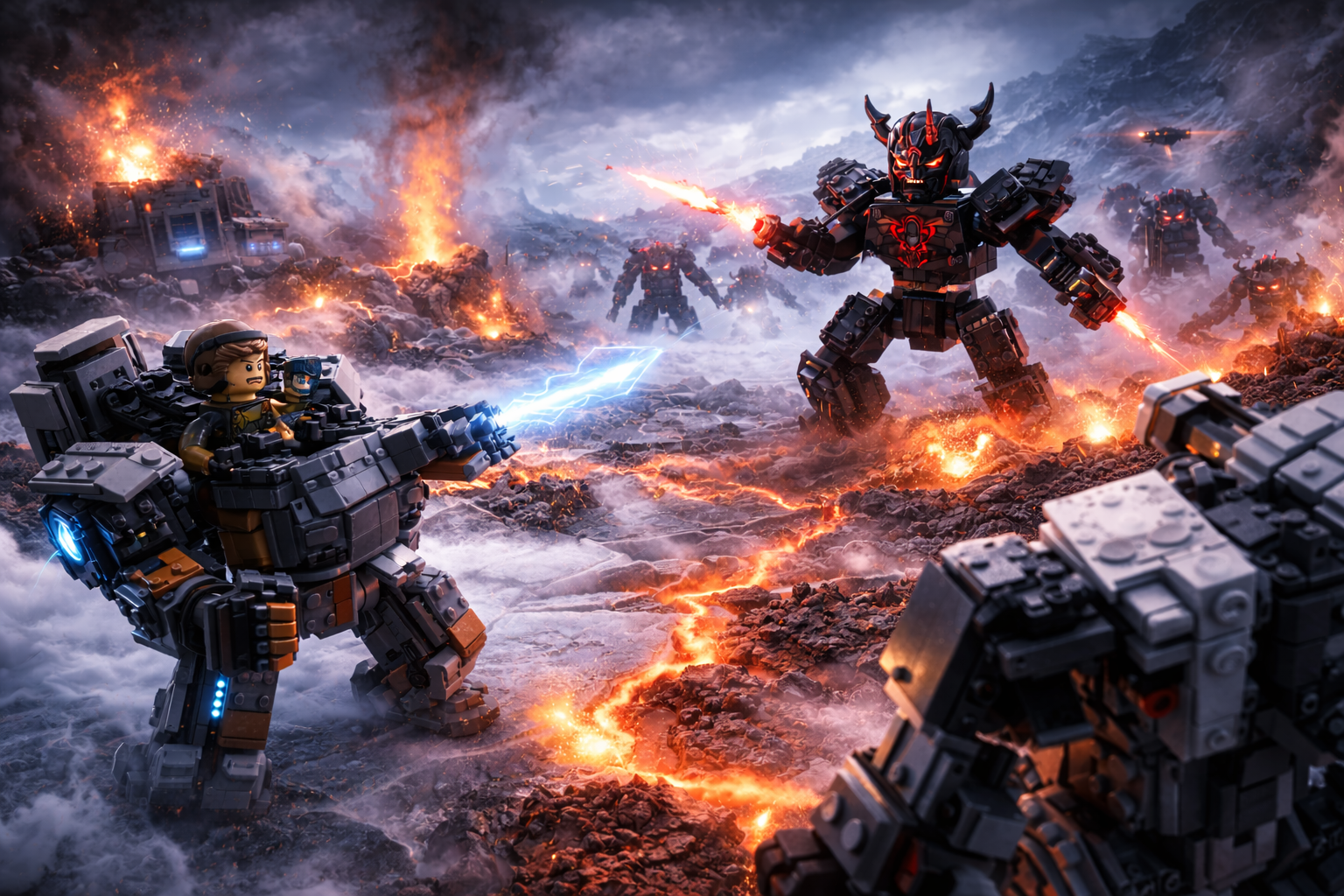
The moon looked dead from orbit—white and still, a marble left too long in the cold.
Up close, it lied.
Heat breathed through cracks in the ice like the planet was trying to speak. Black volcanic rock pushed up in jagged ribs. Steam rose in pale columns and froze again as it drifted, forming ghostly curtains that snapped in the wind. The outpost sat on a basalt shelf above a field of frozen fissures, lights small and stubborn against the endless dusk.
We called it Cairn Station because it sounded like something meant to last.
It was mostly patched metal and old promises.
The defenders were the same.
A handful of soldiers and technicians, a rotating watch schedule, and three outdated mechs stored in bays that smelled like coolant and burnt wiring. The mechs had names painted on their plates—names that had survived longer than their original parts. Their joints creaked. Their armor didn’t match. Their sensors were temperamental. But they were ours.
And on nights like this, “ours” mattered.
The first warning didn’t come from the radar.
It came from the ice.
A tremor—soft, then sharper—ran through the deck plating under our boots. Frost sifted from a beam overhead. A cup on the mess table rattled in place, then tipped on its side like it had chosen to faint.
Sergeant Lio didn’t wait for confirmation. He was already moving.
“Stations,” he said. Calm voice. No wasted breath. “Now.”
We scattered in practiced silence—Mira to the comms, Kett to the generator room, Oren to the mech bay. I followed Lio to the observation slit that overlooked the ice field.
At first, there was nothing. Just wind across the frozen flats and steam rising from the fissures like the moon’s last exhale.
Then the horizon broke.
Shapes moved through the fog—tall, angular silhouettes advancing in a line too precise for nature. Their eyes—if you could call them that—burned with a dull red glow that smeared in the mist. Each step they took compressed the ice with a sound like cracking glass.
Enemy mechs.
Not one. Not two.
A force.
Mira’s voice snapped through the intercom. “Multiple contacts. Heavy. Closing fast.”
“How many?” Lio asked.
A pause—Mira counting and not liking the number. “Too many.”
Kett’s voice came next, strained. “They’re jamming our long-range. We can’t call for help.”
Lio stared at the advancing shapes, then turned away as if refusing to give fear the satisfaction of being seen.
“Oren,” he said into the comm. “How many can we field?”
Oren answered over the clang of tools and shouted instructions. “Two, maybe three if I can wake the old one without it throwing a tantrum.”
“Give me two,” Lio said. “Keep the third for the last card.”
There was a beat of silence, then Oren, softer: “You mean the trap.”
Lio’s mouth tightened. “I mean the plan.”
I followed him into the corridor that led to the mech bay. The walls vibrated now, not from our generators—but from the approaching steps outside. The moon was counting down.
In the bay, the mechs stood like old giants waiting to be convinced.
Mira was already there, helmet under her arm, climbing a ladder to the cockpit of the nearest one. Her mech’s shoulder plate was cracked and reinforced with a welded brace shaped like a question mark.
“You’re flying that?” I said before I could stop myself.
Mira smirked. “I’m not flying it. I’m persuading it.”
Oren slid past with a coil of cable. “Keep talking and I’ll assign you the one that leaks coolant like a confession.”
Lio stepped between them, voice low, urgent. “Listen. They’re better equipped. Faster. Cleaner. We don’t win head-to-head.”
Mira dropped into her seat and clipped in. “Then we don’t fight head-to-head.”
Kett appeared, wiping grease off his hands. He looked toward the doors that led outside, where the wind wailed like a warning siren. “The fissure field,” he said.
Lio nodded. “We hold them at the ice breaks. Make them commit. Make them chase. Then we fold the ground under their feet.”
“That’s not how ground works,” I muttered.
Oren looked at me like I’d offended the moon. “On this rock? That’s exactly how ground works.”
The bay doors began to open, inch by inch, revealing the frozen dusk beyond. Wind punched in, sharp and chemical, carrying steam and the bitter smell of volcanic stone.
Mira’s mech powered up with a reluctant groan. Lights blinked. Joints locked. It took a step forward like it was remembering how.
Beside it, Lio’s mech—older, heavier—came alive with a deeper hum. Its armor was scarred and mismatched, the paint worn from years of being asked to do more than it should.
Two defenders against a coming tide.
Lio’s voice came through our headsets, steady as a heartbeat. “We don’t need to stop them forever,” he said. “We just need to survive the night.”
The first enemy mech appeared through the fog at the ridge line, its red glow cutting through the steam. Behind it, more shadows followed, silent and confident.
Mira moved first—fast, light-footed, leading her mech out onto the ice like she was daring the moon to contradict her. She fired a flare—not at the enemy, but into the fissure field, lighting up the cracks in the ice with a harsh, white glow.
The terrain revealed itself: a spiderweb of fractures, some wide enough to swallow a vehicle, some thin as paper but deep as regret. Steam vents pulsed below, each one a pocket of heat under a fragile ceiling.
“Eyes on the lines,” Lio ordered. “They don’t.”
The enemy advanced without hesitation. Their mechs were sleek, their movements smooth, their confidence absolute.
They stepped onto the fissure field.
For a few seconds, nothing happened. Just the crunch of ice under metal feet and the rising scream of wind.
Then one of them fired.
A bolt of energy tore past Mira and struck the ground behind her, vaporizing a patch of snow and exposing black rock underneath. Steam erupted. The temperature shift made frost form instantly on the surrounding ice, turning it slick and glassy.
Mira laughed—one short burst, more adrenaline than humor. “They’re helping,” she said.
Lio’s mech moved into position, blocking the direct path to the outpost. He didn’t fire. He waited.
That waiting was the first trick.
The enemy expected panic. Retreat. Desperation. Instead, they got stillness—an invitation to come closer.
They took it.
Mira darted sideways, baiting the lead mech across a thin section of ice that looked solid in fog-light but wasn’t. She timed her step with the moon’s pulse—steam venting, ice tightening, cracking, tightening again.
The enemy mech followed—too fast, too sure.
Its foot came down.
The ice broke with a sharp, clean sound. For an instant, the mech hovered between balance and falling.
Mira didn’t shoot it. She didn’t need to.
She fired at the steam vent beneath the crack.
The vent burst open, a blast of heat punching upward. The sudden warmth melted the edge of the fissure just enough to widen it. Then the cold air hit, freezing the meltwater into jagged shards.
The enemy mech slipped.
It crashed down into the fissure with a metallic howl and vanished into steam.
The red glow dimmed below the ice like a sinking star.
Oren whooped over comms from inside the bay. “One!”
“Don’t celebrate,” Lio snapped, but there was steel satisfaction under it.
The enemy force adjusted instantly. Their formation tightened. They spread their weight. They fired into the ice ahead, carving safer paths, trying to turn the ground into something predictable.
Predictable ground was their advantage.
So we made sure it stayed unpredictable.
Lio advanced and struck the ice with the heel of his mech, shattering a surface plate to reveal the slick, glassy layer beneath. He drew the enemy toward it, then pivoted away at the last second. Two enemy mechs charged forward and skidded, their feet losing traction.
Mira came in low and fast, not to attack, but to shove.
She slammed her mech’s shoulder into one of them at an angle—just enough to shift its center of gravity onto a weak seam. The ice fractured under it like it had been waiting for permission.
It dropped halfway, jammed, struggling.
Red lights flared brighter.
And then the enemy did what enemies do when they stop underestimating you.
They stopped trying to chase.
They started trying to destroy.
Bolts rained into the fissure field, not aimed at our mechs but at the ground itself. Steam vents erupted. Ice plates shattered. The battlefield became chaos—heat and cold fighting in the open, creating sudden fog banks and brittle ridges.
Mira’s voice tightened. “They’re clearing the field.”
“They’re trying,” Lio said. “Oren. Now.”
A new sound rolled out from the outpost—low, heavy, old.
The third mech woke.
It stepped from the bay like a relic dragged into daylight, taller and bulkier than the others, its armor crude and reinforced. It carried something slung under one arm: a cable spool the size of a person, wrapped in thick insulated line.
Kett’s voice came through, breathless. “The grid’s ready. If they cross the marker—”
“They won’t cross,” Lio said. “They’ll think they can.”
The third mech drove its anchor spikes into the basalt shelf near the outpost and unspooled the cable across the ice in a wide arc—thin enough to be missed in fog, strong enough to matter if you hit it at speed.
Mira and Lio pulled back deliberately, giving ground in a way that looked like losing.
The enemy took the opening, pushing forward.
They crossed the arc.
Kett triggered the grid.
For half a second, the ice field lit up with thin lines of blue-white energy tracing the fissures like veins. The cable snapped taut, the energy surged, and the ground under the enemy mechs flashed with sudden crackling frost—an instantaneous freeze that locked joints, seized traction, and made movement costly.
The enemy force hesitated.
That hesitation was our breath.
Mira’s mech surged in, shoulder-checking one frozen mech into another. Lio followed, driving a heavy strike into the ground that shattered the frozen surface into a collapsing patchwork.
Two enemy mechs went down together, swallowed by steam and fractured ice.
The remaining enemy units backed off, red glow retreating into fog.
They weren’t defeated.
But they were delayed.
And the outpost still stood.
The wind eased as if surprised.
Steam drifted across the fissure field, hiding broken metal and fragile victory alike. Mira’s mech limped back toward the bay, one stabilizer sparking faintly. Lio’s mech moved slower, heavier, its armor scraped fresh.
In the distance, red lights lingered at the ridge line—watching. Waiting.
Oren’s voice came soft over comms. “They’ll come back.”
Lio looked toward the horizon, then up at the moon’s pale sky where the first hint of dawn tried to exist.
“Let them,” he said. “We learned the ground. They haven’t.”
Mira’s laugh was quieter this time, almost tired. “We survive another day.”
The outpost lights held.
And in the frozen steam beyond the ridge, something shifted—too far to see clearly, close enough to feel.
This is an original work of fiction created by Brick Crossing, inspired by the design themes of LEGO® set 75411.
LEGO® is a trademark of the LEGO Group, which does not sponsor, authorize, or endorse Brick Crossing.