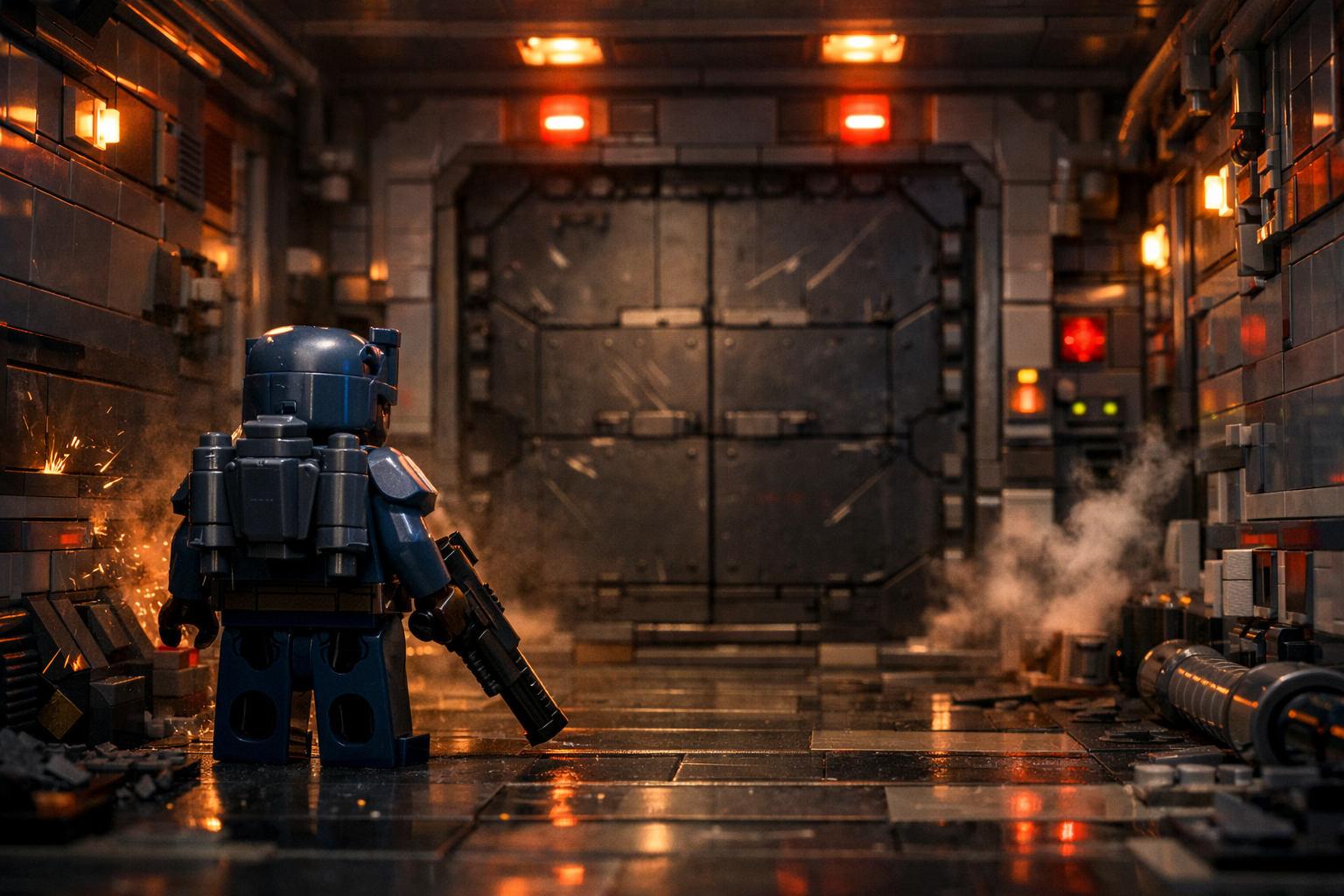
The corridor smelled like hot metal and old smoke, as if the building had been burning for years and only just remembered to stop. Overhead strips of light flickered in slow pulses, casting the kind of shadows that made every corner look like a decision.
At the far end stood the last door.
It wasn’t just a barrier—thick, segmented, reinforced. A door built for invasions, for riots, for the moment when someone with authority decided that everything on the other side had to become unreachable. Frosted dents scarred its surface. Fresh scratches ran in parallel lines where something had tried to pry it open and failed.
In front of it, alone, a defender planted his boots and checked the tightness of his gauntlets. The armor was heavy, practical, pitted from shrapnel and close calls. No insignia worth noticing. No ceremony. Only the weight of what it was designed to do.
Behind the door, people held their breath.
In the hallway, the defender listened to the silence and waited for it to break.
It broke softly at first—an electric whine threaded through the building’s bones, as if power was being rerouted for something that didn’t care who lost heat and light along the way. The corridor’s lights dimmed. Somewhere overhead, a vent fan died mid-spin.
The defender—Garron, called “Garr” when anyone dared shorten his name—kept his visor up, letting his eyes adjust. He liked seeing the world without a filter when it mattered. He liked making choices with his own vision.
A voice crackled in his ear, thin with interference. “Garr… status.”
He pressed two fingers to the comm. “Holding.”
“You’re alone,” the voice said. It belonged to Ilen, the shift coordinator who had stopped being a coordinator and started being a leader the day the facility became a target. “Fallback is still open. You can—”
“I know where fallback is,” Garr replied. He didn’t raise his voice. He didn’t need to. “Keep them sealed. Keep them quiet.”
A pause. He could hear movement behind the door—people shifting positions in a space that suddenly felt too small. “You don’t have to—” Ilen began.
Garr cut in, gentler. “I do.”
He wasn’t saying it to be brave. He was saying it because it was true. The building’s map lived in his muscles: where the corridor funneled, where the floor plating was weakest, where the door’s manual release sat behind a panel only he could reach in time. He’d walked this stretch on dull nights when nothing happened. He’d pictured this moment then without admitting he was picturing it.
Another sound joined the whine: footfalls.
Measured. Unhurried. Not the rush of a squad. Not the scramble of a raiding party. One set of steps, approaching with the calm of someone who believed the hallway belonged to them.
Garr rolled his shoulders, feeling armor plates settle. His breath fogged once in the cooler air, then cleared. He looked down the corridor and saw the figure emerge into the light.
Varrek didn’t wear bulk. He wore intent.
His armor was sharper in its lines, cleaner in its construction, shaped to intimidate as much as protect. A dark cape-like mantle hung from one shoulder—not for warmth, not for function, but for the way it moved when he stopped, the way it made space feel like a stage.
In his hand was a weapon that hummed at the edge of hearing, a blade of condensed energy that didn’t throw sparks so much as it threw warnings.
Varrek didn’t raise it. He didn’t need to.
He simply looked at Garron as if Garr were the last inconvenience between him and a conclusion.
“I expected more,” Varrek said.
Garr didn’t answer.
He shifted his stance—left foot forward, right foot braced—blocking the corridor’s centerline. His weapon came up, heavier and simpler: a broad-powered staff with an energized edge that glowed faintly, the kind of tool built to hold ground rather than carve it.
Varrek’s gaze flicked to the door behind Garr. “You’re protecting something.”
“I’m protecting time,” Garr said at last.
A small smile creased Varrek’s face, quick and unimpressed. “Time runs out.”
Garr’s comm hissed in his ear. Ilen’s voice returned, urgent. “Garr—he’s alone?”
“He’s never alone,” Garr murmured, eyes locked forward. “Not really.”
He could feel it now: pressure, like the building itself knew who was standing in its corridor. The air turned metallic. The lights overhead steadied as if bracing. Garr tasted old smoke and new electricity and the dry bite of fear he refused to let become panic.
Varrek took one step forward.
And the corridor became the only place that mattered.
The first clash was bright enough to erase shadow.
Energy met energy with a sound like metal struck underwater—muffled but violent, the impact traveling through Garr’s arms into his shoulders, into his chest. He held the line by refusing to give even half a step.
Varrek tested him—three fast strikes, precise, elegant. Garr absorbed them with brute practicality, redirecting the force into the floor, letting the corridor take the weight it had been built to take.
“You’re strong,” Varrek observed, almost conversational.
“Not the word,” Garr said, and shoved forward.
His counterstrike wasn’t stylish. It was committed. It forced Varrek back a fraction, boots scraping, mantle whipping.
Behind the door, something thudded—someone flinched hard enough to hit the wall.
Garr heard it. He used it.
He swung wide, not to hit, but to herd—driving the fight away from the door’s seam, away from the hidden panel where the manual release could be forced if Varrek got close enough. He needed the enemy centered in the corridor, where geometry did more work than courage.
Varrek read the tactic instantly. “You’re trained,” he said, and his blade flicked low.
Garr took the strike on a forearm plate. The armor sparked and smoked. Heat licked through the metal and bit his skin. He hissed once, controlled, and returned a heavy blow that rang off Varrek’s shoulder guard.
For a brief moment they were close—close enough for Garr to see Varrek’s eyes through a narrow visor slit. Not wild. Not furious.
Focused. As if this was inevitable and therefore not emotional.
That focus was a kind of cruelty.
“Who’s behind that door?” Varrek asked, voice low, almost curious. “Civilians? Engineers? Something you were told to die for without being told why?”
Garr’s jaw tightened. “Does it matter?”
“It matters to me,” Varrek said. “Because it means someone lied. And I’m here to collect the truth.”
Garr felt anger flare—sharp, dangerous. He tamped it down. Anger made you chase. Chasing got you killed.
He shifted his grip and slammed the butt of his staff into the floor.
The impact triggered a hidden mechanism—a strip of plating along the wall slid open, venting a burst of cold suppressant gas into the corridor. It wasn’t enough to freeze, but enough to sting eyes, enough to make breath catch, enough to disrupt sensors that assumed clean air.
Varrek blinked once, surprised.
Garr used the half-second to drive forward, shoulder-first, armor against armor, pushing Varrek back toward the corridor’s centerline again. The old building groaned, accepting the violence like a familiar burden.
In his ear, Ilen whispered, “We’re almost ready.”
Garr didn’t ask what “ready” meant. He knew: engine spool, emergency detach, the ship—or transport platform, or whatever this facility’s lifeline was—preparing to leave with its secret cargo intact.
He just needed more time.
Varrek recovered quickly. He always would.
The blade snapped upward, too fast. Garr blocked, but the force cut through his defense and scorched a line across his chest plate. The armor didn’t fail. It screamed, heated, and held.
Garr staggered one step.
Varrek seized the opening, pressing in with three more strikes, each one meant to take Garr’s ground inch by inch. Garr retreated another half step, then stopped himself—heel catching against a seam in the floor he’d memorized months ago.
If he went back further, the door was vulnerable.
He couldn’t.
So he did the only thing left.
He advanced.
Garr surged forward into the blade’s path—not reckless, but decisive—using his heavier weapon like a lever, locking it against Varrek’s arm and twisting hard. Energy screamed. Sparks rained. The mantle snapped as Varrek pivoted to avoid being thrown.
For a heartbeat, Garr had him off-balance.
He could feel the hallway tilt toward possibility.
Then Varrek’s free hand came up, palm outward, and a pulse struck Garr square in the chest—an energy shock that wasn’t a blast so much as a command. Garr flew backward and hit the wall hard enough to spiderweb the paneling.
Pain flashed white behind his eyes. His visor snapped down automatically. The corridor blurred.
He forced himself upright anyway.
Varrek walked toward him with patient certainty.
“You’re buying time,” Varrek said. “But you’re spending yourself.”
Garr’s breath rasped. “That’s the job.”
The comm hissed again. Ilen’s voice—shaking now—said, “We’re moving. Garr—get out.”
Garr laughed once, short and bitter. “If I leave, he follows.”
“Garr—” Ilen started.
Garr cut in, voice suddenly quiet. “Then don’t look back.”
He planted his feet again between Varrek and the door. The air felt heavier, charged with finality.
Varrek lifted his blade.
Garr raised his staff.
And for the first time, he didn’t feel like the corridor belonged to him.
He felt like it belonged to the moment.
They moved at the same time—energy flaring, armor colliding, the corridor’s lights strobing like a heartbeat at its limit.
Behind the sealed door, something deep within the ship’s frame shifted—engines catching, clamps releasing, the whole structure preparing to tear itself away from this place and this fight.
Garr lunged.
Varrek met him.
And the screen of Garr’s visor flooded with white—
—then cut to black.
This is an original work of fiction created by Brick Crossing, inspired by the design themes of LEGO® set 75386.
LEGO® is a trademark of the LEGO Group, which does not sponsor, authorize, or endorse Brick Crossing or this content.