When the first shadow crossed the avenue, we thought it was a blackout.
That’s what your brain reaches for in a city—something you’ve heard of before. A grid failure. A passing storm. A helicopter overhead. Something explainable that will end if you wait it out.
But the streetlights stayed on.
Their halos held steady in the early evening haze, lighting up the steam rising from a subway grate and the pale dust drifting through the air like slow snow. The storefront signs still glowed. Traffic signals still cycled through their colors as if nothing had changed.
Only the sound changed.
It came from far away at first—an enormous, distant grinding that didn’t match any engine anyone could name. A rumble so low you felt it in your teeth before you heard it with your ears. Windows shivered in their frames. A few car alarms chirped and then fell silent again, like they’d reconsidered.
Then people began running.
Not in one direction—every direction. From sidewalks into doorways. From crosswalks into alleys. Toward anywhere that felt smaller than the street.
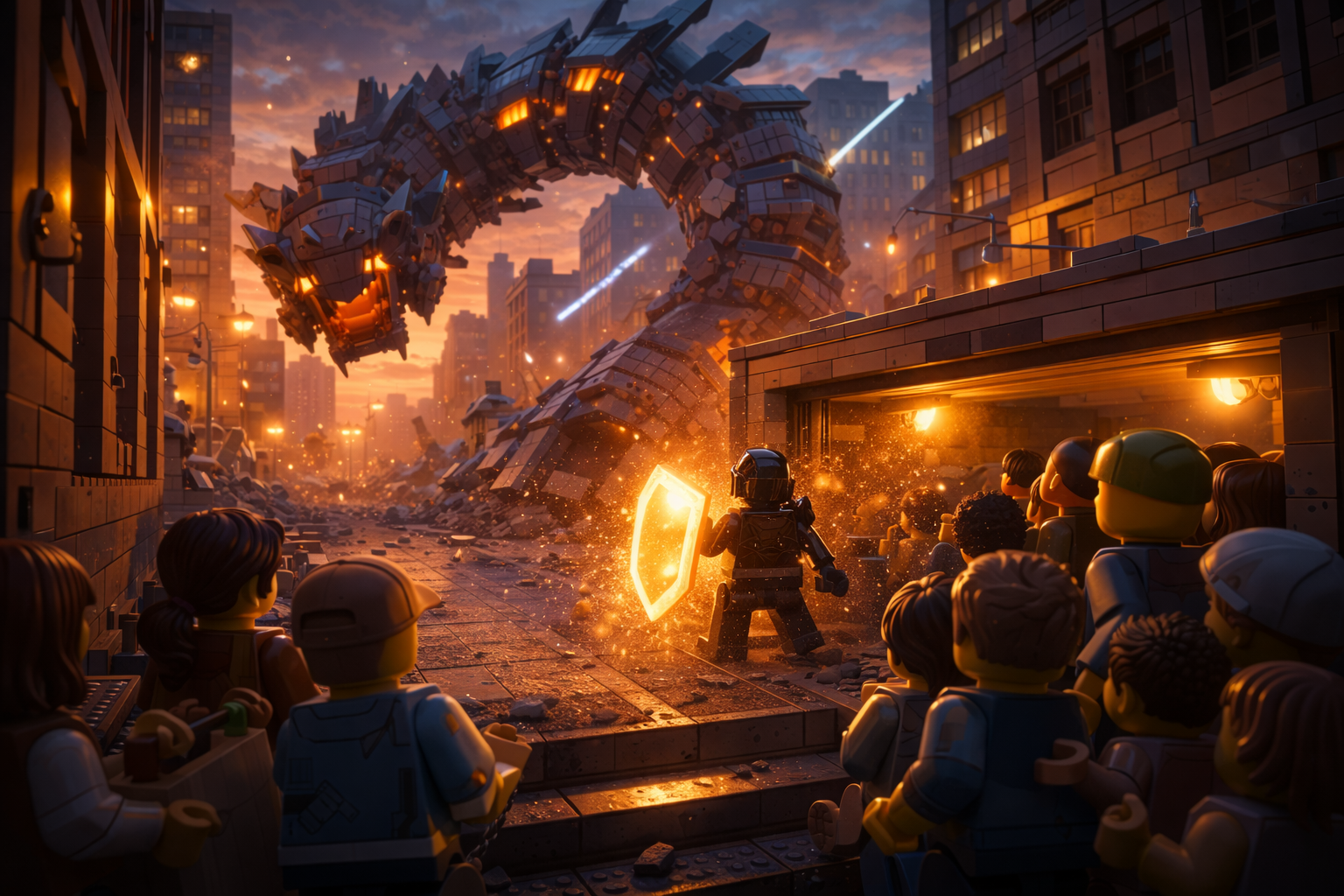
We ended up in the same place for the same reason: the old transit entrance that went down under the block. A concrete stairwell with a metal railing, posters peeling on the walls, and a locked gate that someone had forced open a long time ago and never bothered to fix.
It wasn’t safe.
It just felt like it might be safer than standing in the open.
The crowd formed in layers the way panic always does—front line pressed to the edge, second line craning to see, third line pulling others back, and everyone talking at once without actually communicating.
A woman with a grocery bag clutched it to her chest like it mattered. A teen in a varsity jacket kept refreshing their phone as if the right notification could make reality reverse. A delivery rider stood with their helmet still on, breathing too hard, staring out at the street as if their eyes could calculate the danger.
I was with my little brother, Theo, who had stopped asking questions and started counting his breaths instead. Next to us, an older man in a work shirt held a flashlight that shook slightly in his hand.
“What is that sound?” Theo whispered.
No one answered.
Across the avenue, above the line of buildings, something rose.
Not a head. Not wings.
A segment.
It arched into view like a piece of a moving bridge, plated and ridged, too massive to belong to anything living and too fluid to belong to any machine we’d ever seen. It moved with intent, sliding forward through the air as if gravity was optional for it.
Then another segment followed.
Then another.
A chain of armored curves advancing between buildings, scraping the sky. Streetlight halos snapped across its surface, revealing sharp edges and seams that caught and released light like scales.
The creature—if that’s what it was—didn’t roar. It didn’t need to. Its movement was loud enough: the grinding of metal against itself, the deep thud of impacts as parts of it brushed rooftops and fire escapes, the collapsing crash when a billboard finally gave up and folded down into the street.
A shockwave rolled through the city.
We felt the air punch our faces. Theo flinched and grabbed my sleeve. The crowd surged backward, steps clattering down into the stairwell. Someone shouted to keep moving, but moving where?
Up was open. Down was dark.
Another segment slid into view, closer now—close enough to see that it wasn’t just one body. It was a long, articulated thing, each section able to bend and twist independently, like it could wrap around the city if it wanted to.
It turned its path slightly.
Toward us.
The streetlights flickered once, as if the city itself blinked.
A new sound cut through everything—higher, sharper, like a whistle made of electricity. It came from above the rooftops, moving fast, leaving a trail of light that was almost blue but not quite.
People pointed. People screamed. People filmed. Some people did all three at once.
Something—someone—moved through the air between the creature’s segments, too quick to track, leaving brief flashes that reflected off windows and painted the street in stuttering light.
Not a single person in our crowd could say what we were seeing.
But every person understood the same thing:
The conflict was happening around us, and we were small enough to be accidental.
The creature shifted. One segment dipped low, scraping the corner of a building. Masonry burst outward, raining dust and small stones. A streetlight pole bent like a blade of grass and snapped. Sparks spilled onto the pavement, bright and harmless-looking until they weren’t.
The crowd pressed deeper into the stairwell. Bodies packed tighter. Breath and sweat and fear made the air thick.
A kid in the back started crying. Not loudly—just the kind of quiet crying that happens when you’re trying to be brave but you’re not sure bravery will matter.
Theo’s voice was smaller than I’d ever heard it. “Are we going to die?”
I hated that question because it had no right to exist in a city on a normal evening.
I didn’t answer him with words. I pulled him closer and looked for exits that weren’t there.
Above us, the creature’s shadow passed again, and this time the streetlight halos didn’t return right away.
For a second, the avenue was dim—only the glow from distant windows and emergency lights beginning to pulse in the far blocks.
In that dimness, the creature moved differently. More confidently. Like it preferred the dark.
A segment dipped lower, angling down the street as if it had found something it wanted.
Its direction was unmistakable now.
It was coming straight toward the transit entrance.
Toward us.
The crowd’s panic finally unified into one instinct: down.
People stumbled on the steps. Someone fell and was yanked back up by strangers who didn’t know their name. The flashlight beam jittered wildly, illuminating shoes, railing, faces. A few people shouted at a locked service door that refused to become an escape route just because we asked.
Above, the creature’s movement filled the street with pressure, as if the air itself was being pushed aside to make room for it.
Theo’s fingers dug into my wrist. “Please,” he said, not sure who he was saying it to.
I looked up the stairwell opening and saw the underside of the nearest segment slide into view. It was so close the streetlight glow reflected off it in warm orange, turning its armor almost beautiful for an instant—like a sunset on a storm.
Then the segment lowered further.
Debris rattled down the steps. Dust poured into the stairwell. People screamed. Someone shouted to cover your mouth. Someone else prayed. A phone slipped from a hand and clattered down metal steps, still recording, its screen a tiny trembling window on the street.
The segment tilted, and a seam along its underside began to open—panels separating like jaws, revealing a darker interior that looked too empty for its size. The air changed. A pull, like a vacuum, like the creature was about to swallow space itself.
The crowd froze as one.
Every instinct screamed to run, but there was nowhere to go.
That was the moment we saw the figure.
They dropped into the street between the transit entrance and the creature with the kind of certainty that made the whole scene rearrange itself around them. They weren’t tall like the creature, but they were unafraid in a way that made height irrelevant.
A shield—no, not that, not a symbol, not a known thing—something broad and bright was braced in their hands, angled like a wall you could carry. Their stance was solid, knees bent, shoulders squared, as if they were anchoring themselves to the city.
The creature’s seam opened wider.
The pull increased.
Loose papers and dust lifted off the ground and streamed toward the opening. A plastic cup skittered. A torn poster peeled away from a wall. Someone’s hat flew off and vanished into the dark.
The figure in the street took one step forward and drove their broad barrier down into the pavement.
The impact rang like a bell.
A field—visible only because dust suddenly stopped moving—spread outward in a shallow dome. The air pressure equalized. Theo’s hair, which had started to lift in the pull, settled back down. The crowd exhaled in one shaky wave.
The creature’s “jaws” strained against the unseen barrier, its segments flexing, armor plates grinding. The street trembled.
The figure didn’t move.
They held.
For the first time since we’d run into the stairwell, the city felt like it had a choice.
Above, that blue-not-blue streak returned, arcing through the air, striking the creature’s side in a burst of light that made the streetlights blink. The creature recoiled—just a little, but enough. Another flash hit, then another, each one pushing the segment upward by inches.
The figure in front of us glanced back—just once.
I couldn’t see their eyes clearly, not through the dust and the fading light, but the gesture felt like a message: Stay. Breathe. Live.
Then they turned forward again and charged.
Not at us. Not toward safety.
Toward the creature.
The barrier lifted, and the figure sprinted up a broken chunk of pavement like it was a ramp, leaping onto the nearest segment as it rose. The creature’s body flexed, trying to shake them off, but the figure kept moving—running along armor plates toward the conflict unfolding above the rooftops.
Behind them, the streetlight halos returned fully, bright and steady, as if the city had decided to pretend it hadn’t been terrified.
The crowd in the stairwell didn’t cheer. We couldn’t. We just stared, stunned, as the figure disappeared into the maze of segments and sparks and impossible motion.
Theo finally breathed out.
And somewhere overhead, the grinding sound shifted direction—moving away from us, deeper into the city.
The danger wasn’t over.
It had simply moved on.
This is an original work of fiction created by Brick Crossing, inspired by the design themes of LEGO® set 76290.
LEGO® is a trademark of the LEGO Group, which does not sponsor, authorize, or endorse Brick Crossing.